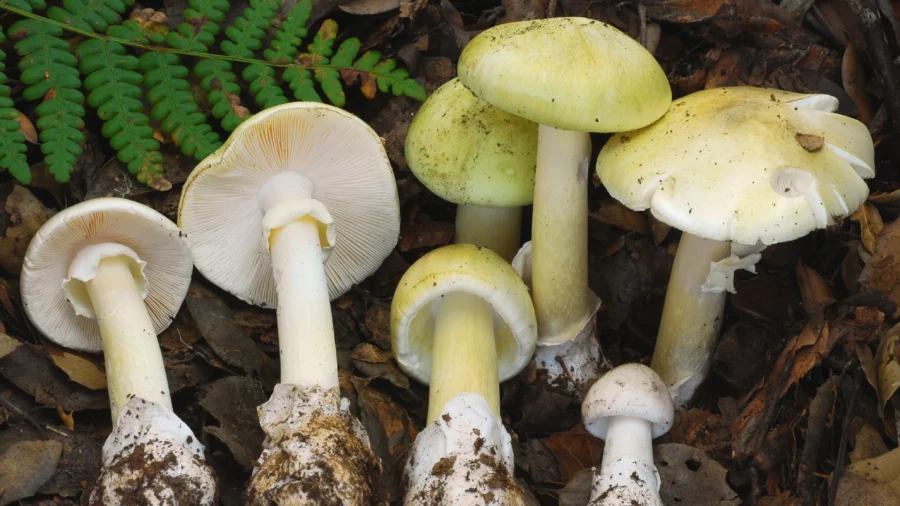
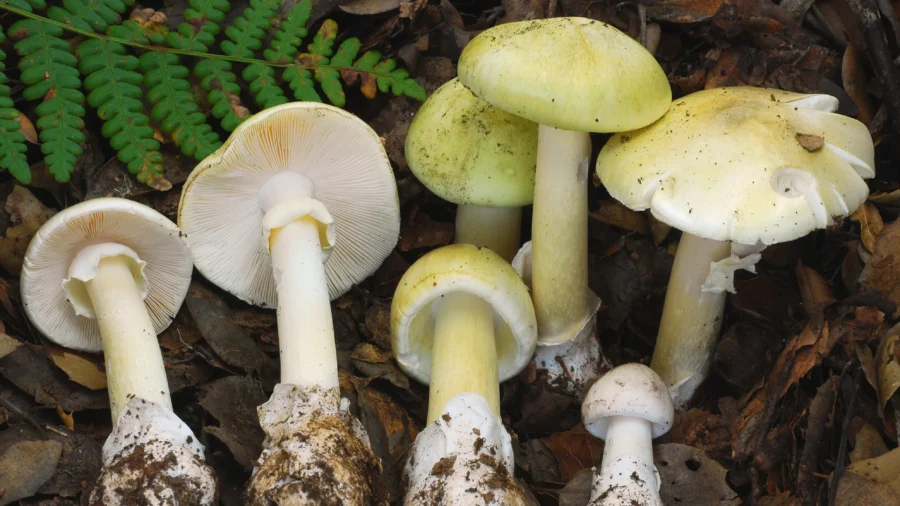
A deadly surge of toxic mushrooms spreading across California has claimed four lives and left several others hospitalized after what experts describe as a “super bloom” of death caps following a wet winter, health officials said.
Since mid‑November, more than three dozen people statewide have been poisoned by the highly lethal mushrooms, according to the California Department of Public Health. The recent outbreak includes four deaths and three liver transplants, with patients ranging in age from 19 months to 67 years old. In a typical year, the state sees only two to five such poisonings.
“This year, it’s really the magnitude—the number of people ingesting this mushroom,” said Dr. Craig Smollin, medical director for the San Francisco Division of the California Poison Control System. “Having almost 40 is very unusual.”
Death caps, known scientifically as Amanita phalloides, are one of the most poisonous mushrooms on Earth. The species contains amatoxins—a class of compounds responsible for 90 percent of fatal mushroom poisonings globally—that destroy liver and kidney cells even in tiny doses.
The California Department of Public Health is warning residents to avoid foraging wild mushrooms altogether this year because these toxic fungi are almost indistinguishable from edible species. They often appear in city parks, forests, and private yards, especially beneath oak trees across Northern California and the Central Coast.
The health department said poisoning victims have included many Spanish, Mixteco, and Mandarin Chinese speakers. Spanish was the primary language for more than 60 percent of cases.
In Salinas, farmworker Laura Marcelino said her family mistook the toxic mushrooms for a familiar variety from their native Oaxaca, Mexico. “We thought it was safe,” Marcelino told the San Francisco Chronicle, translated from Spanish.
After eating the foraged mushrooms twice, both Marcelino and her husband fell violently ill. She spent five days in a hospital, while her husband required a liver transplant to survive. Their young children were unharmed because they refused to eat the mushrooms.
Now, clusters have been spotted from Monterey County to the Bay Area, and health officials warn the fungi could appear anywhere in the state’s damp woodlands. “Unless you’re an expert who studies mushrooms, it can be very difficult to know,” Smollin said.
Symptoms of death cap poisoning can appear within six to 24 hours of ingestion, experts say. Victims often experience nausea, cramping, vomiting, and diarrhea—warning signs that may fade within a day, tricking victims into thinking they’re recovering. In reality, fatal liver damage can unfold within two to three days.
Many patients in recent cases were admitted to intensive care for rapidly progressing liver failure.
The U.S. Poison Centers reported that from September through January, mushroom‑related exposures of all types rose by 40 percent compared with the same period a year earlier.
Officials are urging residents to keep children and pets away from wild mushrooms and to buy only from trusted grocery stores.
“The safest choice right now is to avoid eating any wild mushrooms,” Baldwin‑Santana warned in the earlier notice by San Mateo County Health. “Even experienced foragers should exercise extreme caution and should not rely on AI‑assisted field identification to distinguish between safe and poisonous mushrooms.”
Anyone suspecting mushroom poisoning should seek emergency care immediately or call the California Poison Control System at 1‑800‑222‑1222 or visit PoisonHelp.org.
The Associated Press contributed to this report.