Introduction: Bank of England expected to cut interest rates today
Good morning, and welcome to our rolling coverage of business, the financial markets, and the world economy.
The Bank of England is in the spotlight today, as policymakers at the UK central bank set interest rates in the face of a global trade war, and a weak domestic economy.
To be honest, there’s not much suspense in the City this time. The BoE is widely expected to cut interest rates for the fourth time in the current cycle, at lunchtime.
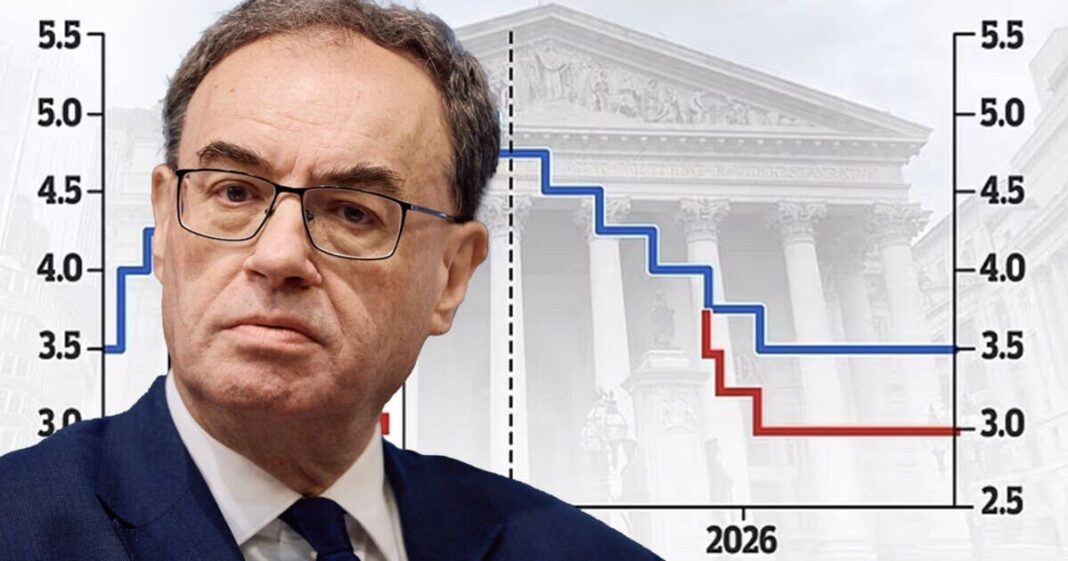
Bank Rate is currently 4.5%, and many traders suspect the only question is whether the monetary policy committee restricts itself to a quarter-point cut, to 4.25%, or gets the big bazooka out and votes for a half-point cut, to 4%.
This morning, a quarter-point cut is much the more likely – it’s priced at a 95% chance in the money markets. A half-point cut would be a surprise, as it’s seen as just a 5% possibility.
James Mashiter, fixed income portfolio manager at asset manager SEI, says:
“We think the Bank of England will cut the base rate by 25 basis points, in line with market expectations.
However, with a whiff of stagflation in the air, the BoE is in a difficult position as it attempts to stimulate growth while keeping inflation expectations anchored and the bond vigilantes at bay.”
The Bank will be concerned that Donald Trump’s trade war will hurt the global economy, with a knock-on impact on UK growth (governor Andrew Bailey often mentions how Britain is an open economy).
But they’ll also have to assess the impact on inflation – if manufacturers from China, say, redirect products initially destined for the US into the UK market, at bargain prices.
Last month, the Bank warned that Donald Trump’s sweeping tariffs have put global growth at risk.
Ranjiv Mann, senior portfolio manager at Allianz Global Investors, predicts a quarter-point cut, given the downside risks for the global growth outlook, and told clients:
-
UK economic activity remains weak and trade policy uncertainty has risen sharply in recent months, weighing on UK consumer and business sentiment.
-
The Bank has been taking a cautious policy approach since it last cut rates in February given that CPI inflation remains above its target. However, business sentiment is now beginning to be weighed down by trade policy uncertainty, placing renewed downside risks for the UK economic outlook.
-
Short term interest rate markets are pricing at least a further three rate cuts in 2025; if the risks of a global trade war intensifies over the coming months, markets may well bring forward UK rate cut expectations.
Last night, the US Federal Reserve left interest rates on hold, and warned that Donald Trump’s tariffs were likely to raise prices, weaken growth and increase unemployment if maintained.
One housekeeping note – today’s decision, and the Bank’s latest economic forecasts, will be delayed by two minutes to honour the silence to mark the 80th anniversary of VE Day. So it’ll be announced at 12.02pm, rather than noon
The agenda
-
7am BST: Halifax UK house price index for April
-
12.02pm BST: Bank of England interest rate decision
-
12.30pm BST: Bank of England press conference
-
1.30pm BST: US weekly jobless data
Key events
German industrial production rises amid trade tensions
Over in Germany, factory output has risen amid a rush for new goods ahead of Donald Trump’s tariffs.
German industrial production jumped by 3% in March, new data from statistics body Destatis shows.
The increase was driven by the automotive industry (+8.1%), the pharmaceutical industry (+19.6%) and the manufacture of machinery and equipment (+4.4%).
Data earlier this week showed that America’s trade deficit hit a record in March, partly due to a surge of imports of pharmaceutical products and cars.
Carsten Brzeski, Global Head of Macro at ING, says Germany industry is “bottoming out”, after a rough time.
While industrial production is still some 9% below its pre-pandemic level, recent months have shown clear signs of bottoming out. A trend that, despite US tariffs, could continue in the first months of the second quarter, as industrial orders have also improved and inventory levels have started to come down.
However, while these are clear ingredients for a typical cyclical rebound, the imposed tariffs of 10% on European goods as well as higher tariffs on automotives will still weigh on German (and European) industry. By how much will become clear over the next few months. In this regard, the stronger euro exchange rate is like an additional tariff on top of the official tariffs.
And there are more potential impediments to German industry which have nothing to do with tariffs; water levels in Germany’s rivers are currently at almost unprecedentedly low levels for this time of the year. Vessels can currently only transport around 50% of their normal cargo.
Next lifts profit guidance after warm weather boost
UK retailer Next has raised its profit forecast after benefitting from hot weather in recent weeks.
Next has told the City this morning that trading in the last three months (26 January to 26 April 2025) had been “better than expected”.
Full price sales over the quarter have risen by 11.4%, almost twice as fast as the 6.5% it had expected, as shoppers have scrambled to buy new “summer-weight clothing” as temperatures rose.
Next explains:
Our performance in both the UK and overseas was better than we had anticipated.
Sales in our Retail shops have been much stronger than we expected but, in our experience, shops benefit disproportionately from the favourable weather. So we are expecting our Retail sales to return to being broadly flat for the rest of the year.
It has lifted its guidance for pre-tax profits this year by £14m, to £1,080m.
Back in March, Next became the fourth UK retailer to report £1bn of profits for a financial year:
Halifax: house prices rose slightly in April
UK lender Halifax has reported that UK house prices nudged higher last month.
According to Halifax, the average house price increased by 0.3% in April to £297,781, a slowdown on the 0.5% growth recorded in March.
On an annual basis, prices were 3.2%% higher in April than a year ago, up from 2.9% in the year to March.
The bigger picture, though, is that prices have been “remarkable stable” over the last six months, Halifax says, down just £48 over the period.
According to lender @HalifaxBank house prices rose in April by 0.3% to £297,781. This meant the annual rate of growth on THEIR index, edged up to 3.2% but prices were down over the past three months.
The North/South price growth divide continued with the North recording record… pic.twitter.com/jzeozl7OXD— Emma Fildes (@emmafildes) May 8, 2025
Amanda Bryden, Head of Mortgages at Halifax, reports that the end of the stamp duty holiday at the start of April did not have a major impact on the market, contrary to other reports.
We know the stamp duty changes prompted a surge in transactions in the early part of this year, as buyers rushed to beat the tax-rise deadline. However, this didn’t lead to a significant increase in property prices, with the last six months characterised by a stability in prices rarely seen since the pandemic.
While the market has cooled slightly since this rush, buyer activity remains strong in comparison to recent years.
“Mortgage rates have continued to fall, with most lenders now offering rates below 4%. Coupled with positive earnings growth that has outpaced broader inflation, these factors have helped to steadily improve affordability for many buyers.
“Overall, the market continues to show resilience despite a subdued economic environment and risks from geopolitical developments. There is likely to be a bump-up in consumer price inflation as household bills increase, but with further base rate cuts also expected, we anticipate a similar trend of modest price growth this year.”
However, last week rival lender Nationwide reported that UK house prices dropped by 0.6% on average in April, which it attributed to the rush in March to beat changes to stamp duty….
Donald Trump’s “major trade deal” announcement later today (3pm UK time) will be closely watched, for at least two reasons.
As well as the identity of the country involved, investors will want to know what the framework of the deal looks like – as a sign for how other negotiations may play out.
Jim Reid, market strategist at Deutsche Bank, explains:
In a Trump 2.0 world it often seems like the news flow doesn’t really get going until after the US market closes and today is another example of that as overnight Mr Trump has teased that a “major trade deal” will be announced today at 10am DC time (15:00 BST). This must be the very big announcement he flagged on Tuesday.
The media are all lining up behind the deal being with the UK. Given that full trade deals take years to negotiate, this will likely be a framework and it will be interesting to see whether the 10% baseline tariff stays as that will provide an important template for negotiations with other countries and a good guide to the long-term tariff strategy of the US.
Pound rises on reports Donald Trump could announce trade deal with UK today
Hopes that the US and UK have agreed the framework of a trade agreement have given the pound a small lift, and could push shares higher in London today too.
Sterling jumped as much as half a cent in early trading, to as high as $1.3356, before slipping back to around $1.332.
The move follows reports that Donald Trump is planning to announce a new trade pact with the UK later today.
Trump has caused a stir, by posting on his Truth Social site that a major trade deal would be announced today, saying:
“Big news conference tomorrow morning at 10:00am, the Oval Office, concerning a MAJOR TRADE DEAL WITH REPRESENTATIVES OF A BIG, AND HIGHLY RESPECTED, COUNTRY. THE FIRST OF MANY!!!”
Big News Conference tomorrow morning at 10:00 A.M., The Oval Office, concerning a MAJOR TRADE DEAL WITH REPRESENTATIVES OF A BIG, AND HIGHLY RESPECTED, COUNTRY. THE FIRST OF MANY!!!
From Donald Trump Truth Social 05/07/25 08:56 PM
— Donald J. Trump Posts From His Truth Social (@TrumpDailyPosts) May 8, 2025
Britain’s FTSE 100 share index is also expected to rise when trading begins at 8am, as traders anticipate that the UK could be the “big and highly respected” country involved.
A team of senior British trade negotiators landed in Washington on Wednesday as talks over a deal between the two countries gathered pace.
Officials from the UK business and trade department were attempting to get an agreement signed before a planned UK-EU summit on 19 May.
More here:
Introduction: Bank of England expected to cut interest rates today
Good morning, and welcome to our rolling coverage of business, the financial markets, and the world economy.
The Bank of England is in the spotlight today, as policymakers at the UK central bank set interest rates in the face of a global trade war, and a weak domestic economy.
To be honest, there’s not much suspense in the City this time. The BoE is widely expected to cut interest rates for the fourth time in the current cycle, at lunchtime.
Bank Rate is currently 4.5%, and many traders suspect the only question is whether the monetary policy committee restricts itself to a quarter-point cut, to 4.25%, or gets the big bazooka out and votes for a half-point cut, to 4%.
This morning, a quarter-point cut is much the more likely – it’s priced at a 95% chance in the money markets. A half-point cut would be a surprise, as it’s seen as just a 5% possibility.
James Mashiter, fixed income portfolio manager at asset manager SEI, says:
“We think the Bank of England will cut the base rate by 25 basis points, in line with market expectations.
However, with a whiff of stagflation in the air, the BoE is in a difficult position as it attempts to stimulate growth while keeping inflation expectations anchored and the bond vigilantes at bay.”
The Bank will be concerned that Donald Trump’s trade war will hurt the global economy, with a knock-on impact on UK growth (governor Andrew Bailey often mentions how Britain is an open economy).
But they’ll also have to assess the impact on inflation – if manufacturers from China, say, redirect products initially destined for the US into the UK market, at bargain prices.
Last month, the Bank warned that Donald Trump’s sweeping tariffs have put global growth at risk.
Ranjiv Mann, senior portfolio manager at Allianz Global Investors, predicts a quarter-point cut, given the downside risks for the global growth outlook, and told clients:
-
UK economic activity remains weak and trade policy uncertainty has risen sharply in recent months, weighing on UK consumer and business sentiment.
-
The Bank has been taking a cautious policy approach since it last cut rates in February given that CPI inflation remains above its target. However, business sentiment is now beginning to be weighed down by trade policy uncertainty, placing renewed downside risks for the UK economic outlook.
-
Short term interest rate markets are pricing at least a further three rate cuts in 2025; if the risks of a global trade war intensifies over the coming months, markets may well bring forward UK rate cut expectations.
Last night, the US Federal Reserve left interest rates on hold, and warned that Donald Trump’s tariffs were likely to raise prices, weaken growth and increase unemployment if maintained.
One housekeeping note – today’s decision, and the Bank’s latest economic forecasts, will be delayed by two minutes to honour the silence to mark the 80th anniversary of VE Day. So it’ll be announced at 12.02pm, rather than noon
The agenda
-
7am BST: Halifax UK house price index for April
-
12.02pm BST: Bank of England interest rate decision
-
12.30pm BST: Bank of England press conference
-
1.30pm BST: US weekly jobless data