UK must ‘do everything’ to rebuild trade with EU, Bank of Engand boss says
The Governor of the Bank of England has called for Britain to “rebuild” its trade relationship with the European Union, as the UK celebrates yesterday’s trade deal with the US.
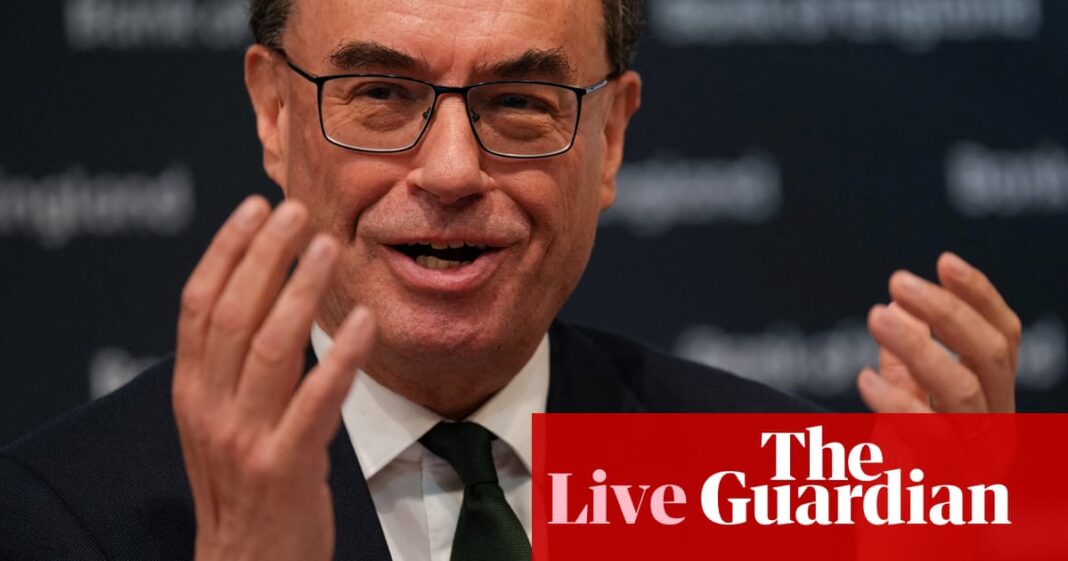
Andrew Bailey has told the BBC that reversing the post Brexit hit to UK-EU trade would be “beneficial”.
And while Bailey was keen not to take a view on Brexit, as a public official, he also argued that a closer relationship between the UK and the EU would help the economy and inflation.
Bailey says:
“It would be beneficial. Having a more open economy to trade with the European Union. Because there has been a fall-off in goods trade with the EU over recent years.
“It is important we do everything we can to ensure that whatever decisions are taken on the Brexit front do not damage the long-term trade position. So I hope that we can use this to start to rebuild that relationship.
That relationship could be improved later this month, when a crucial EU-UK summit is held.
As we covered in yesterday’s blog, Bailey was also pleased that the US and UK had reached a trade deal, telling the Beeb:
“It demonstrates that trade deals are important. Trade deals can be done, and the trade is important…honestly, it seems an unpromising landscape at times.
But I hope that we can use these deals to rebuild the world trading system.”
But while Donald Trump hailed that agreement yesterday, it still leaves the UK facing 10% tariffs on shipments to the US.
Key events
Yesterday, Donald Trump teased us by revealing that an unnamed UK company had bought $10bn of planes from Boeing.
And this morning, British Airways’ parent company has revealed itself as the buyer.
International Airlines Group (IAG) stated, in its latest financial results, that it has ordered 53 aircraft for its medium-term long-haul fleet requirements.
The Group has ordered 21 Airbus A330-900neo aircraft and 32 Boeing 787-10 aircraft for delivery from 2028 to 2033.
The aircraft are mainly for replacement, with around one third for growth in IAG’s core markets.
Minister insist Trump won’t have veto of Chinese investment in UK
Reports that the US will have a veto over Chinese investment in Britain as a result of the UK-US trade deal are “complete nonsense”, Treasury minister Darren Jones has insisted this morning.
The Telegraph reported that such a veto is part the deal, but Treasury minister Mr Jones told Times Radio:
“This story on the front page of the Telegraph is complete nonsense. I mean, I’m at a bit of a loss as to know where it’s come from. I think it was a Conservative Party criticism.
“But as you said, we’ve not even published all of the documents yet, so I’m not quite sure how they were able to come up with that.
“I can be completely categorical with you there is no such thing as a veto on Chinese investment in this trade deal, this is not what this trade deal is about.
“It is a sectoral trade deal in relation to tariffs in key sectors, in the way that we’ve just been talking about. So I’d suggest the Conservative Party reads the documents and they maybe come back for a second go.”
Our First Edition newsletter has kicked the tires on the US-UK trade deal, showing that it is far from comprehensive, but will help crucial British industries such as car-making.
The broader economic impact may be limited, though. As our economics editor Heather Stewart put it:
“It’s very important to have this piece of good news to take to the public and now that the Bank of England has cut interest rates they’re going to have positive headlines about people’s mortgages going down and this deal being done and that will help boost consumer and business confidence,
But in terms of the broader economic impact this deal is really quite small.”
UK must ‘do everything’ to rebuild trade with EU, Bank of Engand boss says
The Governor of the Bank of England has called for Britain to “rebuild” its trade relationship with the European Union, as the UK celebrates yesterday’s trade deal with the US.
Andrew Bailey has told the BBC that reversing the post Brexit hit to UK-EU trade would be “beneficial”.
And while Bailey was keen not to take a view on Brexit, as a public official, he also argued that a closer relationship between the UK and the EU would help the economy and inflation.
Bailey says:
“It would be beneficial. Having a more open economy to trade with the European Union. Because there has been a fall-off in goods trade with the EU over recent years.
“It is important we do everything we can to ensure that whatever decisions are taken on the Brexit front do not damage the long-term trade position. So I hope that we can use this to start to rebuild that relationship.
That relationship could be improved later this month, when a crucial EU-UK summit is held.
As we covered in yesterday’s blog, Bailey was also pleased that the US and UK had reached a trade deal, telling the Beeb:
“It demonstrates that trade deals are important. Trade deals can be done, and the trade is important…honestly, it seems an unpromising landscape at times.
But I hope that we can use these deals to rebuild the world trading system.”
But while Donald Trump hailed that agreement yesterday, it still leaves the UK facing 10% tariffs on shipments to the US.
Introduction: Chinese exports to US slump
Good morning, and welcome to our rolling coverage of business, the financial markets, and the world economy.
Trade between the US and China cooled sharply last month, new data shows, as Donald Trump’s tariff war hit demand.
The latest trade data from China shows that shipments to the US fell 21%, year-on-year, in April. That indicates the tariffs imposed on China by Trump, which rose to 145% during April, hurt trade.
Shipments the other way fell too. China’s imports from the US fell by almost 14%, after Beijing’s tit-for-tat tariffing raised its tariffs on US goods to 125%.
But… the broader picture is that China’s overall exports jumped by 8.1% in April, year-on-year, beating forecasts for a 1.9% rise, while imports dipped by 0.2%.
Economists have suggested that countries around the world are scrambling to take advantage of Donald Trump’s 90-day pause to the tariffs he announced at the start of April (not including China, though). That is leading to stronger demand for China’s materials.
Stephen Innes, managing partner at SPI Asset Management, says:
The numbers just confirmed what markets already suspected: Trump’s tariff blitz is biting, and hard. Chinese exports to the U.S. cratered 21% in April, the sharpest drop in years, while exports to ASEAN, Africa, LatAm, and even the EU surged. The global supply chain is being rerouted in real time.
On the surface, China’s overall April export growth held up—rising 8.1% YoY. But strip out the spin, and it’s clear the headline resilience masks a fundamental shift. The U.S. is no longer China’s growth engine. The manufacturing juggernaut is diverting flow wherever the tariff pain isn’t.
Vietnam, Indonesia, and Thailand—still in the 90-day reciprocal tariff grace period—saw double-digit percentage surges in China-bound exports. These aren’t one-off distortions. This is structural repositioning.
The agenda
-
9.40am BST: Bank of England governor Andrew Bailey to give keynote address at the Reykjavik economic conference 2025
-
12.15pm BST: Bank of England chief economist Huw Pill gives the national Monetary Policy Committee agency briefing