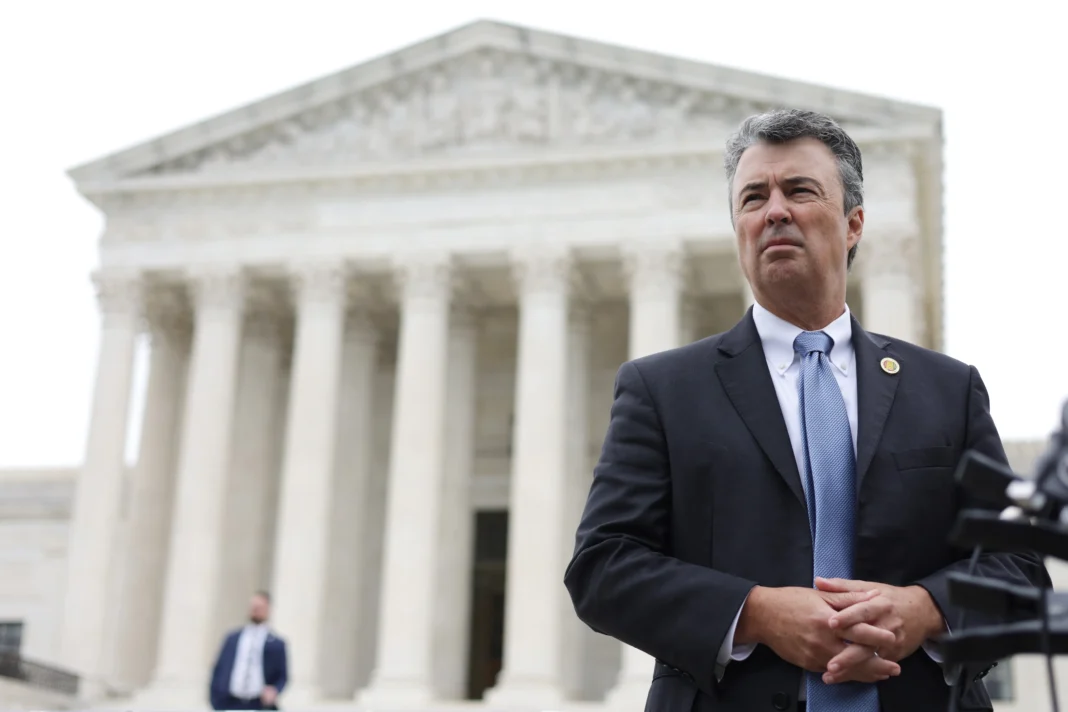
WASHINGTON—Alabama Attorney General Steve Marshall has announced a campaign for the U.S. Senate in 2026 to succeed Sen. Tommy Tuberville (R-Ala.), who is running for governor.
Tuberville, the former head coach of the Auburn University football team, was elected to the Senate in 2020 with President Donald Trump’s endorsement, and announced on May 28 his intention to run for governor of Alabama in 2026 to succeed the term-limited Gov. Kay Ivey (R-Ala.).
The next day, Marshall—another statewide elected official who was previously poised to run for governor—filed campaign papers with the Federal Election Commission, launched a website, and released a video announcing his run for the Senate.
Trump, whose endorsement is widely considered a decisive factor in most Republican primary campaigns, has not made an endorsement in the race.
Marshall’s website lists his top policy priorities as cutting taxes, abolishing the Department of Education, the removal of foreign nationals who have committed criminal offenses, and defunding Planned Parenthood.
Marshall has not yet made a speech or media appearance announcing his candidacy. Neither is he the only candidate in the race. Jared Hudson, a former U.S. Navy SEAL and business owner, is also running for the Republican nomination, presenting himself as a Christian conservative candidate.
Alabama is known for being among the most conservative states in the United States. No Democrat currently holds statewide office, and the state has a Cook Partisan Voting Index Score of “R+15,” meaning that a Republican is likely to win a statewide general election. Hence, the Republican primary is likely the real contest that will determine who becomes the next U.S. senator.
Some upsets have occurred in Alabama’s past elections, however.
In a 2017 special election to the U.S. Senate, for the seat vacated by Jeff Sessions to become U.S. attorney general, a Democrat—Sen. Doug Jones—was elected after defeating the former chief justice of Alabama, Roy Moore, who was the Republican nominee. Moore’s campaign faced criticism amid allegations of sexual abuse of minors, and he became the first Republican to lose a U.S. Senate seat in Alabama since 1992.