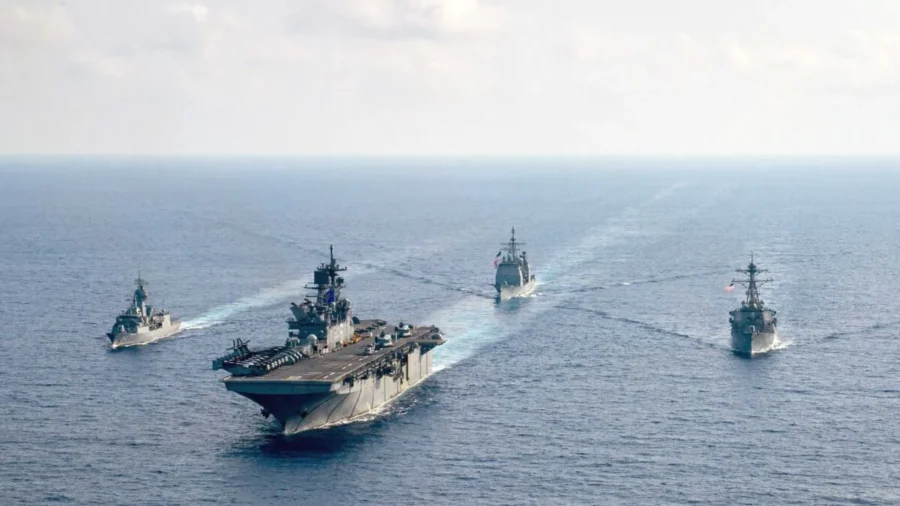
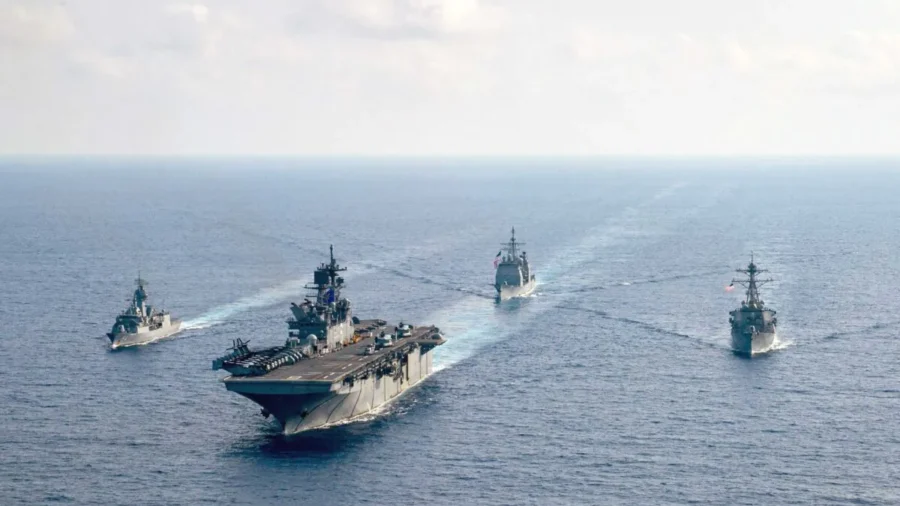
Australia, Japan, and the United States have signed a landmark agreement to boost logistical cooperation between their maritime forces, allowing warships to refuel, resupply, and get repairs more efficiently at ports and at sea.
The trilateral agreement was signed on Friday aboard the USS America, an amphibious assault ship visiting Brisbane, Australia. While the three Pacific-facing allies have long cooperated on naval logistics through bilateral agreements, this is the first formal arrangement to bring all of them together.
The deal covers key areas such as reloading missile systems and refueling each other’s warships at sea, which is critical to sustain naval operations across vast distances.
U.S., Australian, and Japanese naval oilers already routinely fuel partner vessels, but the new agreement could potentially allow Australian and Japanese military oilers to be refueled by commercial tankers contracted by the U.S. Navy.
Vice Adm. Jeff Jablon, the U.S. Navy’s deputy chief of naval operations for installations and logistics, said in a statement that the partnership will ensure that ships from all three countries receive “the right material and services at the right place, at the right time,” whether during routine peacetime exercises, or in times of crisis.
Jablon was joined at the signing ceremony by his counterparts: Commodore Catherine Rhodes of the Royal Australian Navy (RAN) and Rear Adm. Naoya Hoshi of the Japan Maritime Self-Defense Force (JMSDF), Japan’s de facto navy.
The agreement also sends a clear message of deterrence to adversaries, he said.
“Our adversaries face the undeniable reality that a fight against us would be unwinnable and costly,” Jablon said at Friday’s signing ceremony.
“Any country or adversary which would threaten a free and open Indo-Pacific, this is a message to that country or countries,” the flag officer added, invoking the “Free and Open Indo-Pacific” vision, a strategic concept first introduced by the late Japanese Prime Minister Shinzo Abe, and embraced by President Donald Trump in 2017.
The strategy, which has since become a cornerstone of U.S. foreign policy, focuses on building a network of regional allies and partners with shared values, promoting economic prosperity, and responding more decisively to the Chinese communist regime’s attempt to coerce its neighbors into surrendering their sovereign interests.
The new agreement comes as China’s navy continues to expand its reach. In February, a Chinese flotilla—comprising a frigate, a cruiser, and a replenishment ship—circumnavigated Australia and conducted live-fire exercises in the Tasman Sea, between Australia and New Zealand.
More recently, in June, China deployed two aircraft carriers with escorts beyond the so-called First Island Chain, an arc of islands stretching from Japan through Taiwan and the Philippines, to Indonesia, traditionally seen as the first barrier China would have to breach in a hypothetical war with the United States.
Japan raised alarms after confirming that China’s two aircraft carriers, the Liaoning and the Shandong, were seen separately but at about the same time operating near islands in the southern Pacific.
Japanese officials said this was the first time Chinese carriers have been detected operating east of the Japanese island of Iwo Jima—about 750 miles from Tokyo—in the Second Island Chain, which includes Guam, Palau, and Papua New Guinea.
Only 15 countries in the world own aircraft carriers, and even fewer can deploy two at once with a full escort. While the Liaoning and the Shandong, both based on a modified Soviet Kuznetsov-class design, are not the most advanced, their coordinated operations show China’s capability to project naval power beyond its immediate coastal waters and into the wider Pacific.
China is estimated to have a 395-ship navy, while the U.S. Navy operates 296 battle-force ships and falls short of the statutory requirement of 355 ships, according to recent congressional reports.
“With their naval fleet nearing 400 ships, China’s goal is not the defense of its homeland only,” Navy Secretary John Phelan told the House Armed Services Committee at a budget hearing in June. “It is the forward projection of power and influence in the Indo-Pacific.”