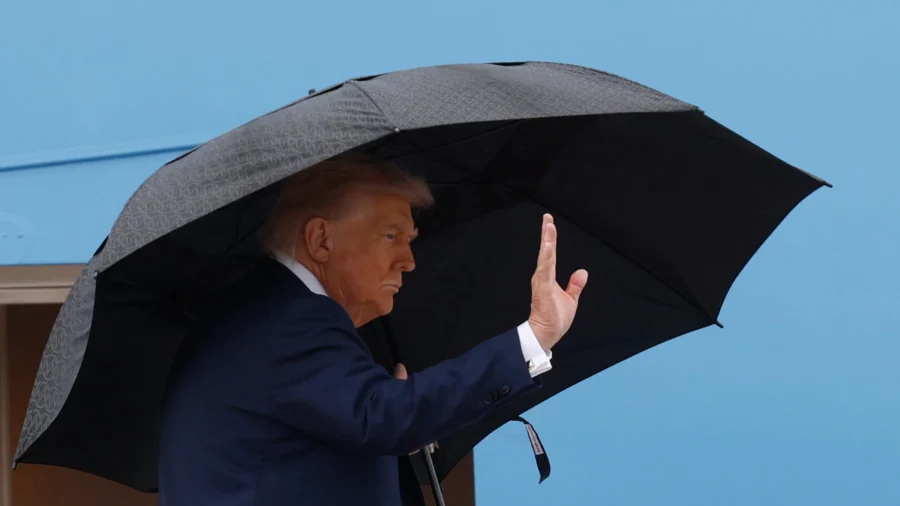
President Donald Trump said on Oct. 12 that he may authorize sending long-range Tomahawk missiles to Kyiv if Russia refuses to end the war in Ukraine.
Trump told reporters that he had talked to Ukrainian President Volodymyr Zelenskyy about the weapons. He noted that the long-range missiles would be sold to NATO, which would then provide them to Ukraine.
“They’d like to have Tomahawks. We talked about that. And so we’ll see,” Trump said aboard Air Force One en route to Israel.
When asked whether the United States would supply Ukraine with Tomahawks, Trump suggested that he may speak to Russian President Vladimir Putin before reaching a decision.
“I might talk to [Putin]. I might say, ‘Look, if this war is not going to get settled, I’m going to send them Tomahawks,’” he said. “The Tomahawk is an incredible weapon, very offensive weapon. And honestly, Russia does not need that.”
Tomahawk missiles have a range of about 1,000 miles, according to manufacturer Raytheon, which would allow Ukraine to strike targets as far away as Moscow if equipped with the U.S.-made weapons.
Trump said the long-range missiles would be “a new step of aggression” in the conflict if they were provided to Ukraine.
“I might tell [Russia] that if the war is not settled that we may very well do it. We may not, but we may do it,” the president said.
Zelenskyy said on Oct. 12 that he spoke with Trump for the second time in two days to discuss strengthening Ukraine’s “air defense, resilience, and long-range capabilities.” The two leaders also discussed the energy sector, according to his statement.
The Russian leader said the weapons could pose a threat to Russia but he believed they “won’t change the balance of power on the battlefield at all.”
“Can Tomahawks harm us? They can, we’ll be shooting them down and improving our air defense systems,” Putin said on Oct. 2.
U.S. Vice President JD Vance told Fox News in September that European nations would cover the cost of the sale if the Tomahawks are approved.
“What the president is going to do is [based on] what’s in the best interest of the United States of America,” Vance said.