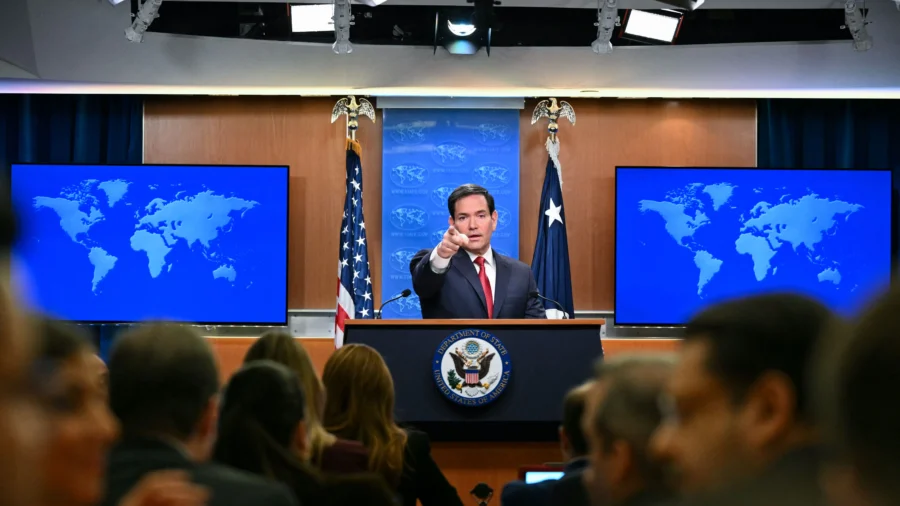
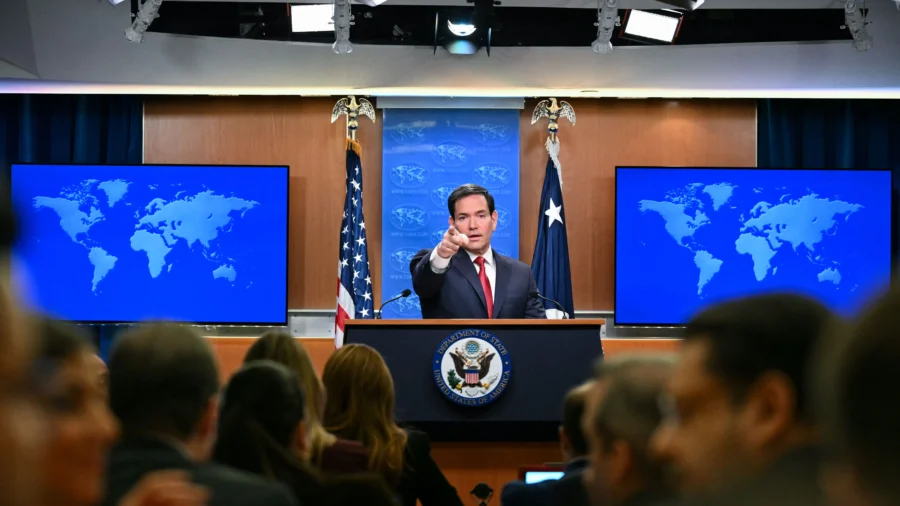
Secretary of State Marco Rubio held an end-of-the-year press briefing on Dec. 19, highlighting the Trump administration’s foreign policy agenda and fielding reporters’ questions about issues including Venezuela, the Russia-Ukraine war, and the cease-fire between Israel and Gaza.
The briefing at the State Department began with Rubio stating why he believes President Donald Trump was elected—from a foreign policy point-of-view.
“One of the reasons why President Trump was elected is sort of an understanding among the American people that our foreign policy was in need of a complete recalibration because the world has dramatically changed,” he said.
“Many of the institutions, policies, assumptions that our foreign policy was operating under were built upon a world that no longer existed, and it required us to re-examine that.”
Venezuela and Narco-Terrorism
Rubio said that Latin American countries such as Mexico, Panama, and Costa Rica have cooperated with the United States on the issue of drug smuggling.
However, he criticized Venezuelan government officials for their alleged support of narco-terrorism, an issue the administration has prioritized as evidenced by recent strikes on drug boats.
“We know that they are in cahoots with drug trafficking organizations,” he said. “It’s not just that they don’t work with us against these organizations, OK? It’s that they openly cooperate with these guys and allow them to operate.”
Rubio also called out Venezuela for providing terrorists in general such as Hezbollah a safe haven in the South American country.
He also named what he believes to be the greatest threat to the United States in its own hemisphere.
Cooperating With Colombia
The U.S.-Colombia relationship has been complicated. Trump and Colombian President Gustavo Petro have traded barbs, with the latter even suggesting getting “rid of” Trump. Nonetheless, Rubio said that there has been cooperation between the two countries and, despite the rocky relationship between the two leaders, the United States seeks to increase cooperation with Colombia.
“We’re not gonna let pronouncements of an unstable individual over there impact our broader relationship with Colombia. It’s an important relationship,” said Rubio. “It extends through commercial, people-to-people, cultural, obviously security and stability, all these things.”
Rubio said the Trump administration will not let Petro impede ties between Colombia and the United States.
“This is a very important alliance, a very important strategic partnership, which we’ve built up through a lot of hard work over decades,” he said. “And we’re not like gonna let that fall apart because of one person.”
In September, the United States struck a Colombian boat believed to be carrying drugs.
Resolving the Israel-Gaza Conflict
Rubio acknowledged it will take time for the conflict between Israel and Hamas to be resolved. The first phase of the cease-fire, reached in October, has included Israel getting back its living and dead hostages in exchange for the release of Palestinian prisoners. It has also consisted of a gradual withdrawal of Israeli forces in Gaza.
“Peace is a verb. It’s an action. It’s not a sentiment. Every single day will bring challenges,” he said.
Rubio cited Hamas carrying out violence since the cease fire took effect such as attaching an explosive device to the side of a vehicle, injuring and almost killing Israeli soldiers.
“We saw early on the atrocities they were committing in the streets against people as they were trying to show people how strong they were,” he said. “So I don’t think I’m standing here to tell you this is going to be easy.”
Special Envoy Steve Witkoff is expected to meet in Florida with Arab countries such as the United Arab Emirates to implement the second phase of the cease-fire that requires Hamas to disarm.
Ukraine-Russia Peace Talks
Rubio acknowledged that the war between Russia and Ukraine has been tough to resolve.
“What we’re trying to figure out here is what can Ukraine live with and what can Russia live with. Sort of identify what both sides’ positions are and see if we can sort of drive them towards each other to some agreement,” he said.
Rubio said that only a negotiated settlement can end the war, as neither side is looking to surrender. He went on to say that the administration has been asking both sides what they want and what they can give to cease the fighting.
“This is not about imposing a deal on anybody. It is about determining what both sides expect and need to have and what both sides are prepared to give in return for it, and figuring out whether we can have those two overlap,” he said. “And of course, it takes a lot of time, a lot of hard work. It can’t generally be done in the media and press conferences. I think we’ve made progress, but we have ways to go. And obviously the hardest issues are always the last issues.”
Witkoff and the president’s son-in-law, Jared Kushner, have held meetings with both sides of the conflict in seeking a resolution to the conflict, which has lasted for more than three years.
Europe’s Defense Spending
Finally, Rubio applauded Europe for increasing its defense spending.
Trump has pushed NATO members to increase their defense spending by 5 percent of their GDP by 2035.
Rubio recalled attending a meeting where NATO members made the 5 percent commitment. Spain was the lone country not to do so.
“And we’ve had no indication from any other countries that agreed to that they’re not going to do it because it’s in their own interest,” he said.
“I mean, it’s in their own interest. Bottom line is, you know, increasing their defense capacity is in their interest because it’s their defense.”