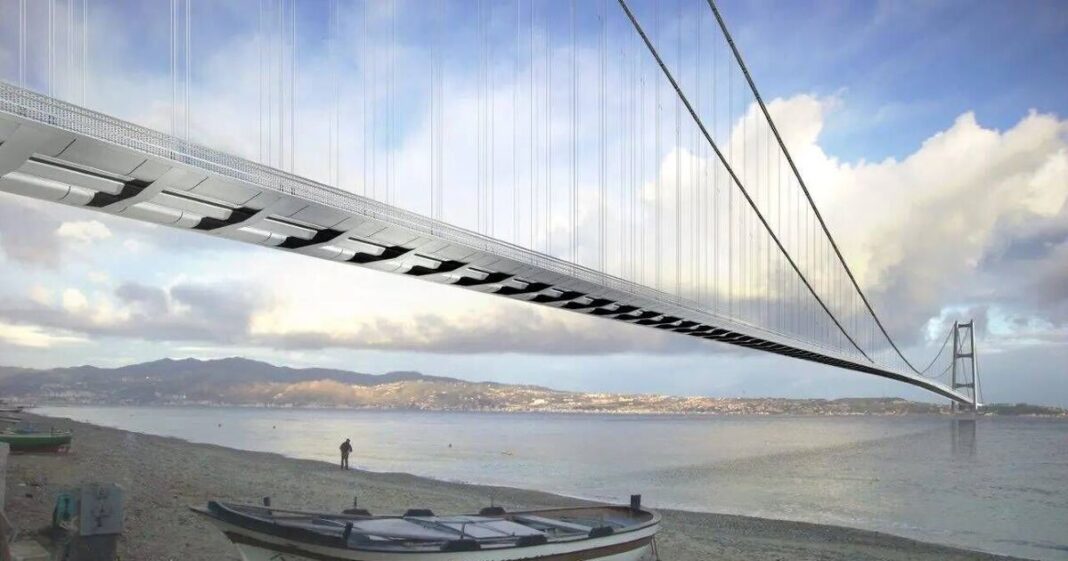
The world’s longest suspension bridge has received approval – and it’s set to be a massive hit with British travellers.
Just four months ago, the Italian government gave the go-ahead to construct what would become the globe’s most extensive suspension bridge, linking mainland Calabria with Sicily. Nevertheless, significant developments have occurred during this period.
The contentious Messina Bridge scheme, carrying an eye-watering price tag of £11.7bn, encountered a major setback last month, placing the project back in limbo.
Should the bridge eventually materialise across the Strait of Messina, as Prime Minister Giorgia Meloni remains determined to achieve, it would represent an extraordinarily ambitious engineering feat that Italy has been discussing for generations.
The enormous structure, featuring twin towers rising 400-metres (1,300 feet) high, would stretch an astonishing 3.3km (2.05 miles) across the water.
Three traffic lanes would run on either side of twin railway tracks positioned centrally.
British holidaymakers exploring Italy would particularly benefit from this development, as it would slash their journey time to Sicily to merely ten minutes, rather than relying on ferry crossings that frequently exceed the standard 30-minute voyage due to extensive queuing during busy periods.
Speaking earlier this year, Meloni declared: “It is not an easy task but we consider it an investment in Italy’s present and future, and we like difficult challenges when they make sense.”
Transport minister Matteo Salvini declared in August that the objective was to complete construction between 2032 and 2033. He also claimed that 120,000 positions annually would be generated, something he argued would deliver economic prosperity to the impoverished regions of Sicily and Calabria, located at the southern tip of Italy.
Rome received authorisation for the scheme in August following years of the proposals being abandoned. One of the primary reasons plans have been suspended historically was fears of organised crime corruption, including anxieties about public funds being diverted by Sicilian and Calabrian criminal organisations.
Additional concerns have consistently been voiced regarding environmental harm, expense and security, and given the area is amongst the most earthquake-prone zones in the Mediterranean, engineers pledged the Strait of Messina Bridge would be capable of surviving seismic activity.
And last month, another obstacle emerged after an Italian tribunal determined the bridge would violate EU environmental and procurement regulations.
The Court of Auditors judgement stated: “The assumptions regarding the various ‘reasons of public interest’ are not validated by technical bodies and are not supported by adequate documentation.”
Yet the Italian administration is determined not to surrender and has pledged to examine the judgement thoroughly and proceed with its aspirations of making the bridge a reality. In addition to needing approval from the Italian Court of Auditors and both national and EU environmental agencies, there’s likely to be resistance from the 4,000 residents living on either side of the Strait.
Their homes could face demolition, potentially leading to legal disputes over being forced to vacate their properties.
Currently, the world’s longest suspension bridge is the 915 Canakkale Bridge in Turkey – a structure that links Asia and Europe and takes a mere six minutes to traverse.
Work began on this impressive feat of engineering across the Dardanelles Strait in 2017, and it was opened to the public just three years ago. The result has been a dramatic reduction in travel times by up to 93%.
This means that lengthy 90-minute ferry journeys can now be bypassed thanks to the bridge, which begins in Gelibolu, Turkey, located on the European side, and ends in the Asian town of Lapseki.