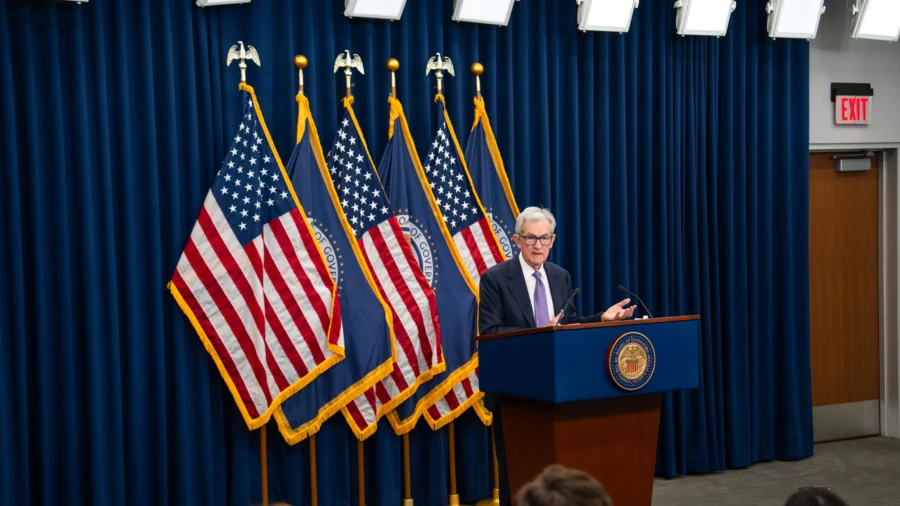
The Federal Reserve’s December meeting proved far more fractured than the final vote suggested, underscoring the persistent split in policymakers’ views.
The new target range sits between 3.5 percent and 3.75 percent.
While meeting participants eventually moved forward with an interest rate cut, officials provided a variety of views regarding rates and monetary policy, according to minutes released on Dec. 30.
Most participants agreed to keep lowering interest rates if inflation declines “over time as expected.”
However, the size and frequency of policy adjustments were a source of contention at this month’s two-day meeting.
“With respect to the extent and timing of additional adjustments to the target range for the federal funds rate, some participants suggested that, under their economic outlooks, it would likely be appropriate to keep the target range unchanged for some time after a lowering of the range at this meeting,” the document said.
The meeting summary indicated that the final vote was “finely balanced” and could have gone either way.
Fed Governor Stephen Miran supported a half-point reduction, arguing that he does not see inflation as a threat. Instead, according to Miran, prolonged restrictive policy could threaten employment conditions and the wider economic landscape.
Chicago Fed President Austan Goolsbee and Kansas City Fed President Jeffrey Schmid voted for no change to the policy rate.
Goolsbee expressed concern about front-loading rate cuts without the full scope of data, while Schmid stated that it would be prudent to leave policy untouched since the economy had changed little since October.
Minutes indicated that officials supporting keeping rates unchanged viewed President Donald Trump’s tariffs as contributing to inflation pressures, thereby blocking the central bank’s progress in restoring price stability.
They also “indicated that they needed to have more confidence that inflation was being brought down sustainably to the committee’s objective.”
Others stated that moving toward a neutral policy rate—interest rates are neither stimulative nor restrictive—would help prevent a further deterioration in employment conditions.
“Many of these participants also judged that the available evidence pointed to a reduced probability that tariffs would lead to persistent inflation pressures,” the minutes said.
They argued that easing policy was warranted given rising risks to employment and would better balance the Fed’s dual-mandate goals, price stability, and maximum employment.
Persistent Divergence
Minutes from the final policy meeting of 2025 reflected the ongoing divergence at the central bank.
For months, officials have been divided on whether inflation or employment was the greater risk to the broader economy.
The discussion has also fueled the policy debate: cut or pause.
Appearing at a Dec. 16 Yale University event, Fed Gov. Christopher Waller said he believes inflation will continue to moderate and inch closer to the institution’s 2 percent target “in the next three to four months.”
As a result, Waller said he and his colleagues could cut rates by as many as 100 basis points, bringing interest rates below 3 percent.

Market watchers were stunned when November’s annual inflation rate unexpectedly slowed to 2.7 percent.
Core inflation, which removes food and energy prices, eased sharply to 2.6 percent—the lowest level since March 2021.
While the labor market is in balance, Bostic warned that if elevated inflation persisted for the coming months, markets could begin to doubt whether the central bank will reach the 2 percent target.
“Will the public lose faith after five years of above-target inflation? Six years?” Bostic wrote in a Dec. 16 post on the regional central bank’s website. “Nobody knows. But what we do know is that credibility is a cornerstone of effective monetary policy.”
The labor market has shown signs of loosening since the summer.
Meanwhile, updates to the Summary of Economic Projections suggest officials expect a quarter-point rate cut in 2026.
The Fed will hold its next two-day policy meeting on Jan. 28 and 29. Investors overwhelmingly expect no action next month.