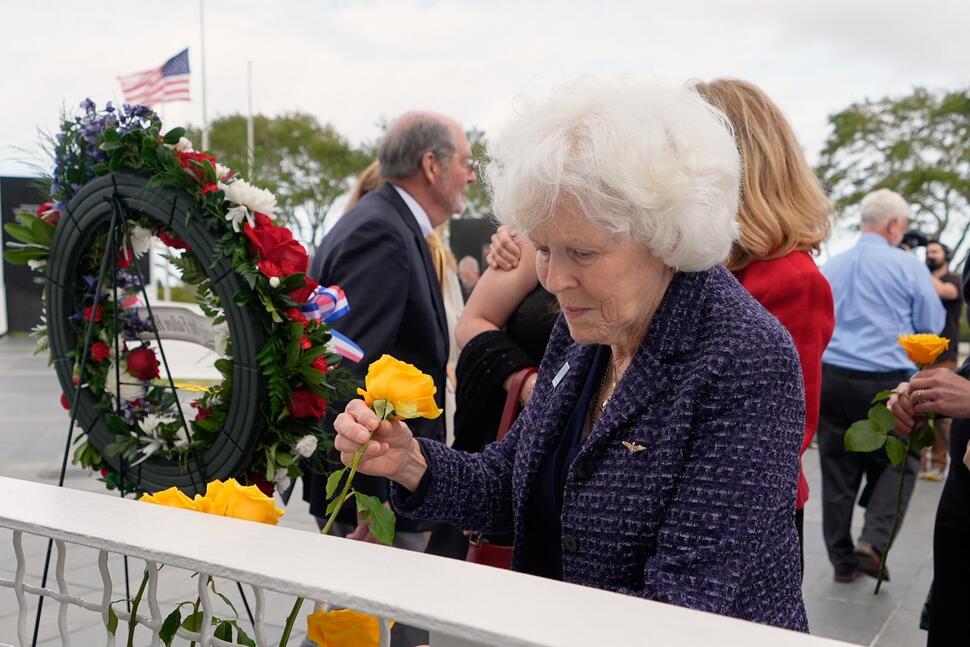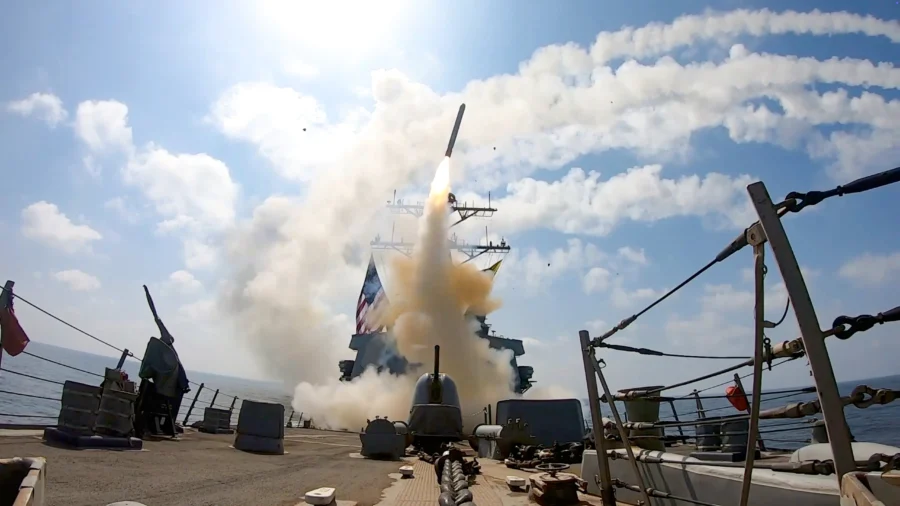
WASHINGTON—Early Saturday, the United States and Israel carried out coordinated strikes on Iran, which resulted in the death of Iran’s Supreme Leader Ayatollah Ali Khamenei.
“Khamenei, one of the most evil people in History, is dead,” President Donald Trump announced on Truth Social nearly 16 hours after the start of the operation.
“This is not only Justice for the people of Iran, but for all Great Americans, and those people from many Countries throughout the World, that have been killed or mutilated by Khamenei and his gang of bloodthirsty THUGS,” Trump said.
The move followed months of increased U.S. military presence in the Middle East and repeated warnings from Trump urging Tehran to abandon its nuclear program.
The strikes occurred while indirect talks were still underway between U.S. officials and the Iranian regime over a potential nuclear deal. Trump said Friday he was “not happy” with the progress of talks with Iran.
Here are the key takeaways from the U.S.–Israel joint military operation.
Operation Epic Fury
The U.S.–Israeli joint strikes began at 1:15 a.m. ET, according to the U.S. Central Command (CENTCOM).
Dubbed Operation Epic Fury, the mission targeted military sites, as well as compounds and command centers of top Iranian leaders.
The targets included command and control sites of Islamic Revolutionary Guard Corps; Iranian air defense systems, missile, and drone launch sites; and military airfields.
The Israeli Air Force (IAF) announced that about 200 Israeli jets participated in the operation, striking more than 500 targets in several cities in Western and Central Iran.
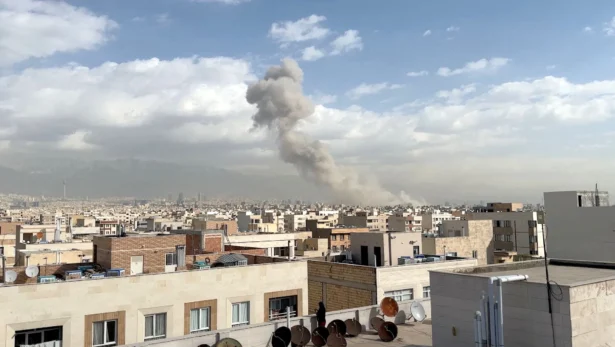
Smoke rises following an explosion, after Israel’s defense minister said Israel had launched a pre-emptive attack in Tehran on Feb. 28, 2026. West Asia News Agency/Handout via Reuters
According to reports, other senior Iranian officials who were killed in the attacks included Secretary of Supreme National Security Council Ali Shamkhani, Defense Minister Amir Nasirzadeh, and IRGC commander Mohammad Pakpour. In addition, four senior Intelligence Ministry officials—Javad Pourhossein, Mohammadreza Bajestani, Ali Kheirandish, and Saeed Ahyah Hamidi—were reportedly killed.
Iran’s Red Crescent reported that 201 people were dead, 747 were injured, and 24 provinces were impacted by the strikes.
Trump Sends Message to Iranians
Following the death of Khamenei, Trump called on the Iranian people to seize control of their country.
“This is the single greatest chance for the Iranian people to take back their Country,” Trump wrote on social media.
“We are hearing that many of their IRGC [Islamic Revolutionary Guard Corps], Military, and other Security and Police Forces, no longer want to fight, and are looking for Immunity from us,” Trump added.
Earlier, in a video message soon after the U.S. strikes, Trump warned the Iranian military and police force, urging them to lay down their weapons.
“Lay down your arms. You will be treated fairly with total immunity, or you will face certain death,” the president said.
Trump also directly addressed the Iranian people at the end of his video message.
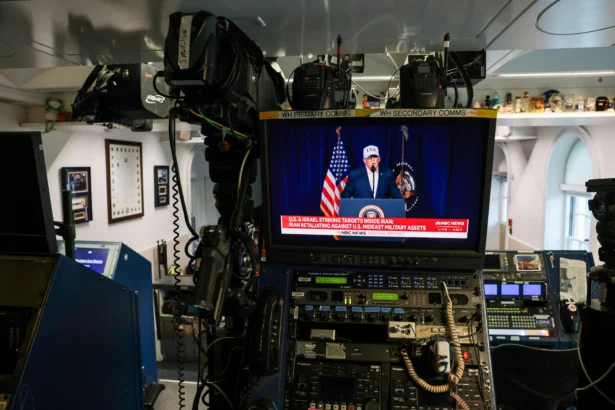
An NBC News live feed airs a clip from President Donald Trump’s Truth Social video announcement in the White House James S. Brady Press Briefing Room in Washington, DC, on Feb. 28, 2026. Anna Moneymaker/Getty Images
“For many years, you have asked for America’s help. But you never got it,” Trump said.
“Now is the time to seize control of your destiny, and to unleash the prosperous and glorious future that is close within your reach. This is the moment for action. Do not let it pass.”
Iran’s Retaliatory Strikes
The Iranian Islamic Revolutionary Guard Corps quickly responded to the strikes by launching hundreds of retaliatory attacks on U.S. bases and facilities in Gulf Arab states and Israel.
The Israel Defense Forces (IDF) have faced and shot down continuous rounds of missile launches and other unmanned aerial vehicles from Iran since the attack, which it dubbed Operation Lion’s Roar. Tel Aviv and other areas of the country continue to face missile threats.
Iran also targeted the U.S. bases positioned in neighboring countries, especially in the Persian Gulf. Those bases included the U.S. Navy’s 5th Fleet headquarters in Bahrain; the Al Udeid Air Base, roughly 20 miles outside of Doha, Qatar; the Ali Al Salem Air Base in Kuwait; and the Al Dhafra Air Base in the United Arab Emirates.
Iranian missiles and drones have also hit civilian sites in the Gulf states, including several hotels in Abu Dhabi, an airport in Kuwait, and a building in Bahrain.
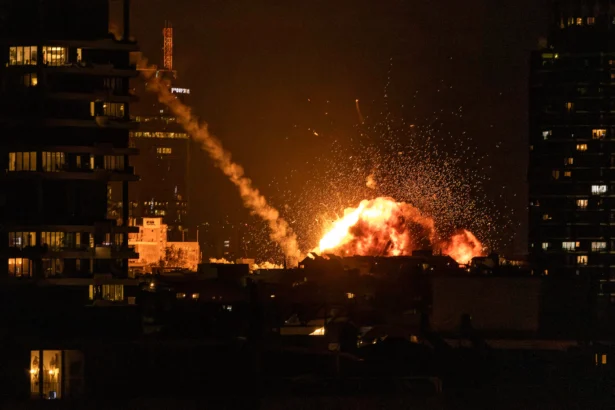
A fireball lights the sky following a missile strike on Tel Aviv, in Tel Aviv, Israel, on Feb. 28, 2026. John Wessels / AFP via Getty Images
No American Casualties, Arab Nations Respond
Despite the bombardment, U.S. Central Command (CENTCOM) reported no casualties.
“CENTCOM forces successfully defended against hundreds of Iranian missile and drone attacks,” it stated. “There have been no reports of U.S. casualties or combat-related injuries. Damage to U.S. installations was minimal and has not impacted operations.”
However, Iran’s retaliation put its Arab neighbors in the crossfire, even outright targeting their territory during the bombardment.
Kuwait, Bahrain, Qatar, the United Arab Emirates, Saudi Arabia, and Jordan confirmed that they each launched their own anti-missile defense systems. They all issued statements condemning the attacks; however, none chose to launch retaliatory strikes against Iran.
Iraq’s leadership, meanwhile, condemned what it called “unjustified aggression” toward Iran and warned against violating its airspace and territories to launch attacks against Iran.

President Donald J. Trump Monitors U.S. Military Operations in Iran: Operation Epic Fury, on Feb. 28, 2026. WhiteHouse
Preemptive Action
A senior Trump administration official said the United States “had indicators” that the Iranian regime would use its missiles “preemptively” to any American action on Iran.
“And the President decided he was not going to sit back and allow American forces in the region to absorb attacks from conventional missiles,” the official told reporters on a background call.
“We had analysis that basically told us, if we sat back and waited to get hit first, the amount of casualties and damage would be substantially higher.”
In addition, Trump administration officials have determined that negotiations with Iran were unsuccessful due to its refusal to address ballistic missiles, proxies, and the nuclear program.
The regime in Iran rejected a U.S. proposal to have a peaceful nuclear program that could be used only for civilian purposes, another official said.
European Allies’ Respond
The U.S.–Israel campaign also sparked attention and reaction from European leaders.
British Prime Minister Keir Starmer released a video stating that while his nation played no part in the attack, he denounced Iran’s Islamic regime and emphasized that it should never be allowed to have nuclear weapons. He also condemned Iran’s attack on its neighboring nations.
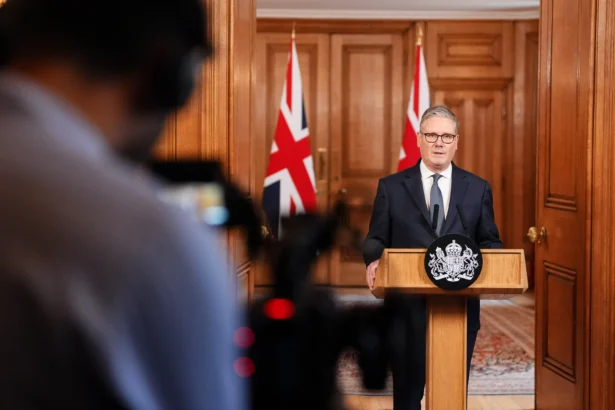
Britain’s Prime Minister Keir Starmer speaks as he makes a statement from Downing Street in central London on Feb. 28, 2026, following the US and Israel’s strikes on Iran. Jonathan Brady / POOL / AFP via Getty Images
Meanwhile, French President Emmanuel Macron spoke out against the military escalation. He called an urgent meeting of the United Nations Security Council.
“The Iranian people must also be able to freely build their future,” Macron said. “The massacres committed by the Islamic regime disqualify it and demand that the voice be returned to the people. The sooner, the better.”
Antonio Costa, president of the European Council, welcomed a meeting of the U.N. Security Council, expressing great concern over the campaign. While he stressed a commitment to safeguarding regional security and stability, he urged “all parties to exercise maximum restraint, to protect civilians, and to fully respect international law.”
He also condemned Iran’s attacks on other countries in the region.
Meanwhile, communist China and Russia condemned the attack on Iran.
U.N. Secretary General Antonio Guterres condemned both the attack on Iran and its retaliation.
“I reiterate that there is no viable alternative to the peaceful settlement of international disputes, in full accordance with international law, including the UN Charter,” Guterres said in a statement. “The Charter provides the foundation for the maintenance of international peace and security.”
Congress Divided
Back home, the president’s decision to launch this military campaign against another country without getting prior authorization from Congress has left lawmakers on both sides of the aisle vocally divided.
House Speaker Mike Johnson (R-La.) issued a statement on X saying that the bipartisan group of eight congressional leaders who are briefed on classified information, called the Gang of Eight, was briefed several days ago on the mission and the fact military action may be necessary.
Johnson stood by the administration’s decision.
“Iran and its proxies have menaced America and American lives, undermined our core national interests, systematically destabilized the Middle East, and threatened the security of the entire West,” he said.
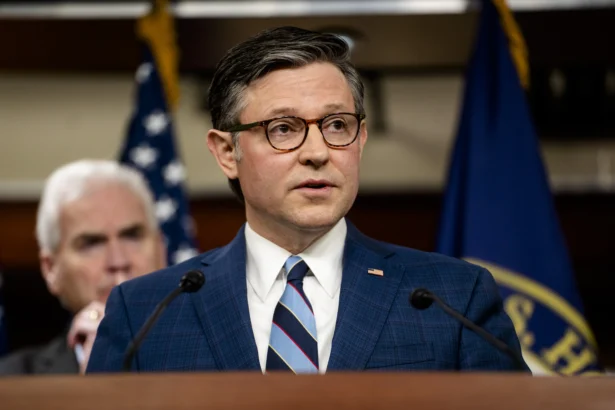
Speaker of the House Mike Johnson (R-La.) speaks during a press conference on Capitol Hill in Washington on Jan. 21, 2026. Madalina Kilroy/The Epoch Times
While many Republicans praised the operation, Democrats, who have long argued that full congressional approval is needed for military actions, used the day to push for a vote on their War Powers resolution.
“The administration must brief Congress, including an immediate all senators classified briefing and in public testimony,” Senate Minority Leader Chuck Schumer (D-N.Y.) said, calling on the Senate to return to session to “reassert its constitutional duty by passing our resolution to enforce the War Powers Act.”
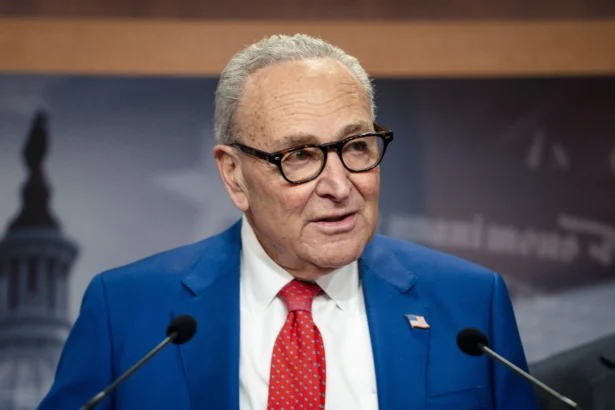
Senate Minority Leader Chuck Schumer (D-N.Y.) speaks at a press conference on Capitol Hill in Washington on Jan. 14, 2025. Madalina Kilroy/The Epoch Times
Some Republicans shared their disapproval as well. Sen. Rand Paul (R-Ky.) lamented the idea of another war in the Middle East, and Rep. Thomas Massie (R-Ky.) said the strikes were not “America First.”
“When Congress reconvenes, I will work with [Rep. Ro Khanna] to force a Congressional vote on war with Iran,” Massie said on X. “The Constitution requires a vote, and your Representative needs to be on record as opposing or supporting this war.”
Sen. John Fetterman (D-Pa.) broke ranks with his party and supported the president’s decision.
“President Trump has been willing to do what’s right and necessary to produce real peace in the region,” Fetterman said on X. “God bless the United States, our great military, and Israel.”
What’s Next?
Trump and his officials indicated that the strikes will continue until the Iranian regime stops its nuclear ambitions and peace is restored in the region.
“The heavy and pinpoint bombing,” Trump said on Truth Social, “will continue, uninterrupted throughout the week or, as long as necessary to achieve our objective” to bring peace to the Middle East.
Israeli Prime Minister Benjamin Netanyahu also announced during a video message that the country’s military strikes on Iran will continue “as long as necessary.”