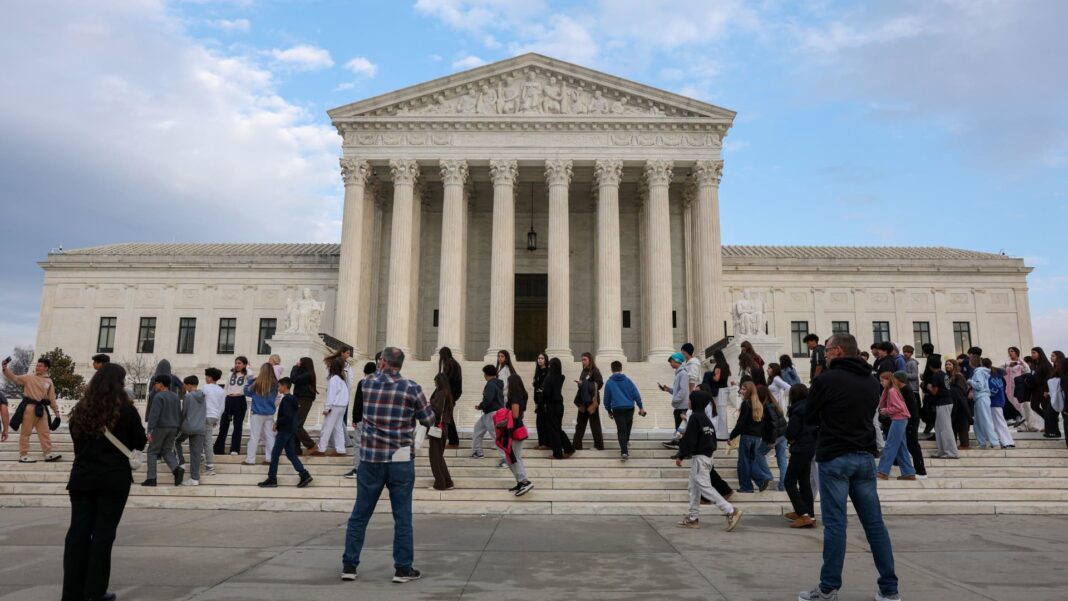
People walk near the U.S. Supreme Court, where justices are expected to issue opinions in pending cases, in Washington, D.C., U.S., Feb. 25, 2026.
Kylie Cooper | Reuters
The Supreme Court on Monday issued an order effectively barring the redrawing of the boundary lines of the only congressional district in New York City currently held by a Republican for the 2026 midterm elections.
The decision is a victory for the incumbent seeking re-election this November, Rep. Nicole Malliotakis, the Staten Island Republican who had asked the Supreme Court to hear her bid to block new lines for that contest.
The Supreme Court order is a potentially significant one for Republicans, who are trying to retain their narrow majorities in both chambers of Congress. The order comes on the heels of efforts in Texas, California, and elsewhere to redraw maps for congressional districts before the midterm elections.
The GOP has just a 218-214 majority in the House of Representatives.
Democrats likely would have had a better chance to defeat Malliotakis in her 11th Congressional District if more Black and Latino voters were added to it, as was expected after a ruling in January by a New York state court judge that directed the district’s lines to be redrawn.
Neither the exact numerical breakdown of which Supreme Court justices voted in favor of Monday’s order, nor the rationale for the decision were disclosed. But the court’s three liberal members all dissented from the order.
Justice Samuel Alito, a member of the court’s six-member conservative supermajority, in a concurring opinion in the ruling called a New York state judge’s order that Malliotakis’ district be redrawn for the 2026 election one that “blatantly discriminates on the basis of race.”
“The New York Supreme Court (that State’s trial-level court) ordered the New York Independent Redistricting Commission to draw a new congressional district for the express purpose of ensuring that ‘minority voters’ are able to elect the candidate of their choice,” Alito wrote.
“That is unadorned racial discrimination, an inherently ‘odious’ activity that violates the Fourteenth Amendment’s Equal Protection Clause except in the ‘most extraordinary case,’ ” he said.
US Rep. Nicole Malliotakis (R-NY) speak with the press on Capitol Hill on Wednesday July 2, 2025.
Demetrius Freeman | The Washington Post | Getty Images
Justice Sonia Sotomayor, the liberal justice who authored a dissent of the order, noted that the order consisted of just 101 words, without explanation, but “can be summarized in just 7: ‘Rules for thee, but not for me.'”
Sotomayor blasted the order for not giving New York state appeals courts time to resolve Malliotakis’ challenge of the judge’s ruling calling for new district lines.
“Time and again, this Court has said that federal courts have limited jurisdiction,” Sotomayor wrote.
“Time and again, this Court has said that federal courts should not interfere with state-court litigation,” she said. “Time and again, this Court has said that federal courts should not meddle with state election laws ahead of an election. Today, the Court says: except for this one, except for this one, and except for this one.”
The map of the 11th was redrawn in 2024. The district includes all of Staten Island and parts of South Brooklyn.
In the 2024 election, Malliotakis crushed her Democratic challenger by a wide margin.
Last October, four New York City residents filed a lawsuit challenging the design of the district, arguing that it diluted the votes of Black and Latino residents in a manner that violated the U.S. Constitution.
In January, a New York state court judge in Manhattan, Jeffrey Pearlman, ruled for the plaintiffs and ordered the Independent Redistricting Commission to redraw the map of the district by Feb. 6.
Pearlman, in his ruling, said that the 11th District, as drawn, denied Black and Latino voters the equal “opportunity to participate in the political process . . . and to elect representatives of their choice” guaranteed to them,” Sotomayor noted in her dissent.
Malliotakis soon after asked the Supreme Court to block Pearlman’s order.