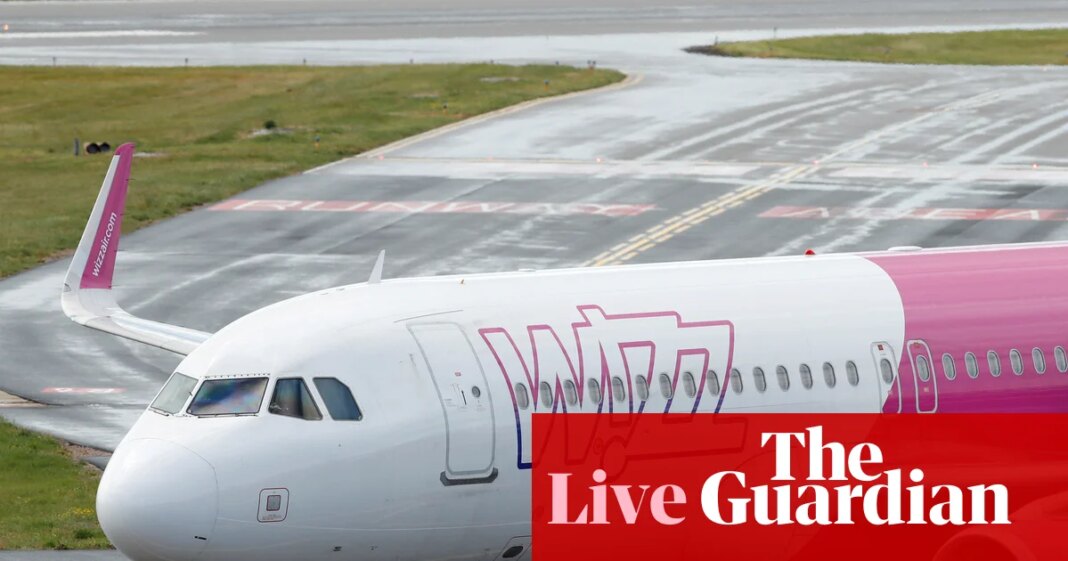
Wizz Air issues profits warning due to Middle East crisis
The travel disruption, the higher oil price and the fall in the euro caused by the Iran war has prompted low-cost airline Wizz Air to issue a profits warning.
Wizz Air warned investors last night that it believes the current crisis in the Middle East will wipe €50m off its profits this financial years.
Wizz had previously predicted that earnings would fall within a profit of €25m to a loss of €25m, so today’s warning means it expects a loss for the year.
The company told the City:
In terms of the expected impact, approximately one third is a result of the cessation of certain scheduled services to the Middle East, with the remainder from the adverse movement in macroeconomic factors as a result of the Iran conflict.
Our assessment of the impact of these macroeconomic factors is based on jet fuel and US$/€ rates as of today, and assumes that these rates will remain at current levels for rest of Fiscal Year 2026.
Key events
Demand for private jets from UK firm soars by up to 300% amid Iran war

Diane Taylor
Planes are always urgently sought out when a crisis strikes somewhere in the world. Since the US-Israel war against Iran started on Saturday, demand has outstripped supply with thousands of people stranded in the Middle East frantically searching for an exit route.
While many are reliant on governments to dispatch aircraft to evacuate them, those with the financial means can look at a more expensive and much speedier option – a private jet. Matt Purton, the director of aviation services at UK-based global company Air Charter Service, is the man some of them have on speed dial.
Purton not only organises for the rich and the famous to be ferried around the world, he also assists governments, fielding requests from everyone from the UK Home Office to the US government seeking planes to deport migrants or carry out evacuations from collapsed countries such as Libya.
While his company does not accept all requests for private planes from anyone who can pay, he admits that the latest Middle East war has not been bad for business. “Requests for planes are probably up 200-300% on what’s usual for this time of year,” he says. “We’re going gangbusters.”
Cost of living Q&A: post your questions for money expert Hilary Osborne now
This week’s events in the Middle East have sent stock markets plummeting and energy prices soaring.
Are you wondering what this economic shock means for your own finances – from the cost of everyday items to interest rates and investments?
If so, we have the answers! My colleague Hilary Osborne will be answering your questions from 1pm, and you can get your query in now:
UK mortgage lenders start to hike rates
The inflationary peril from the Iranian war means there seems little chance that the Bank of England will lower interest rates this week.
The money markets indicate that a quarter-point rate cut on 19 March is just a 25% chance.
And some lenders are already responding, by increasing their own rates.
David Hollingworth, associate director at L&C Mortgages explains:
“We are now seeing the first big name lender moves begin to feed through. HSBC has this morning announced that its rates will be increasing tomorrow. Coventry has also given notice to the market that fixed rates will be hiked with effect from Monday.
“The conflict in the Middle East has led to market expectation of higher inflationary pressure causing rate cuts to be slowed or put on hold. That pushes up the cost for lenders when pricing their fixed rate mortgages, which can force rates higher.
ECB policymakers warn of inflation spike if Iran war drags on
Three European Central Bank policymakers have warned today that euro zone inflation would likely rise, and growth sag, if the war in Iran becomes drawn out and sucks in more countries.
The ECB’s vice president Luis de Guindos and the central bank governors of Germany and Finland all said it was too early to draw conclusions but warned that a prolonged, wider war may push up inflation, both present and expected.
De Guindos told an event in Brussels (via Reuters):
“The baseline (is) that this is going to be short-lived. If it is longer, then there is a risk that inflation expectations will change.”
James Bristow, portfolio manager at Templeton Global Investments, says European equity markets have been pricing in a ‘growth scare’ on gas.
“Experts would characterize the oil market as generally having somewhere between 2-4 weeks ability to cope with disruptions like this before more serious disruptions to the price happens.
My rationalisation of the rise in the oil prices so far is that it reflects near term uncertainty, but before this started, there were estimates of surplus of around 3-4 million barrels of oil per day, which is why the price isn’t up even higher. Looking at gas, this is unambiguously worse for Europe than other regions.
If you look at what equity markets have been trying to price in the last couple of days, it is no surprise that in Europe, banks, and consumer discretionary have been very poor performers. Europe itself has underperformed other regions. This is the market trying to price some form of a growth scare, but how long the growth scare lasts, is up for grabs.”
That drop in the gas price didn’t last long.
UK month-ahead gas prices are up almost 1% at 128p a therm.
European gas prices are up 2.2% at €49.9 per Megawatt hour.
UK construction slump deepens as housebuilding stumbles
The downturn in the UK construction sector shrank at a faster rate last month, dragged down by weaker housing activity.
Data provider S&P Global has reported that construction activity fell for the fourteenth successive month in February, and at a more rapid pace than January.
Building firms reported a sharper decline in new orders, with input cost inflation the highest since July 2025.
This pulled the UK’s construction PMI down to 44.5 in February, down from January’s seven-month high of 46.4, and further away from the 50-point mark showing stagnation.
S&P Global explains:
Residential building remained the weakest-performing segment in February (index at 37.0) and the rate of decline accelerated since January.
Commercial construction activity (46.5) also decreased at a faster pace than at the beginning of the year, but the speed of the downturn was much less marked than seen across the rest of the construction sector. Civil engineering was the only sub-sector to record a slower fall in activity levels during Februar
Markets turnaround
In the last few minutes, an interesting turnaround has taken place in the markets.
The US dollar has lost all its earlier gains, to trade flat against a basket of other currencies.
European stock markets have shaken off their losses, with the FTSE 100 share index now up 36 points (+0.33%).
Wall Street is now expected to open a little higher too….
And happily for consumers, gas prices have now erased their earlier rise.
The rise in the oil price today could soon hurt motorists, as petrol retailers haven’t been slow to lift their prices this week.
Howard Cox, founder of campaign group FairFuelUK, suspects some profiteering is taking place, saying:
“120+ FairFuelUK Supporters have contacted the campaign from all across the UK to report that pump prices have increased in the last 48 hours by an average of 6.7p for petrol and 8.8p for diesel.
Most of these forecourts, many believe, are selling fuel at these higher prices even though they bought these stocks before any wholesale rises. It seems opportunistic profiteering is rife once again.”
Gas price are up again
Gas prices are rising this morning, threatening to push up inflation and hit living standards.
The month-ahead UK gas price is up 6.5% at 135p per therm, wiping out much of yesterday’s fall – and almost twice the lows seen in mid-February.
European gas prices are 7% higher this morning too, at €52 per Megawatt hour.
Susannah Streeter, chief investment strategist at Wealth Club, says:
The heat has turned up under gas prices again, with the global rally taking off once more. The world’s largest LNG export plant in Qatar remains out of action and the key supply route from the Gulf is disrupted. The surge in gas prices is already being felt by energy customers in the UK, with big providers pulling some of the cheaper fixed-price deals.
Household budgets could take a further hit, given that hopes for interest rate cuts are fading. Higher energy prices look set to push up the headline rate of inflation, keeping central bankers wary about voting for further interest rate cuts.