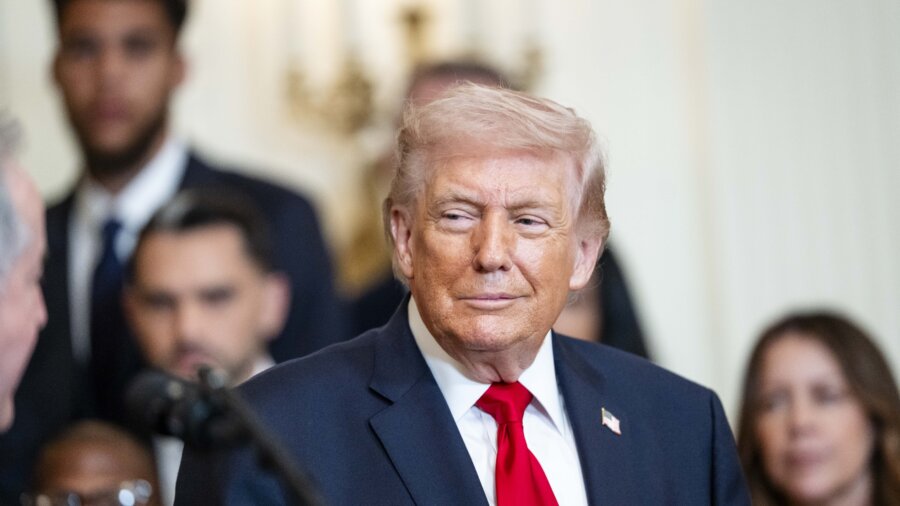
DORAL, Fla.—President Donald Trump on March 7 will host leaders from 12 Latin American countries in Florida for a summit to address drug cartels and illegal immigration and counter China’s influence in the region.
The event, called the Shield of the Americas Summit, will be hosted at Trump National Doral Club in Miami and is the first such regional meeting to bring together, as the State Department described, “like-minded allies” in the Western Hemisphere.
The heads of state of Argentina, Bolivia, Chile, Costa Rica, the Dominican Republic, Ecuador, El Salvador, Honduras, Panama, Paraguay, and Trinidad and Tobago will attend the summit, the White House said.
“The United States will welcome our strongest likeminded allies in our hemisphere to promote freedom, security, and prosperity in our region,” the State Department said in a statement. “This historic coalition of nations will work together to advance strategies that stop foreign interference in our hemisphere, criminal and narco-terrorist gangs and cartels, and illegal and mass immigration.”
All countries in attendance are governed by right-wing or center-right parties, while left-leaning governments such as Brazil, Colombia, and Mexico will not participate in the summit.
The summit in Miami will champion Trump’s new policy, called the “Donroe Doctrine.”
“After years of neglect, President Trump established the ‘Donroe Doctrine’ to restore American preeminence in the Western Hemisphere,’ White House spokesperson Anna Kelly told The Epoch Times.
“His efforts have been a tremendous success—our southern border is secure, Latin American countries are working with us to defeat the cartels, and illegitimate [Venezuelan] dictator Nicolás Maduro is facing justice for his crimes in the Southern District of New York—ushering in historic economic cooperation with Venezuela,” Kelly said.
The Trump administration compared its new policy to the Monroe Doctrine of 1823, a U.S. policy that told European powers to stay out of the Americas.
China’s Influence in Latin America
Over the last two decades, China has become a dominant force in Latin America and the Caribbean, with trade surpassing $500 billion in 2024. In countries such as Brazil and Peru, China has replaced the United States as a key trading partner.
In recent years, more than 20 Latin American and Caribbean countries have joined Beijing’s Belt and Road initiative. As a result, China has secured hundreds of infrastructure projects, gaining control of assets, including ports, throughout the region.
The Western Hemisphere “remains a key and top priority of this president,” White House press secretary Karoline Leavitt said during a press conference on March 4.
Secretary of State Marco Rubio, Secretary of War Pete Hegseth, Secretary of Commerce Howard Lutnick, and U.S. Trade Representative Jamieson Greer will accompany the president at the summit.
Friendly Countries
Unlike broader gatherings like the “Summit of the Americas,” this meeting includes only friendly countries, so there will be less tension and more goodwill toward working with the United States, according to Evan Ellis, Latin American studies research professor at the U.S. Army War College Strategic Studies Institute.
“This is going to be a group of countries that are aligned with Trump and applaud his leadership and congratulate him for his successes in the Middle East as well as on Venezuela, and commit to working together,” Ellis told The Epoch Times.
The leaders attending the summit are Javier Milei, president of Argentina; Rodrigo Paz Pereira, president of Bolivia; Jose Antonio Kast, president-elect of Chile; Rodrigo Chaves Robles, president of Costa Rica; Luis Rodolfo Abinader Corona, president of the Dominican Republic; Daniel Roy Gilchrist Noboa Azín, president of Ecuador; Nayib Bukele, president of El Salvador; Mohamed Irfaan Ali, president of Guyana; Nasry “Tito” Asfura, president of Honduras; José Raúl Mulino Quintero, president of Panama; Santiago Peña, president of Paraguay; and Kamla Persad-Bissessar, prime minister of Trinidad and Tobago.
The summit comes amid a tense geopolitical backdrop, with the conflict in Iran entering its second week.
On Feb. 28, Iran’s Islamic leader, Ali Khamenei, and dozens of top leadership figures were killed in the U.S.–Israeli joint military operation. Since then, Tehran has launched a series of retaliatory attacks across the region.
The Lebanese Hezbollah terrorist group, an Iran proxy, has networks in Latin America and, for years, used the region for money laundering, fundraising, and terrorism.
Eva Fu contributed to this report.