Published on
March 10, 2026

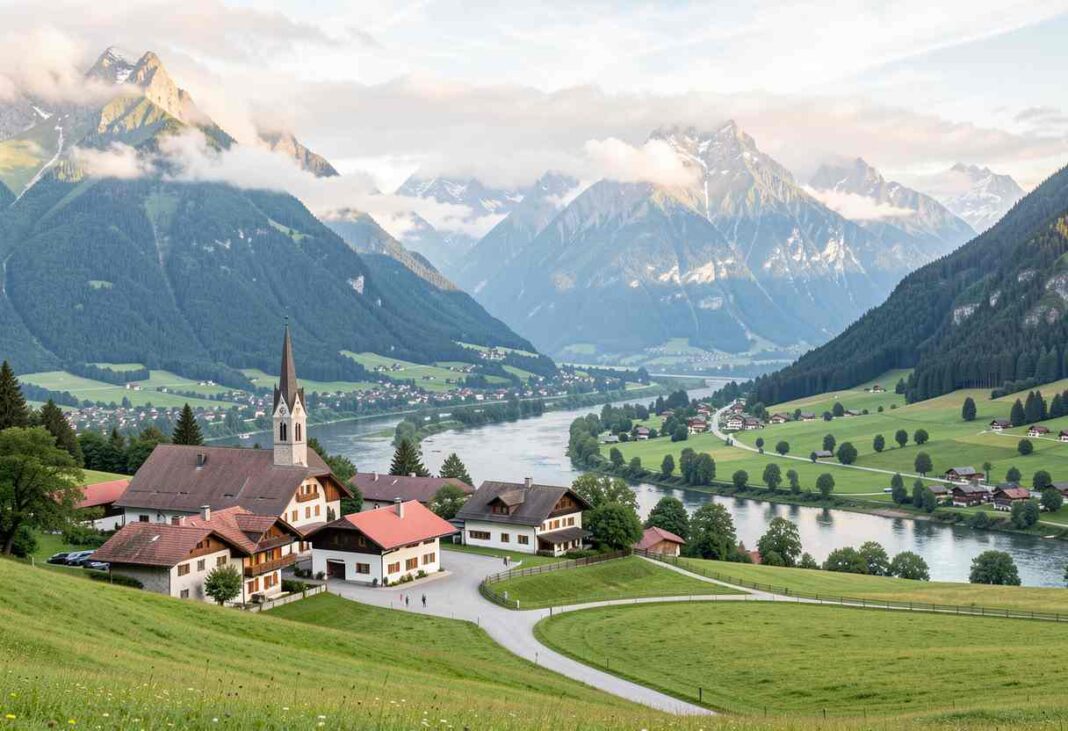
Image generated with Ai
Triesen is being positioned as one of the quieter but steadily more appealing corners of Liechtenstein’s tourism landscape. The municipality is being included in a small yet developing tourism economy that is largely driven by day visitors and overnight guests spread across a limited number of towns. Triesen is being favoured by its location close to Vaduz and along the Rhine Valley corridor, where much of the country’s hotel capacity continues to be concentrated. In the 2024 summer season, a total of 100,824 overnight stays was being recorded in Liechtenstein’s hotels, marking the strongest summer since records began in 1990 and reflecting robust demand in the Rhine Valley region that encompasses Triesen. Alpine hotels in Steg and Malbun were being credited with 32,870 overnights, while valley hotels registered 67,954 nights, indicating that many travelers are choosing valley municipalities like Triesen as convenient bases for exploring the surrounding mountains and towns.
By 2025, annual international tourist arrivals to Liechtenstein overall were being estimated in the region of 70,000 to 80,000 visitors, with a gentle upward trend expected to continue through 2026. Most guests are being drawn for short breaks or day trips, often as part of combined itineraries with Switzerland or Austria, and a significant share is likely to pass through or stay in Triesen as part of broader Rhine Valley journeys. Independent budget analyses are suggesting that visitors are spending on average around 110 to 160 USD per day, depending on travel style and whether accommodation costs are shared, with a relatively large proportion of that going on lodging and food due to high regional price levels. Within this framework, Triesen is being shaped as a small‑scale destination with a modest hotel sector, several guesthouses and apartments, and no cruise traffic – unsurprising in a landlocked country where cruise visitors are typically arriving via Swiss or German ports rather than directly. Tourism in Triesen is therefore being defined by intimate accommodation, cultural and nature‑based attractions, and spillover demand from nearby Vaduz and Malbun rather than by mass tourism or resort‑driven development.
Landscape, character and atmosphere
As the third‑largest municipality in Liechtenstein, Triesen is being found in the Rhine Valley just south of Vaduz, pressed between the river and steep hillsides that rise toward Alpine ridges. The setting is being experienced as a blend of valley-floor scenery and mountain views, producing a compact but varied landscape that appeals to visitors who appreciate both nature and village life. From the lowest areas by the Rhine up to higher elevations, a mix of riverbanks, traditional neighbourhoods and hillside viewpoints is being encountered within a small geographic area.
Historically, Triesen is understood to have developed through agriculture and early industry, and remnants of this past are still being recognised in the old weaving mill and preserved working‑class housing. In the present, the town is being perceived as a calm alternative to nearby Vaduz, with less bustle but very easy access by bus to the capital, to Schaan and to mountain destinations. The resident population remains in the low thousands, and German is being used as the official language, with Alemannic dialects in daily life and widespread understanding of English in tourism‑facing contexts. Triesen is being considered part of Liechtenstein’s lowland region and is serving as a practical base for travelers interested in both Rhine Valley cultural experiences and Alpine excursions to places such as Malbun and Steg. For those seeking a slower rhythm, the municipality is being appreciated as a place where heritage, nature and everyday local routines come together in a relaxed way.
Advertisement
Advertisement
Sights, chapels and quiet viewpoints
Triesen’s main points of interest are being anchored in its religious and historic architecture. The Pfarrkirche St. Gallus, first mentioned in the 15th century and rebuilt in the 1990s, is being recognised as a significant parish church and a visual landmark in the settlement. The St. Mamerta Chapel, which dates back to the 9th or early 10th century, is widely regarded as the oldest chapel in Liechtenstein, giving visitors a rare window into early medieval religious building traditions. Further depth is being added by the Marienkapelle, a Romanesque chapel from the 13th century that contributes to an unusually dense collection of historic worship spaces within one municipality.
Beyond its churches, Triesen is offering built heritage in the form of the Kosthaus, a working‑class residence constructed in 1873 that has been preserved as an example of older housing types. Cultural life is being concentrated at the Kulturzentrum Gasometer, where rotating art exhibitions, curated displays and events are being staged, providing a platform for local and regional artists. Additional interest is being drawn by the Lawena Museum, dedicated to the history of energy and electricity, and by Seilpark Im Forst, an aerial adventure park in nearby woodland, which appeals to families and active visitors. The slopes above the village are being dotted with small viewpoints accessible by walking paths, from which broad panoramas over the Rhine Valley and across to Switzerland can be enjoyed. Away from main roads, low‑key spots such as traditional farmsteads and lesser‑known chapels are being discovered by those who wander a little further from the centre.
Advertisement
Advertisement
Experiences: from chapels to forest adventure
In Triesen, cultural encounters and outdoor experiences are being easily combined in a single stay. The historic churches and chapels, including St. Gallus, St. Mamerta and Marienkapelle, are naturally inviting unhurried visits, moments of quiet reflection and opportunities for photography. Their long histories are being sensed in details of stonework, setting and simple interiors, giving visitors a tangible link to the area’s past. At the same time, the Kulturzentrum Gasometer is being used to present an evolving programme of exhibitions and events, ensuring that contemporary creativity is also represented.
For those who prefer movement and light adventure, the nearby Seilpark Im Forst is providing zipline and aerial courses among the trees, designed to suit families and travelers seeking a bit of excitement without the extremity of high‑alpine climbing. Hiking and walking routes beginning in or near Triesen are leading up through hillside forests and fields, linking with regional trail networks and making it possible to reach viewpoints and nature areas without long transfers or complex logistics. In daily practical terms, Triesen is being characterised by modest shopping and nightlife, with a small selection of local shops, cafés and restaurants rather than extensive retail zones or late‑night entertainment. More variety in shopping, dining and evening activities is being accessed in Vaduz, just a short bus ride away, where museums, wine tasting and riverside promenades are drawing visitors later in the day. Dining in Triesen itself is tending to centre on local restaurants, hotel dining rooms and traditional cuisine, a pattern that suits travelers who favour a quieter, more local ambience over large international chains.
Getting there and getting around
Despite having no airport or long‑distance railway station of its own, Triesen is being linked smoothly to wider transport networks. International travelers are usually arriving via Switzerland or Austria, with common approaches involving train journeys to Sargans, Buchs or Feldkirch, followed by buses into Liechtenstein. From Buchs, bus line 12 is running via Vaduz to Triesen, creating a straightforward connection for passengers stepping off Swiss rail services and continuing directly to the municipality.
Within Liechtenstein, an extensive LIEmobil bus network is being operated, connecting Triesen with Vaduz, Schaan and other communities, with services running frequently through the day and allowing car‑free movement up and down the valley. A direct bus route is being provided between Triesen (Sonnenkreisel) and Schaan Zentrum, using central stops and making it easy for visitors to reach key nodes for further travel. Once in Triesen, walking is being made very practical because of the compact size of the settlement and the proximity of main sights and services. Cycling is being encouraged along valley routes and marked paths, with bike rental available in nearby towns. For those with their own vehicle, local roads are giving rapid access to Malbun, Steg and border crossings into Austria and Switzerland, although it is being noted that parking in smaller streets can be limited at busy times, so the bus network remains an attractive option.
Budgeting for a stay in Triesen
From a financial point of view, travel to Triesen and Liechtenstein more generally is being recognised as relatively expensive when compared globally, with price levels more or less aligned with neighbouring Switzerland. Independent budget breakdowns compiled for Liechtenstein visits are suggesting daily costs of about 110 to 160 USD per person, with the exact figure depending on accommodation choice and whether rooms are being shared. This daily estimate is typically covering lodging, local transport, meals and incidental expenses.
Accommodation is being identified as the largest single cost category, as hotels and guesthouses in the region commonly charge mid‑range to upper‑mid‑range rates that reflect local living costs. Savings are being made possible through advance booking, by choosing smaller guesthouses or apartments in Triesen instead of higher‑profile properties in Vaduz, and by travelling outside the busiest Alpine seasons. Food spending is being reduced by balancing restaurant visits with supermarket purchases and simple self‑catering where kitchens are available, since groceries are often significantly cheaper than eating out multiple times a day. Public transport passes covering Liechtenstein and adjacent areas of Switzerland and Austria are being used to lower per‑trip costs for visitors who plan to move frequently between towns or cross borders several times. ATMs are being widely available throughout the Rhine Valley, cards are being broadly accepted in accommodation, restaurants and shops, and banking fees are being kept down by using low‑fee cards and avoiding unnecessary currency exchanges.
Entry rules and formalities
In terms of formalities, Triesen is being governed by the same entry rules as the rest of Liechtenstein due to the country’s participation in the Schengen Area through a close association with Switzerland. Travelers from most European states, along with citizens of several visa‑exempt countries such as the United States, Canada, the United Kingdom and Australia, are being allowed to enter the Schengen Area for tourism stays of up to 90 days within any 180‑day period without a visa. Those who do need a visa for Schengen travel are being required to obtain it in advance, usually via a Swiss diplomatic mission responsible for their home state, because Liechtenstein relies on Swiss consular services for visa issuance.
Once a valid Schengen visa or visa‑exempt status is in place, movement between Switzerland, Liechtenstein and other Schengen members is being permitted without systematic border checks. In practice, no routine passport controls are being carried out at the border between Switzerland and Liechtenstein, although random checks by customs or police can occur. Travelers are being advised to make sure that their passports remain valid for at least three months beyond the intended end of their stay in the Schengen Area and that they remain within the 90‑day limit where applicable. Any health or pandemic‑related restrictions that arise are typically being aligned with Swiss and EU guidance, so official Swiss or Liechtenstein information sources are being consulted before travel for the latest details.
Safety, connectivity and local etiquette
From a safety perspective, Triesen is being regarded as very secure. Crime rates in Liechtenstein are low, and the atmosphere in Triesen is being experienced as calm and small‑town in character. Normal travel precautions, such as safeguarding valuables and remaining aware of surroundings in busier spots or on public transport, are being considered sufficient for most visitors. Medical care is being accessible through facilities in the Rhine Valley and across the nearby Swiss border, and comprehensive travel insurance is being recommended to cover healthcare and potential trip disruptions.
Digital connectivity is being strong, with hotels, cafés and many public places providing Wi‑Fi and mobile networks covering the valley reliably. The official language in the municipality is German, with local Alemannic dialects widely spoken, but standard German and English are generally being understood by staff in tourism‑related services, making basic communication straightforward for most international guests. Social norms are being centred on politeness, punctuality and respect for privacy and property. In religious and historic sites such as St. Mamerta and St. Gallus, modest dress and quiet behaviour are being appreciated. Tipping is not being mandatory but is often being practised by rounding up bills or adding around 5 to 10 percent for good service. Strong emphasis is being placed on environmental responsibility, with recycling systems and nature protection rules in place; visitors are being encouraged to follow local guidance on waste separation and to treat walking paths and mountain landscapes with care.
Where to stay and how to choose
The accommodation landscape in Triesen is being shaped by small, varied properties rather than large complexes. A mix of hotels, guesthouses, apartments and bed‑and‑breakfasts is being offered, many of them family‑run, with a focus on personal attention, clean and comfortable rooms, and a quiet environment. Prices are generally aligning with broader Rhine Valley rates, which sit in a mid‑ to high‑range bracket by international standards. Some travelers are being drawn to Triesen specifically for its residential, less touristy feel, while still appreciating the rapid access to Vaduz and other attractions. Others are choosing to stay in Vaduz or in the mountain resort of Malbun and then to visit Triesen as part of day trips.
When accommodation is being selected in or around Triesen, proximity to bus stops is being considered important by those planning to rely on public transport, as it simplifies transfers between towns and up into the mountains. Because overall hotel capacity in Liechtenstein is limited, early booking is being regarded as prudent, especially in summer and during winter holiday periods. Self‑catering apartments and vacation rentals can be more economical for families and longer stays, particularly when guests intend to prepare some meals themselves. Checking whether breakfast is included is being recommended to help stabilise daily costs in a destination where food prices are relatively high.
Food, flavours and simple pleasures
The culinary scene in Triesen is being modest in scale but rooted in broader Liechtenstein and Alpine traditions. Visitors are generally being presented with hearty dishes that feature cheese, potatoes, noodles and meat, alongside salads, soups and more contemporary lighter options. Käsknöpfle, made with small pasta or dumplings combined with melted cheese and onions, is being recognised as a key regional speciality associated with Liechtenstein and neighbouring areas. Rösti, schnitzel, sausages and seasonal specials are also commonly being offered, while cafés highlight pastries and cakes.
Local bakeries and valley markets are being appreciated as sources of fresh bread, cheeses and cured meats, which can be assembled into inexpensive picnics, convenient for hikes or viewpoints around Triesen. Regional wines and beers from nearby Swiss, Austrian and German regions are being widely available, and Rhine Valley wines are sometimes being found on menus or in shops in Vaduz and adjacent municipalities. Triesen does not appear to claim globally famous dishes of its own, but it is being used as a gateway to Liechtenstein’s wider food culture in a peaceful setting. Travelers with dietary requirements are generally being accommodated at a basic level, particularly vegetarians, although options for strict vegan or specialised diets may remain more limited than in larger urban centres.
Suggested itineraries and smart planning
A focused one‑day visit to Triesen is being structured naturally around a blend of heritage and light outdoor activity. A morning could be devoted to exploring Pfarrkirche St. Gallus and wandering through older streets in the village core, followed by a short hike to a nearby viewpoint offering panoramas over the Rhine Valley. Around midday, an unhurried visit to St. Mamerta Chapel and Marienkapelle can be combined with time for photographs and quiet contemplation at these historic sites. The afternoon might then be spent at the Kulturzentrum Gasometer, viewing the current exhibition, before continuing to the Lawena Museum or Seilpark Im Forst for a family‑friendly end to the day.
For a stay of two or three days, Triesen is being easily woven into a broader Rhine Valley and Alpine circuit. One full day can be devoted to Triesen and Vaduz, focusing on churches, historic buildings and museums. A second day can be given to Malbun or Steg for hiking in summer or winter sports in the colder months. A third day might be used for cross‑border excursions to Swiss towns such as Buchs or Sargans, making use of convenient bus and train links. Practical tips include taking advantage of the local bus network for efficient town‑to‑town movement, carrying a reusable bottle to enjoy high‑quality tap water, and timing visits to churches to avoid services where possible. Because accommodation options are limited and weather in the mountains can change quickly, advance booking and flexible day‑by‑day planning are being recommended to make the most of any visit to Triesen.