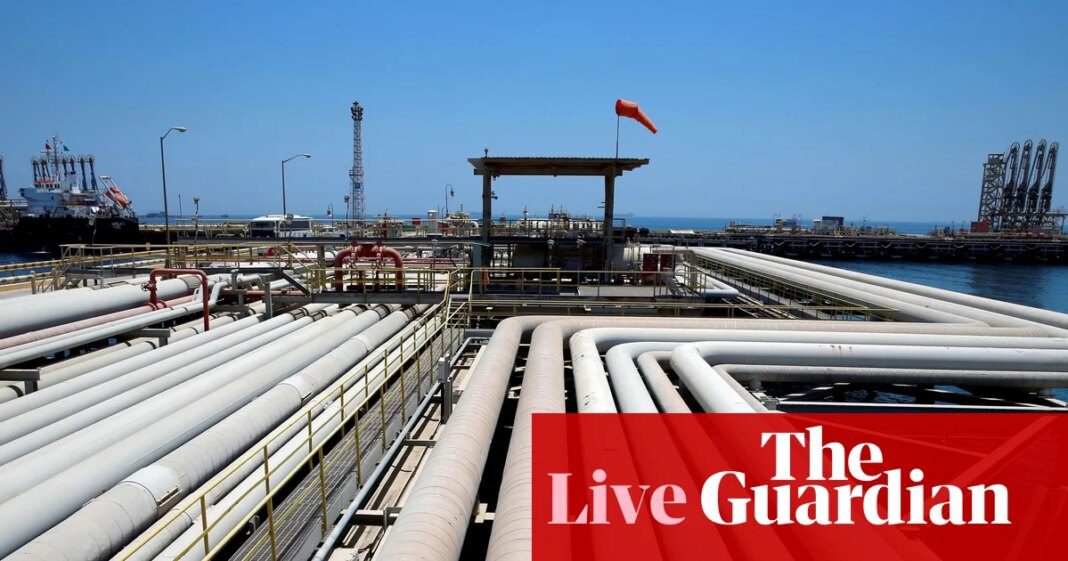
Saudi Aramco will be able to export 70% of normal crude shipments ‘within days’

Saudi Arabia’s state-owned oil company has said it will be able to export about 70% of its normal crude shipments within days.
Amin Nasser, the chief executive of Saudi Aramco, said in an earnings call that the company was working to boost exports at its port in the Red Sea, which will allow about 5m barrels a day to reach the global market without going through the strait of Hormuz.
He said:
Immediately as the ports were starting to close, we ramped up production through the East-West Pipeline, which has a capacity up to 7 million barrels a day, most of it for export.
Approximately 2 million barrels of that will be utilised supplying existing refineries in the western regions, which also export some of the products to the global market. We are ramping up. We should be reaching capacity in a couple of days.
…As I said, within a couple of days, we should be reaching the capacity on the East-West Pipeline, pending an availability of vessels which are currently en route.
However Nasser warned that the Middle East conflict would have “catastrophic consequences” for the oil market if it continued.
Oil prices are still down this morning, with the international benchmark Brent crude down 7.7% to $91.48 a barrel.
Key events
Lego sales rise but Iran war could hit costs, boss says

Sarah Butler
Lego said supplies of its toys would not be affected by conflict in the Middle East but a prolonged increase in the oil price could hit costs as it revealed a 16% rise in sales last year.
The company said sales had risen strongly to kids, teenagers and adults as it expanded its ranges into new kinds of toys such as its Botanicals, plant-influenced kits, as well as tie-ups with well known brands including Formula One and Starwars.
Jesper Andersen, the finance director of Lego Group, said its supply chain set up, with seven factories around the world, meant the toymaker was protected during periods of disruption as “we do not have to ship products or materials across long distances.”
He said:
We have strategies and contracts in place so we are able to mitigate short term impact [but if there was a] “prolonged increase in the oil price costs of course will be affected”.
Lego said sales to shoppers had grown more than twice as fast as the toy market, which increased by 7% last year, and it expected to continue to outperform the global market which will grow by less than 10% this year.
The company’s revenues rose 12% to 83.5bn Danish Kroner (£6.5bn) and operating profits rose 18% to 22bn Kroner (£1.7bn) last year. More than half the material in its plastic bricks is now made from recycled or renewable material, up from a third in 2024.
Saudi Aramco will be able to export 70% of normal crude shipments ‘within days’
Saudi Arabia’s state-owned oil company has said it will be able to export about 70% of its normal crude shipments within days.
Amin Nasser, the chief executive of Saudi Aramco, said in an earnings call that the company was working to boost exports at its port in the Red Sea, which will allow about 5m barrels a day to reach the global market without going through the strait of Hormuz.
He said:
Immediately as the ports were starting to close, we ramped up production through the East-West Pipeline, which has a capacity up to 7 million barrels a day, most of it for export.
Approximately 2 million barrels of that will be utilised supplying existing refineries in the western regions, which also export some of the products to the global market. We are ramping up. We should be reaching capacity in a couple of days.
…As I said, within a couple of days, we should be reaching the capacity on the East-West Pipeline, pending an availability of vessels which are currently en route.
However Nasser warned that the Middle East conflict would have “catastrophic consequences” for the oil market if it continued.
Oil prices are still down this morning, with the international benchmark Brent crude down 7.7% to $91.48 a barrel.
Renault will end sale of fuel-only cars in 2030

Lisa O’Carroll
Renault has announced it will end the sale of fuel-only cars in 2030 and develop a new electric car platform with Google.
The French company said it was forging ahead with the end of the internal combustion engine.
“By 2030, the brand is aiming for … 100 % electric sales in Europe and 50% outside Europe,” the company said, adding that the transition would also include its budget brand Dacia.
The EV sales will include hybrid cars, which are allowed under concessions made by the EU earlier this year to help car companies reach net zero targets and develop small cars in their EV ranges.
The company said it plans to develop its new electric car platform together with Google based on android technology.
Renault said the aim is to have 90% of the vehicle functions able to be updated remotely, cutting time to deploy updates, and able to handle ultra-fast charging in as little as 10 minutes.
Volkswagen to cut 50,000 jobs by 2030 in Germany
Volkswagen has said it will cut 50,000 jobs in Germany by 2030, as the German car manufacturer struggled year against US trade tariffs, tough competition in China and an expensive strategic shift at Porsche.
The carmaker, which owns brands such as Porsche, Audi and Seat, reported that its profit before tax slumped by 44% in 2025 to €9.3bn, with revenue flat largely flat at €322bn.
Oliver Blume wrote in a letter to shareholders:
In total, around 50,000 jobs are due to be cut by 2030 across the Volkswagen Group in Germany. As a result of collective bargaining agreements and downsizing measures, we managed to achieve cost savings of around €1 billion in fiscal year 2025 as planned. We are on course to meet our goal of achieving net annual cost savings of more than €6 billion across the Group by 2030.
Oil market faces ‘catastrophic consequences’ of Iran war, says Aramco
Oil prices have dropped sharply this morning (Brent crude is now down 8.7% to $90.37 a barrel), but the continued disruption in the strait of Hormuz could create “catastrophic consequences” for the industry, Saudi Arabia’s state-owned oil company has warned.
Amin Nasser, the chief executive of Aramco, said the disruption is likely to hit aviation, agriculture, cars and other industries.
He said:
There would be catastrophic consequences for the world’s oil markets, and the longer the disruption goes on, and the more drastic the consequences for the global economy.”
The boss of the world’s top oil exporter added that its Ras Tanura refinery was in the process of being restarted after a small fire from an attack last week.
His comments came as Aramco reported a 12% drop in annual profit due to lower oil prices last year. It also announced it would buy up to $3bn in shares in its first ever buyback.
Markets are pricing in a chance that the Bank of England could cut interest rates this year, but a cut next week looks unlikely, says Kathleen Brooks, of the broker XTB.
There is currently 0.4 rate cuts priced in for this year, and UK rates are expected to end the year at 3.65%, down from the current level of 3.75%. There is a 7.2% chance of a rate cut priced in for the BOE’s meeting next week.
While we doubt that a rate cut is on the cards, the Bank of England will need to use next week’s meeting to signal their future intentions. Will they look through the crisis in the Middle East as a temporary spike in commodity prices and focus on the weakening economy? Or will the situation have died down enough for them to signal that further rate cuts are coming, albeit with a small delay? Either way, next week’s meeting is still important for sterling and UK bond markets.
Market data suggests that investors think the BoE will keep its base rate on hold at 3.75% on 19 March. Before the Iran war began, a rate cut at the meeting had been priced at an 80% chance.
Gilts are also rallying this morning, after Donald Trump’s suggestion that the war with Iran could end “very soon” eases investor worries about inflation.
The yield on two-year gilts, which falls when gilt prices rise, dropped 0.12 percentage points to 3.84%. Yields on 10 year gilts fell 0.09 percentage points to 4.54%.
Gilt prices had been falling since the war broke out, as investors grew worried that higher inflation could stop central banks from cutting interest rates.

Phillip Inman
Mohamed El-Erian, an adviser to the German insurer Allianz and a former chief economist of the International Monetary Fund, says the likelihood of permanent harm being done to oil markets and higher inflation this year and next is being underestimated.
His baseline forecast is that a 50% probability of rising inflation feeding into higher interest rates is nearer the mark.
He says the UK is in the front line because over the last decade it has failed to deal with three linked issues – low productivity, a heavily constrained budget and deep seated inequality.
Whereas the US has high productivity and the EU has lower levels of inequality, the UK has all three problems, putting it in an especially weak position going into the crisis.
Labour needs to spend cash to help its poorest households, but constraints on the public finances limit the government’s room for manoeuvre. Low productivity means that we can rule out strong economic growth coming to the rescue.
The Bank of England also has a single remit – to keep inflation anchored at 2% – forcing it to react. The European Central Bank, which also has a single remit, may follow suit, even though high oil and gas prices will depress their economies and would usually provoke a cut in the cost of borrowing.
The Federal Reserve, which has a dual mandate, may delay interest rate rises if the economic outlook worsens.
He said it was possible some of the restrictions on oil supplies would ease if Saudi Arabia can pump enough oil through a pipeline to the Red Sea, avoiding the Straits of Hormuz.
The United Arab Emirates may also find another route for its oil, but El-Erian, who until last year was also president of Queen’s College, Cambridge, and remains the a professor at The Wharton School in Pennsylvania, said adopting different ways to transport oil out of the region would only restrict the rise in price, not bring it back down to the $60 level seen before the crisis.
He said:
There are also all the other things that make their way through the Straits of Hormuz, like fertilisers and liquid petroleum gas (LNG). That’s why I think of it as a supply chain shock.
…The [White House] didn’t seem to have a plan to deal with Iran effectively shutting the Straits of Hormuz, and that is a big problem. There were people who considered that as a possibility, but not the people who started it.
And it is not clear how this ends because even when the US president declares victory, we don’t know whether Israel or Iran will agree.”
UK ‘stuck in a low-growth pattern’, says business group
More gloomy signs for the UK economy – the British Chambers of Commerce (BCC) has downgraded its expectations for growth this year from 1.2% to 1%, in a warning that the UK is “stuck in a low-growth pattern”.
The business group thinks global uncertainty will push UK inflation to as high as 2.7%, before falling back to 1.9% in 2027.
Meanwhile unemployment is expected to increase 5.5% in 2026, up from 5.1% in its previous forecast. That rate is expected to be even higher among young people, at 17% in 2026, peaking at 17.!% in 2027 before falling to 16.7% in 2028.
David Bharier, head of research at the BCC, said:
The UK economy remains stuck in a low-growth pattern. Our forecast of just 1% growth in 2026 reflects weak productivity, subdued investment and cautious consumer spending.
The recent escalation of conflict in Iran risks interrupting progress made on inflation. Higher energy prices linked to it could keep inflation firmly above the 2% target and lead the Bank of England to hold the interest rate longer than expected.
Much depends on the duration of the conflict. Covid supply shutdowns showed how sudden stops put long term damage into the trading system.
At the same time, elevated labour costs, stemming from national insurance increases and new employment regulations could weigh on hiring decisions. That has the potential to push the unemployment rate higher, making it especially difficult for younger people to enter the jobs market.
Looking further ahead, our research shows that firms are increasingly adopting AI tools. While the immediate impact on employment is likely to remain limited, deeper integration could reshape the labour market more fundamentally. At the same time, it could offer an important opportunity to lift the UK’s persistently weak productivity growth over the longer term.”
UK consumer confidence shaken by Iran war
UK consumer confidence has dropped since the outbreak of war in Iran, Barclays has found, as a new bout of uncertainty “risks snuffing out” positive signs of growth for the year.
Its index, which tracks how confident people feel in the UK economy, dropped by two percentage points to 23%, erasing gains it made at the start of the year.
The bank, which interviewed around 2,000 people between 3rd March to 6th March in the days after the first US-Israeli attacks on Iran, found that around eight in 10 Brits are worried that war in the Middle East will push up inflation.
Most people were particularly worried about fuel costs, energy bills and food prices, with about 6 in 10 people worried about a blow to their personal finances. Nearly half of the people surveyed said they were already taking action to cut back their energy consumption.
Barclays also found that consumer spending was sluggish before the start of the war in Iran, with card spending up juts 1% in February, a smaller rise than inflation. Spending on essentials slipped 0.6%, with most people saying that they were looking for discounts and switching brands to cut costs.
Jack Meaning, chief UK economist at Barclays, said the figures showed the economic risks for the UK if the conflict in Iran did not de-escalate. He said:
The start of 2026 had brought positive signs of growth and improving consumer sentiment. A new, prolonged bout of uncertainty risks snuffing that out before it has had a chance to really get going.”
It chimes with a separate report from the British Retail Consortium, which found retail sales grew just 1.1% to February, compared with a 12-month average of 2.3%.
The UK housebuilder Persimmon is the best performer in Europe today, with its shares rising by almost 10% after it reported a rise in annual sales and profit.
Pre-tax profit for the year was up 11% to £397.3m, with revenue up 17% to £3.75bn. Overall new home completions were up 12%.
However Richard Hunter, head of markets at the broker Interactive Investor, notes the Iran war could weigh on the property sector. While oil prices are falling this morning, they are still elevated, feeding concerns around inflation and lowering the likelihood of interest rate cuts.
Whereas one or even two interest rate cuts had been priced in for this year, the current estimate is that there could actually be one rise, which would impact mortgage affordability.
That being said, there are a number of tailwinds which could yet revitalise the sector. More broadly, there remains a noticeable supply shortage of homes domestically and government reforms to planning should oil the wheels of being able to break ground. At the same time, the group noted that for some, inflation-beating pay rises and the relaxation of lending rules led to higher enquiry rates and has underpinned growth alongside wider mortgage availability.
Still, Dean Finch, chief executive at Persimmon, said in a statement that the impact of the Iran conflict on consumer sentiment “remains to be seen”. He said:
Assuming the conflict with Iran and its impact is short, Persimmon is set to grow again in 2026.
FTSE opens higher, joining global market rally
The UK’s blue-chip FTSE 100 share index has opened 1.4% higher this morning, as the relief rally across global stock markets continues.
European markets are following Asia higher, with the Italian FTSE MIB up 2.4%, the German Dax up 2.1% and the French Cac 40 up 1.9%. The Stoxx Europe 600, which tracks the biggest companies across the continent, is up 1.5%.
European gas prices falling
European natural gas prices are falling this morning too, with the Dutch month-ahead gas contract (the European benchmark) down 16% to €46.59 per megawatt hour (MWh), down from as high as €56 on Monday.
But Susannah Streeter, chief investment strategist at the broker Wealth Club, warns that given that the fighting continues and the strait remains impassible, investors may still be worried.
Oil prices remain more than 25% higher than before the conflict began. Trump has pledged that the US Navy will provide a guard for tankers through the strait, but any timeline for that is highly obscured, with forces for now focused on taking out military infrastructure rather than becoming ship escorts.
Until a longer‑term resolution is found, companies and consumers are still set to pay the price for the attack by the US and Israel on Iran. The repercussions for an array of everyday costs affecting companies and households are becoming clear.
Prices at the pumps have already increased, and motorists are being warned to drive more conservatively to offset an expected further rise in costs. More generous fixed‑rate energy tariffs have been scrapped, and households are bracing for a rise in the energy price cap in July. Borrowing costs are set to stay elevated for longer due to the inflation pressures higher energy costs will bring, and better mortgage deals have been withdrawn.”
Oil prices are already down by more than 6% this morning, with brent crude at $92.19 a barrel. It peaked at just over $119 on Monday.
Jim Reid at Deutsche Bank says investors will be watching for signs that shipping through the strait of Hormuz can recover from its suspended levels, especially after Saudia Arabia became the latest country to cut oil production yesterday.
Remember that the oil moves have been much more contained further out the futures curve, with December 2026 Brent futures currently trading at $74.95/bbl.
We will also be watching whether plans to release oil reserves materialise. Yesterday’s virtual G7 finance ministers’ meeting didn’t get to that point yet, with their statement saying they “stand ready to take necessary measures”, and France’s finance minister said they were “not there yet”. Overnight, Japan’s Finance Minister Katayama said that G7 energy ministers are expected to meet to discuss the process of oil reserve release today.
Introduction: Markets rising after Trump says Iran war will end ‘very soon’
Good morning, and welcome to our rolling coverage of business, the financial markets and the world economy.
Oil prices are falling and stocks are rebounding after US president Donald Trump said the war with Iran would end “very soon’.
Speaking from his Doral resort in Miami, the president described the war in Iran as a “little excursion” that had succeeded “much faster than we thought”.
He said his administration was “looking to keep the oil prices down”, as “they went artificially up because of this excursion”.
The remarks triggered a relief rally across markets, although Trump indicated that the war would not be ended within the next week.
Oil prices are dropping sharply, with the international benchmark Brent crude now down 6.8% to $92.19 a barrel, after surging past $100 a barrel on Monday morning.
Stock markets rose in Asia, which has been one of the most exposed regions to higher energy prices. Japan’s Nikkei 225 share index has risen by 2.5%, while the South Korean Kospi jumped 6%. Hong Kong’s Hang Seng index is also up by 2%.
While Trump has said the war may be ending soon, he has also vowed to hit Iran “TWENTY TIMES HARDER than they have been hit thus far” if it “does anything” to stop the flow of oil through the strait of Hormuz.
About a fifth of global oil and seaborne gas tankers typically pass through the strait, which has already in effect been closed for a week, heightening concerns over energy supplies which have propelled prices higher.
Tehran declared that it would not allow “one litre of oil” to be exported from the region if US and Israeli attacks continue, Iranian state media reported on Tuesday, citing a spokesperson for the regime’s Revolutionary Guards (IRGC).