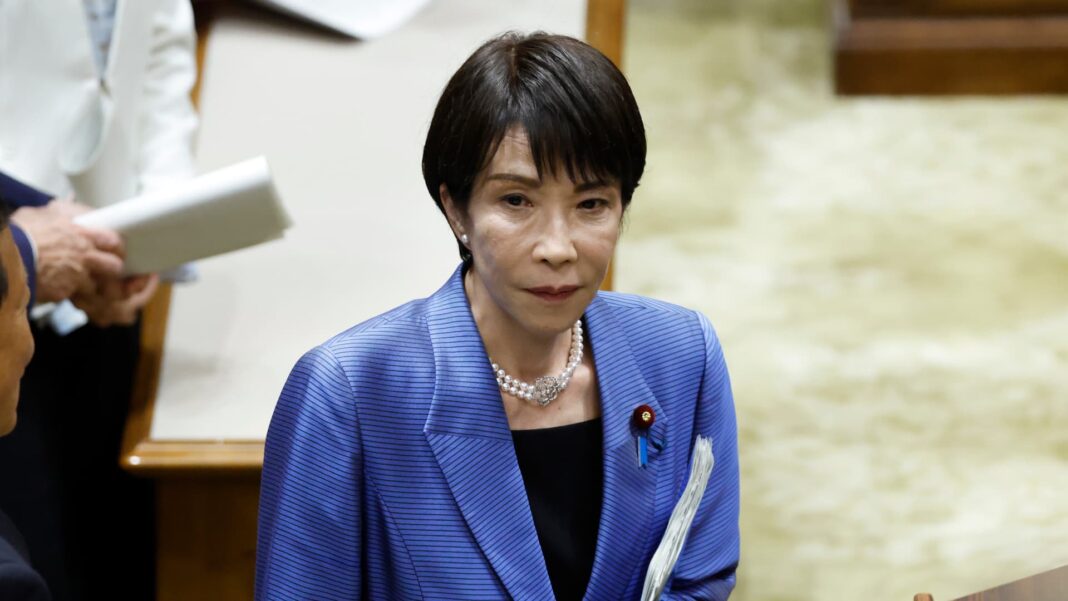
Sanae Takaichi, Japan’s prime minister, during a party leaders’ debate at the upper house of parliament in Tokyo, Japan, on Wednesday, Nov. 26, 2025. Takaichi said she hadn’t intended to get into any details of a Taiwan contingency in recent remarks that have been fiercely criticized by China.
Bloomberg | Bloomberg | Getty Images
Japan on Thursday rejected a U.S. intelligence assessment that said Prime Minister Sanae Takaichi’s remarks on Taiwan represented a “significant shift” for a sitting Japanese prime minister.
Chief Cabinet Secretary Minoru Kihara told reporters during a press briefing that Tokyo’s approach remains “quite consistent.”
“A significant policy shift is not something that is happening right now,” Kihara said, according to a translation provided by the Prime Minister’s Office.
The response came as Takaichi arrived in the U.S. for a summit with U.S. President Donald Trump, with the Iranian conflict expected to dominate the meeting.
Takaichi had sparked a furious response from Beijing in November when she told parliament that a Chinese attempt to seize Taiwan by force could prompt the intervention of Japan’s Self-Defense Forces.
China responded by suspending imports of seafood and issuing travel advisories for its nationals not to travel to Japan, resulting in a sharp decline in Chinese tourist numbers to the country.
The intelligence report, issued on March 18, said that Takaichi’s characterization of a potential Chinese invasion of Taiwan — as a “survival threatening situation” for Japan — carried weight.
The term could open the door for Japan to intervene under its 2015 reinterpretation of its Constitution, which allows Japan’s military to engage in “collective-self defence” to protect allied forces under certain scenarios.
The U.S. report also said that “China is employing multidomain coercive pressure that probably will intensify through 2026, aimed both at punishing Japan and deterring other countries from making similar statements about their potential involvement in a Taiwan crisis.”
However, the intelligence community also assessed that Chinese leaders do not currently plan to execute an invasion of Taiwan in 2027.
Beijing regards democratically governed Taiwan as part of its territory, and has not ruled out the use of force against the island. Taiwan, on its part, rejects those claims and says that only it can decide its future.
Power politics
Earlier Wednesday, China’s Taiwan Affairs Office said that peaceful reunification with Taiwan would benefit the island, including improving the security of Taiwan’s energy resources, “backed by a strong motherland.”
This comes as Taiwan President Lai Ching-te sought to ease concerns over its energy stockpile, saying that supplies for Taiwan are “100% in place” for the next two months. He added that Taiwan intends to increase its gas imports from the U.S. to meet domestic energy demand.
According to Taiwan’s Energy Administration, 95.8% of its energy was imported in 2024. Saudi Arabia and the United States each accounted for about 30% of crude imports.
Taiwan sourced 38% of its liquefied natural gas (LNG) imports from Australia, with about a quarter coming from Qatar.
Imported coal made up 29.1% of Taiwan’s energy supply, with nearly half from Australia and just 0.03% from China. Taiwan did not import any crude oil or LNG from China that year.