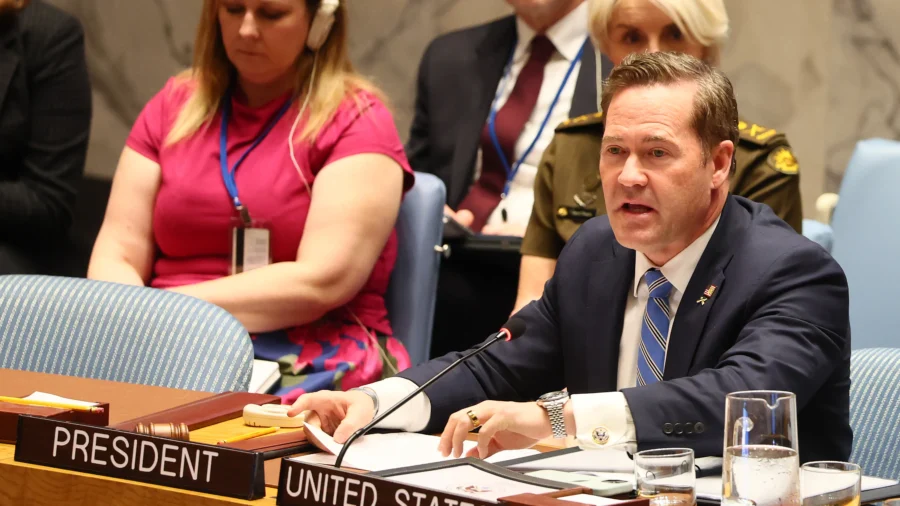
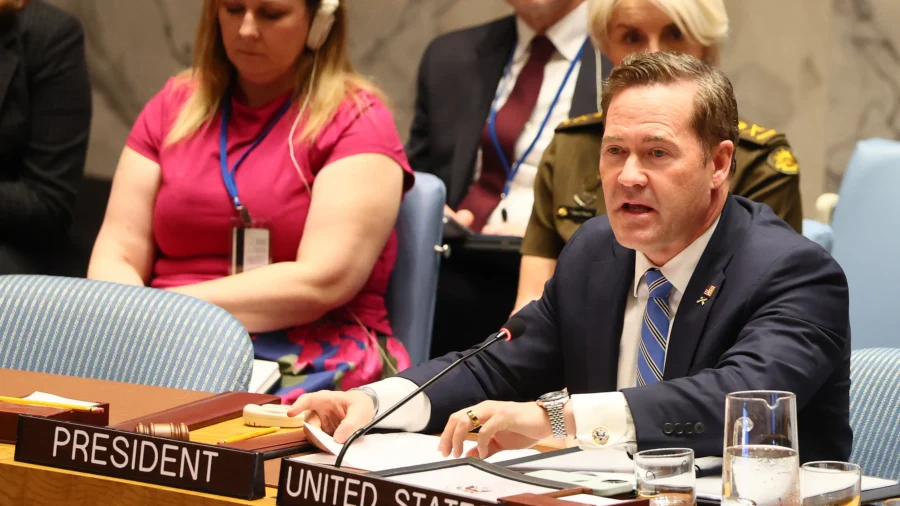
The United States is pushing back against China’s influence at the United Nations, citing competition over staffing and leadership roles and support for Taiwan’s participation in international organizations, according to U.S. Ambassador to the United Nations Mike Waltz.
Speaking at a congressional field hearing on March 20, Waltz, who took up the U.N. post last year, said the People’s Republic of China (PRC) was leveraging its contributions to expand its influence within the U.N. system.
“We have seen the Chinese very aggressively leverage their funding with demands in terms of positions. … Where we’re most engaged are some of these other organizations that affect [U.S.] industry,” Waltz said, pointing to U.N. specialized agencies of the International Maritime Organization, the International Telecommunications Union, the Food and Agriculture Organization (FAO), and the World Intellectual Property Organization.
“We are much more, I think, strategically and assertively, inserting qualified Americans into key leadership positions. Where I think we could do more is at the junior level, even at the intern level, where we’ve seen the PRC push their nationals, increasingly at scale, and we could do more on our side.”
Waltz made the remarks in response to questions from Rep. John Moolenaar (R-Mich.), chairman of the House Select Committee on the Chinese Communist Party (CCP).
“It is exploiting the U.N., installing its own personnel in key posts, bankrolling initiatives to counter the United States, and deploying U.N. troops to secure its business interests,” Moolenaar said in a statement accompanying the release of the report.
Waltz also said it was important for Washington to show support for Taiwan, a self-governing island that is facing growing pressure from China.
“The continual support of Taiwan’s meaningful participation in international organizations is a key part of our charge here,” Waltz said.
“The world benefits from Taiwan’s expertise and resources, addressing some of the most critical challenges, particularly with the technology that they bring.
“The U.S. will not advocate for partners that don’t also share this view in terms of their freedoms.
Waltz said the United States opposes, for example, “China’s intentional misuse and mischaracterization” of U.S. General Assembly Resolution 2758, as “part of China’s broader efforts to isolate Taiwan from the international community.”
“We pushed back on that, I think, very forcefully and, hopefully, effectively,” he said.
The CCP views Taiwan as part of its territory and rejects the island’s right to independent international representation, pressuring other governments to avoid formal diplomatic ties and blocking Taipei’s participation in global organizations.
On March 21, Taiwanese foreign minister Lin Chia-lung issued a statement thanking Waltz.
“The international community must not allow any country to use politics to distort reality and exclude a democratic partner that is capable of contributing to the world,” Lin said.
Lin said that U.N. Resolution 2758 does not authorize any country to exclude Taiwan’s participation in the U.N. system or other international organizations.
The Taiwanese foreign ministry urged the international community to continue taking concrete steps to counter China’s distortion of the resolution.
“As a force for good, Taiwan will continue advancing its international participation and actively contributing to the global community, working together to safeguard peace, stability, and prosperity in the Taiwan Strait and the broader Indo-Pacific region,” the ministry stated.