Introduction: Markets hit by Iran crisis and tech sell-off
Good morning, and welcome to our rolling coverage of business, the financial markets and the world economy.
Stock markets across Asia-Pacific countries are in retreat today, as investors fear a rise in US interest rates, renewed conflict in the Middle East, and an end to the AI boom.
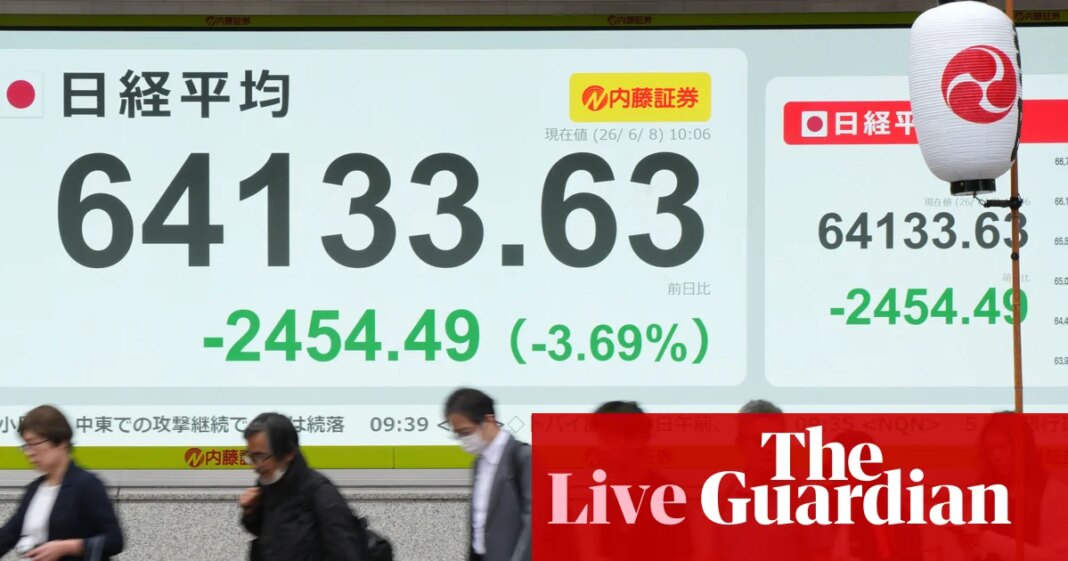
Major bourses are all in the red; South Korea’s KOSPI index fell by amost 9% at one point, forcing trading to be briefly suspended, while Japan’s Nikkei 225 index is 3.8% lower.
The sell-off followed a painful Friday on Wall Street, where the S&P 500 fell by 2.64%.
Friday’s drop was triggered by a surprisingly strong US employment report, which left many traders concluding that the next move in US interest rates will be up, not down.
Technology stocks have also been pummelled in recent days, on fears that the AI race is turning into a battle over who can raise, and spend, the most money, as ChatGPT and Anthropic prepare to float on the stock market.
Add in renewed conflict in the Middle East today, and it’s a recipe for more losses across global markets…
Kyle Rodda, senior financial market analyst at Capital.com, explains:
Things could get a bit hairier today in the markets after a flare-up in geopolitical tensions over the weekend.
Iran launched strikes on Israel for its attacks on Hezbollah targets in Beirut, leaving a nervous wait for the Israeli response. There is the heightened risk the war escalates again as peace talks between the US and a clearly emboldened Iran stall.
The agenda
Key events
Nvidia’s Huang draws crowd at chiicken restaurant
The sell-off in AI stocks last night didn’t dampen the mood at Kkanbu Chicken restaurant in Seoul lst night, where Nvidia CEO Jensen Huang met with senior executives from SK Group.
Huang and SK chairman Chey Tae-Won drank beer, scoffed fried chicken, and even handed out food to a large crowd who gathered at the scene.
The pair were in a convivial mood, as they celebrated a tie-up between the two companies to advance the development, design and manufacturing of next-generation memory for AI factories.
European tech firms’ shares side
Shares in European companies at the heart of the AI boom are falling sharply at the start of trading.
Chip firms such as Besi – BE Semiconductor Industries – (-4.5%) and ASML (-3.2%) which makes chipmaking machines are among the big fallers on the pan-European Stoxx 600 index, which is down almost 0.9%.
German tech firm Aixtron has dropped almost 6%, while Finland’s telecoms firm Nokia has dropped 5%.
This follows the heavy losses among tech firms in South Korea overnight (see earlier post).
Government bond prices are falling in early trading, pushing up borrowing costs for the US, the UK and eurozone countries.
The yield, or interest rate, on UK 10-year bonds has risen by 3.5 basis points (0.035 of a percentage point) to 4.93%. Shorter-dated bond yields (which rise when bond prices fall) are also up.
FTSE 100 joins sell-off
London’s stock market has dropped at the start of trading, as the missile attacks between Israel and Iran worries the City.
The FTSE 100 index of blue-chip shares has fallen by 42 points, or 0.4%, to 10,326 points at the start of trading.
Jet-engine maker Rolls-Royce is the top faller, down 4.3%, after the company was criticised by the head of United Airlines over a delayed order for Airbus planes.
British Airways parent company, IAG, are down 2.6%.
Oil producers are rallying, though, with BP and Shell both up 1.5%.
UK companies opting to hire temporary workers over permanent staff
Britain’s jobs market cooled rapidly in May after employers cut back on hiring permanent staff, a survey this morning shows.
The monthly Report on Jobs from accountants KPMG and the Recruitment and Employment Confederation, a trade body, showed permanent job placements fell at the fastest pace since July 2025.
German factory orders fell more than expected in April, in a sign that Europe’s largest economy could be faltering as the Iran war drives up costs and weakens demand.
Manufacturing orders fell by 3.8% during April, statistics body Destatis reported this morning.
Orders in the automotive industry fell by 5.3%, while electrical equipment orders slumped by 16.3%.
BoE’s Taylor doesn’t see need for higher interest rates
One of the Bank of England’s more dovish policymakers has suggested there’s no need to raise UK interest rates to tackle the inflationary impact of the Iran war
Alan Taylor told Sky News – on a trip to the West Midlands – that interest rates are restrictive for the economy at their current level (3.75%), explaining:
I think interest rates don’t need to go higher as they’re quite restrictive at the moment.
I feel comfortable where we are unless we get the worst-case scenario. But I really want to get that sense that this is moving behind us.”
Under the BoE’s worst-case scenario, energy prices surge sharply and remain high, leading to a jump in prices and wage.
Taylor visited the construction site for HS2’s Birmingham Curzon Street station, where he learned that supply chain pressures are filtering into the project, affecting steel, copper, concrete and other raw materials.
He told Sky:
It’s a very volatile world right now.
The markets are being hit by a collision of technology, macroeconomic and geopolitical factors, says Kathleen Brooks, research director at XTB:
As we start a new week, the market is digesting a large upside surprise in US payrolls, tech stock jitters, a huge week for macroeconomic data and an increasingly fragile ceasefire in the US, after Iran and Israel both attacked each other, which could end the truce which has been in place since April. Oil prices have jumped 4% and Brent crude is back above $97 per barrel.
Circuit breakers triggered as South Korea’s market tumbles
Major chipmakers led the slump on South Korea’s stock market today.
Samsung Electronics are down 9.2%, and SK Hynix has dropped by 6.4%, helping to pull the KOSPI index down by over 8%. That slump tripping circuit breakers on the Seoul stock market.
Reuters has the details:
Circuit breakers were activated at 0003 GMT, halting trading for 20 minutes for the first time in three months. It was the third time they were triggered this year, and the ninth in history.
The KOSPI had surged through most of 2026, as the AI boom pushed up the value of South Korea’s chipmakers.
Oil jumps 4.8% after Middle East attacks
The oil price is climbing back towards the $100 a barrel milestone, after new missile strikes in the Middle East today.
Brent crude, the international benchmark, has jumped by 4.8% to $97.60 a barrel, after Iran launched missiles at Israel on Sunday in response to Israeli strikes on Beirut’s southern suburbs.
With the fragile ceasefire in the Middle East shattering, hopes that the strait of Hormuz could be reopened, allowing energy flows from the region to resume, are being dashed.
Introduction: Markets hit by Iran crisis and tech sell-off
Good morning, and welcome to our rolling coverage of business, the financial markets and the world economy.
Stock markets across Asia-Pacific countries are in retreat today, as investors fear a rise in US interest rates, renewed conflict in the Middle East, and an end to the AI boom.
Major bourses are all in the red; South Korea’s KOSPI index fell by amost 9% at one point, forcing trading to be briefly suspended, while Japan’s Nikkei 225 index is 3.8% lower.
The sell-off followed a painful Friday on Wall Street, where the S&P 500 fell by 2.64%.
Friday’s drop was triggered by a surprisingly strong US employment report, which left many traders concluding that the next move in US interest rates will be up, not down.
Technology stocks have also been pummelled in recent days, on fears that the AI race is turning into a battle over who can raise, and spend, the most money, as ChatGPT and Anthropic prepare to float on the stock market.
Add in renewed conflict in the Middle East today, and it’s a recipe for more losses across global markets…
Kyle Rodda, senior financial market analyst at Capital.com, explains:
Things could get a bit hairier today in the markets after a flare-up in geopolitical tensions over the weekend.
Iran launched strikes on Israel for its attacks on Hezbollah targets in Beirut, leaving a nervous wait for the Israeli response. There is the heightened risk the war escalates again as peace talks between the US and a clearly emboldened Iran stall.