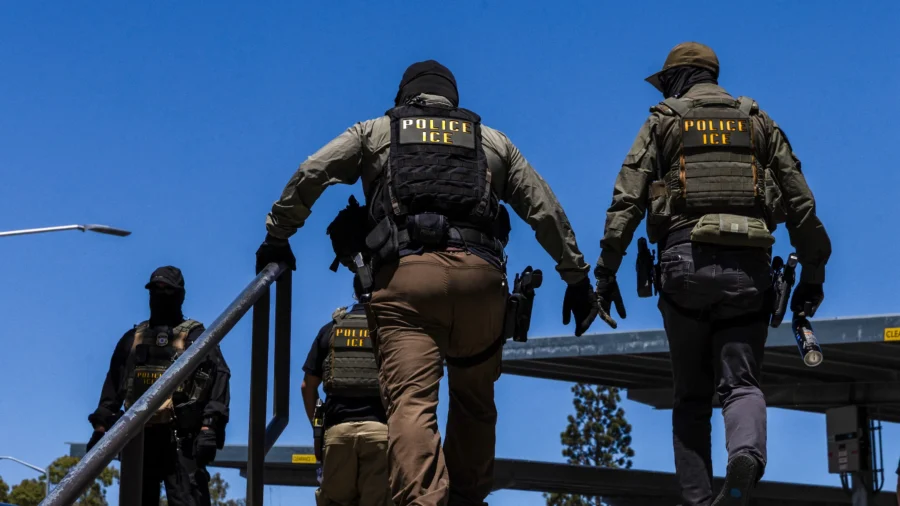
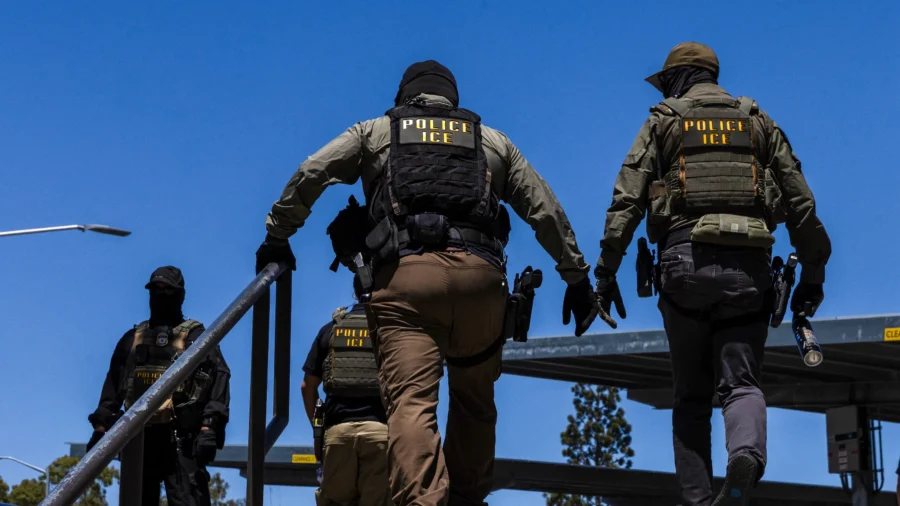
All Immigration and Customs Enforcement (ICE) officers will be equipped with body-worn cameras by the end of August, the agency’s acting director, David Venturella, said on Saturday.
In a statement posted on X, Venturella said that the rollout is ahead of schedule. The cameras are a key measure congressional Democrats demanded during a months-long funding dispute earlier this year over the Department of Homeland Security.
“We’re committed to transparency and accountability,” the acting director said.
In his statement, Venturella also criticized a Friday report from The Associated Press that said ICE’s policy of releasing body-camera footage states that any disclosures must be in the agency’s “best interests.”
Venturella called the report “disappointing, though not surprising,” “misleading,” and “sensationalized.”
The acting director said the news outlet misconstrued ICE’s body-worn camera policy by conflating the expedited release of footage following a serious injury or death in custody with the agency’s broader authority to release footage.
“Those are distinct issues,” Venturella said. “Here is the truth: ICE policy permits expedited release when appropriate — and clarifies that it’s not appropriate to release footage when doing so could compromise investigations or privacy.”
He added that this protocol mirrors that of other federal law enforcement agencies and is compliant with the Freedom of Information Act and Privacy Act.
“[Body cameras] exonerate more law enforcement than they convict, and I want officers to wear body cameras because I want the American people to see what the officers saw when they took that action,” Homan said in an interview aired July 19 on “Fox & Friends Weekend.”
Homan also blamed protesters, Democratic officials, and activist groups calling on the public to resist ICE operations for worsening the dangers of vehicle stops.
“We CANNOT give up one of I.C.E.’s most important and effective Crime Fighting tools, THE TRAFFIC STOP,” Trump said in a post on Truth Social. “Once we do, we are playing right into the criminal’s hands.”
After the deaths of two U.S. citizens earlier this year by federal agents during protests against an immigration operation in Minnesota, then-Homeland Security Secretary Kristi Noem said body cameras for ICE officers would be rolled out across the country in accordance with available funding.
Democratic lawmakers in Congress demanded ICE be reformed, as funding for Homeland Security stalled and forced a record shutdown.
Legislation was approved in April to fund most of Homeland Security but not ICE and Border Patrol.
“We’ll give the heroes of ICE and Border Patrol—and that’s what they are … the support and resources they need to defend our borders, protect our homeland, and to keep America safe,” Trump said to reporters in the Oval Office after signing the bill.
The legislation gave $38 billion to immigration enforcement efforts, funding for new hires, training, equipping, and compensating ICE personnel. Of that amount, $7 billion was directed to Homeland Security Investigations, and the remaining $31 billion was designated for enforcement activities, including the increase of immigration attorneys, assisting local law enforcement agencies partnered with ICE, and purchasing equipment such as body cameras.
The bill also set aside $22 billion for Border Patrol recruiting, training, paying, and equipping.
According to the legislation, $5 billion was allocated for border security technology and screening systems. Another $350 million was meant for enforcement activities in jurisdictions that are not formally partnered with ICE.
Jackson Richman contributed to this report.