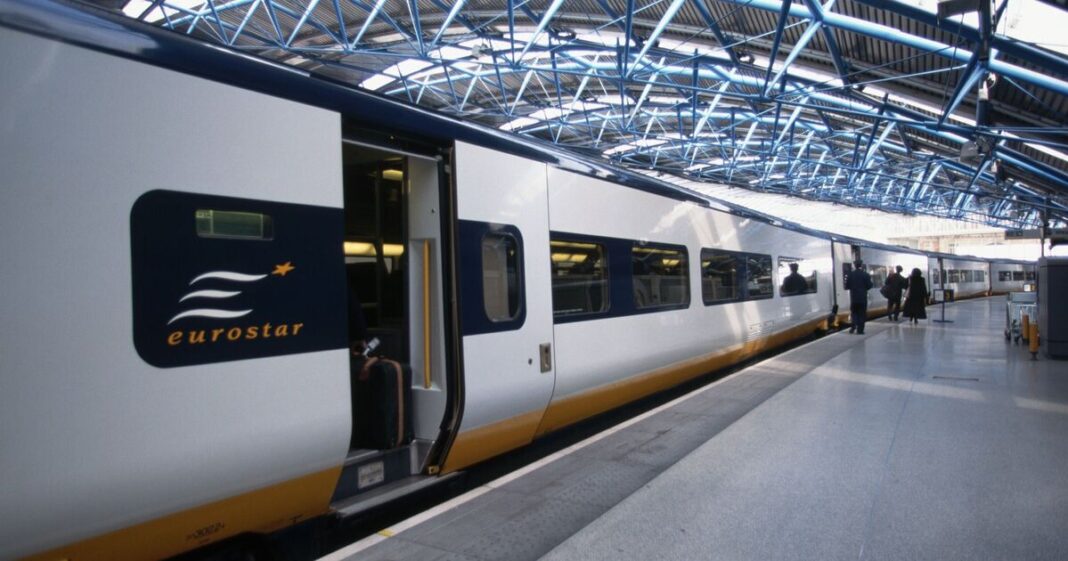

Eurostar currently enjoys a monopoly on services through the Channel Tunnel (Image: Getty)
Virgin Trains has secured a crucial regulatory green light to challenge Eurostar’s Channel Tunnel dominance, but serious obstacles remain, a leading rail expert has warned. The Office of Rail and Road (ORR) has granted Virgin track access rights for up to 20 daily return services from London St Pancras to Paris, Brussels and Amsterdam from October 2030 until the end of 2040.
The decision follows last year’s approval for Virgin to share Eurostar’s Temple Mills depot in east London, the only facility reachable from High Speed 1. Rail commentator Christian Wolmar said the decision represented a major step towards ending Eurostar’s three-decade dominance, but warned Virgin faced a long and expensive battle before its first train could run.

Virgin Group founder Richard Branson (Image: Getty)
Speaking about Eurostar’s dominant shareholder, Mr Wolmar said: “There’s no doubt that SNCF have rather exploited that monopoly. You know, there’s very few cheap deals, and they probably don’t run enough off-peak trains that would be cheaper and so on.”
He added that “there’s certainly space on the rails,” but noted tunnel access fees of around £25 per passenger immediately inflate fares.
Mr Wolmar said he was not normally convinced competition was the answer to transport problems, but believed the cross-Channel market was an exception.
However, he warned that serious physical and regulatory problems remain, particularly at the London and Paris termini, saying: “There are terrible space issues in that lower hall. They’re going to have to redesign the whole space underneath. I mean, there’s a whole lot of wasted space at St Pancras. Gare du Nord is even worse—sometimes you have to queue up halfway to the metro station before you can get in.”
Mr Wolmar also questioned whether Virgin had actually bought the 20 trains required for its proposed operation: “Have they really bought those 20 new trains? To buy trains on spec before you’ve got any kind of real certainty of being able to use them is quite a gamble. They might never be able to run anything.”

Rail commentator Christian Wolmar (Image: Getty)
Security rules provide another major hurdle, with the Channel Tunnel Security Order imposing tight controls at destination stations and limiting where international trains can stop.
Pointing to a report by transport campaigner Jon Worth highlighting the scarcity of suitable platforms, Mr Wolmar said: “There’s a limited number of places it will serve. I think it’s a great disappointment. I think they ought to relax the security requirements. I don’t understand these security requirements—why can’t they just check people as they go on?”
He also criticised the way high-speed services to the Continent have developed separately from the wider European rail network. He continued: “There’s no sense that this is part of Europe’s rail network; it’s just treated as distinctive and separate.” Operators, he added, “consider themselves more like an airline”.
Temple Mills could also become a battleground between Virgin and Eurostar, Mr Wolmar suggested.
He said: “Virgin appealed, and quite rightly they won the right to use it. But how many bays are there? How many trains can be stored overnight? Where will they work on them? How will they separate them out as they come in? Eurostar will fight tooth and nail to say, ‘Oh no, we need all these bays ourselves.’ I suspect it’s going to be the subject of lots of rows.”
We talk to residents of Ashford about withdrawal of Eurostar
Eurostar is already responding with new destinations and an order for double-deck Celestia trains from Alstom, Mr Wolmar pointd out. Anticipating further expansion, he added: “They’re definitely looking at more destinations and perking up in the face of this imminent competition.”
However Mr Wolmar remained doubtful about Virgin’s commercial prospects, stressing: “It will be very difficult for Virgin to make any money out of this, given the huge capital investment required. Nobody has said who is funding it—Virgin generally doesn’t invest vast amounts of money themselves; they’re a brand rather than an operator.”
As for timescales, he pointed out: “2030 is the earliest they’re talking about.”
In contrast, Mark Smith, founder of the Seat61 website, was considerably more upbeat about the prospect of competition: “Virgin—and the two other potential operators Trenitalia and Gemini—will bring significant extra capacity and almost certainly lower average prices to journeys between London and the Continent, which is very good news for passengers.”
Mr Smith cited Italy as evidence that competition can expand the overall rail market rather than simply take passengers from an established operator: “Trenitalia now carries more passengers than it did before Italo started up in competition with it. The big winner is the passenger. The big loser has not been the incumbent (Trenitalia), but short-haul airlines—nobody flies any more between Turin, Milan, Venice, Florence, Rome or Naples!”
Mr Smith added: “I’d echo what Eurostar’s own CEO has said: Competition keeps everyone on their toes! I have every confidence Eurostar will rise to the challenge, exactly as Trenitalia did in Italy. Great for passengers and the environment—not so good news for airlines!”
Sir Richard Branson has previously argued it is “time to end this 30-year monopoly and bring some Virgin magic to the cross-Channel route.”
Rail regulator the Office of Rail and Road (ORR) said it had granted approval for Sir Richard Branson’s company to run up to 20 new daily return services through the Channel Tunnel. The agreement covers the period between October 1 2030 to December 31 2040.
ORR deputy director Martin Jones called the access decision “an important next step in bringing competition and growth to the market for international rail services,” while noting “there is still more work to do”.
Virgin must still secure paths on French, Belgian and Dutch networks and obtain safety approvals on both sides of the Channel.
The regulatory decision is therefore a major step towards breaking Eurostar’s monopoly, but passengers still face a long wait before Virgin services could begin.