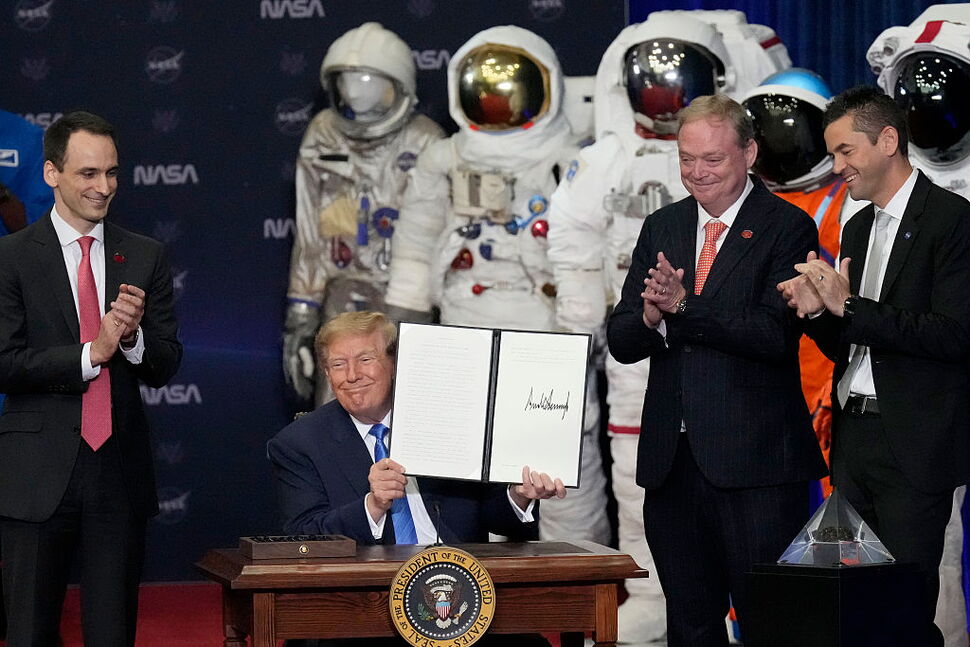
President Donald Trump has yet again turned his eye to the cosmos, signing an executive order to begin developing plans for a federal space academy intended to train future military and civil aerospace leaders.
- Make Your Inbox Smarter
- Sign up for these free email newsletters from U.S. News:
Pick Newsletters
Trump announced the initiative during an event at NASA’s Lyndon B. Johnson Space Center in Houston last Friday, where he awarded the Artemis II crew the Congressional Space Medal of Honor for their historic journey around the moon. During his visit, he signed an executive order creating the Presidential Commission on the United States Space Academy.
The commission acts as a study and advisory panel to help draft plans for the proposed academy. Actually establishing the Space Academy will take an act of Congress.
NASA Administrator Jared Isaacman will act as chair of the commission, an unusual departure from the norm set by existing military academies which fall under the Department of Defense (or the Department of Homeland Security for the Coast Guard Academy). This academy will fall under the civilian agency, NASA, but will supposedly produce both civilian and military personnel.
Aided by senior defense and economic policy officials, the commission has 120 days from Aug. 28 – the day of the signing – to flesh out a plan for the academy.
What Will Students Learn at the Academy?
“We’re going to have an academy for what the people in this room love the most,” Trump said during his remarks in Houston.
The proposed federal academy would develop the next generation of leaders across the aerospace field and would supply recruits to both NASA and the U.S. Space Force, which Trump established as a branch of the military during his first term. Students will reportedly be provided with technical training and leadership courses. The program prepares graduates for careers “supporting America’s military, civil, and broader space enterprise.”
In a release from NASA, Isaacman named a number of the agency’s aspirations, including returning NASA astronauts to the moon, building a lunar base, capitalizing on nuclear power and other “missions of science and discovery.”
“I have no doubt that so much of the future talent that will graduate and contribute to these exciting endeavors will be educated at the United States Space Academy,” Isaacman said.
How Will the Academy Interact With Other Military Branches?
That will depend on the final proposal, but the U.S. military relies on space infrastructure for missile detection, secure communications, pinpoint navigation and tactical intelligence. Space systems frequently support military campaigns, such as Operation Epic Fury, the joint U.S.-Israeli campaign targeting Iran early this year.
Replacing Old Blood
The promise of new recruits being funneled into NASA and the Space Force comes a little over a year after major cuts were made to both institutions.
Nearly 4,000 civilian workers left NASA in 2025 – equating to more than 20% of the agency’s workforce – following the Department of Government Efficiency’s proposed cuts. Many major projects reported feeling the effects of this loss in manpower. With additional budget cuts proposed in the 2027 fiscal year budget request, hiring more workers could prove to be challenging.
The Space Force is also reckoning with a thinned workforce. After losing nearly 14% of its civilian workforce in the aftermath of federal downsizing, the service faces staffing shortfalls but has requested to double its budget in 2027.
One Giant Leap
The commission is the first step in a long journey to establish the academy. The president does not have the authority to create the academy on his own.
“Let’s be clear, it will be Congress that decides whether such an academy is established, where it would be sited, and what its purpose would be,” former NASA Chief of Staff and Californian Rep. George Whitesides said in a social media post.
Whitesides also questioned where funding for the academy would come from, pointing out the high price tag of existing federally-run colleges.
Whitesides also asked how the academy’s education would distinguish itself from existing U.S. universities that produced the current aerospace workforce.
The academy’s commission will likely lay out these details in its coming proposal to the president in the next 120 days.