The 2026 MLB postseason resumed on Saturday with Game 1 of all four Division Series matchups. Since the best-of-five Division Series became a thing in 1995, the team that wins Game 1 has gone on to win the series 73% of the time, and 32% of the time the series ended in a sweep. Winning Game 1 doesn’t guarantee a Division Series win, but it is a big advantage.
Here are the final scores and schedule for Saturday’s playoff action:
To sum up all the Game 1 action, we’re here to declare a winner and loser from each of the four games. You can find those authoritative and inarguable declarations just below.

Winner: Drew Rasmussen
Rays ace flirts with playoff no-hitter in win over Yankees
Drew Rasmussen, the 31-year-old linchpin at the front of the Tampa Bay rotation, has pitched like an ace over the last two seasons. This year, he took it to career-best levels, as he notched a sub-3.00 ERA, a sub-2.00 FIP, and an AL-leading K/BB ratio of 5.44 in 172 innings. He’s headed for a high finish in the AL Cy Young vote, and he deserves it.
A fitting follow-up to Rasmussen’s excellence in the regular season was the absolute gem he spun against the Yankees in Game 1 of their ALDS clash:


Those 10 strikeouts tied a Rays postseason record. Most tellingly, he earned a jaw-dropping 23 whiffs on 54 swings for a 43% swing-and-miss rate.
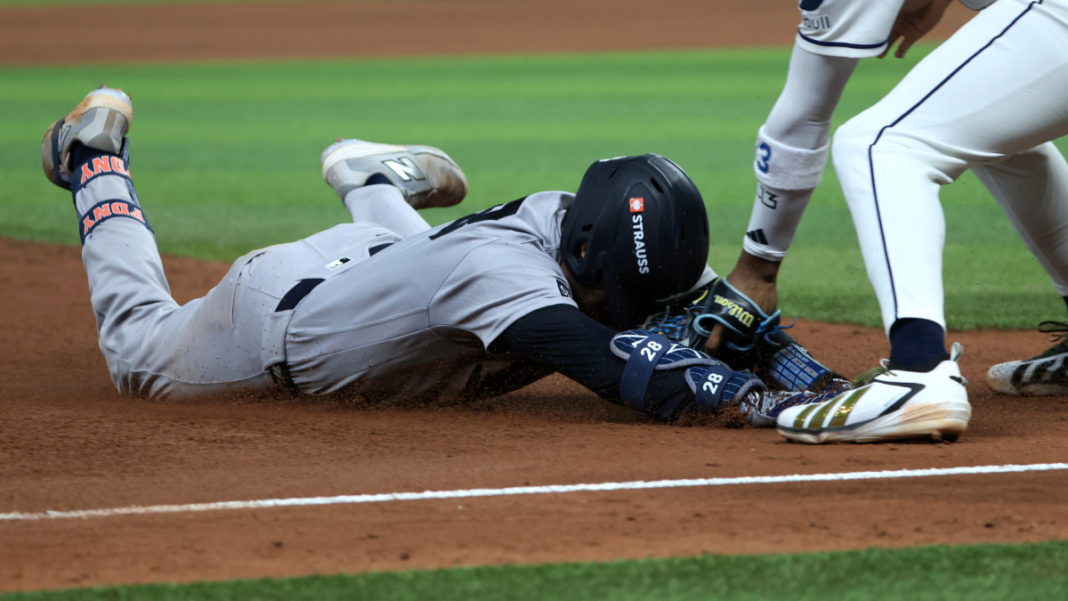
Rasmussen set the dominant tone early. In the top of the fourth, he responded to the Rays’ taking the lead on a Jonathan Aranda homer with a nine-pitch shutdown inning. He walked a pair of batters along the way, but at one point, he retired 15 batters in a row and carried a no-hitter into the eighth inning. After getting two outs, Yankees catcher Austin Wells ripped a double down the line to end the no-hitter, but he was thrown out foolishly attempting to make third base.
In the first postseason start of his career, Rasmussen earned a Game Score of 88. That’s dominance at just the right time, and it’s just what the Rays needed to take a 1-0 lead.

Loser: Austin Wells
Yankees catcher tries to be a speed merchant at just the wrong time
Austin Wells, for a few seconds, came up huge in the eighth inning of Game 1. Rasmussen had a no-hitter intact with two outs in the eighth with the Rays caring for a 1-0 lead. Wells ripped a 1-0 sinker from Rasmussen for a 107.8 mph double down the right field line. Had he stopped at second, he might have ended Rasmussen’s night. Rays manager Kevin Cash might have gone to a lefty to face Ryan McMahon, and in response, Yankees manager Aaron Boone might have summoned Giancarlo Stanton for a platoon-advantaged pinch-hitting appearance in a clutch spot.
Wells, though, negated all those possibilities by inexplicably trying to stretch that double into a triple. What ensued was as unsurprising as Wells’ base-running decision was surprising:
Wells is a catcher, and in keeping with the standards of his guild, he ranks in the 16th percentile in sprint speed among MLB hitters. Yankees third base coach Luis Rojas was giving Wells the stop sign before he even reached second:
That Wells did this with two outs and his team down by one run in the eighth inning makes the decision impossible to justify.
“Two outs there, trying to make something happen, be aggressive with not much going on in the game,” Wells told reporters after the game (via SNY). “Obviously, would love to be safe there or standing on second base.”
Wells didn’t hit a triple in the regular season, and for his career, he has two three-baggers in 382 career games. He picked precisely the wrong time to try to add to that meager tally.

Winner: Playoff Teo
Teoscar Hernández has 11 homers in 38 career playoff games
Despite the scorching hot weather — game time temperature was 100 degrees in the second-hottest playoff first pitch ever — the offenses were pretty quiet in this one. It was a scoreless tie in the middle of the fourth inning. A one-out walk to Freddie Freeman set the table for one of the more prolific playoff home run hitters in recent history, and Teoscar Hernández responded by going deep to give the Dodgers a 2-0 lead.
That was the 11th career playoff home run for Hernández, including at least one in each of his last six postseason series. He’s been especially productive in the divisional round. He’s now 12 for 37 (.324) with four home runs and 12 RBI in 10 career NLDS games.
As for this season, this game continued a trend of a scorching Hernández at the plate recently. He was faced with the possibility of losing playing time in a platoon situation in late August (manager Dave Roberts even pondered it out loud) and then something inside him woke up. In his last 25 regular-season games, Hernández hit .352/.433/.582 with four doubles, a triple, five home runs, 20 RBI and 15 runs.
It should be noted that despite a rough season overall, Kyle Tucker got hot down the stretch as well. In his last 22 games, he hit .284/.365/.595 with six homers and 12 RBI. He added a two-run homer for insurance in the bottom of the sixth inning in Game 1. — Matt Snyder
Losers: All the teams that let the Dodgers get Skubal
Dodgers deadline acquisition Tarik Skubal dominated on Saturday
The Dodgers are the two-time defending World Series champions. Two-time defending AL Cy Young winner Tarik Skubal landed on the trade block in July when the Tigers threw in the towel. Surely the rest of the league wouldn’t let the Tigers trade him to the Dodgers, right? Boy, were we naive to ignore how strongly some teams wanted to hug prospects instead of doing whatever it took to make sure the champs didn’t get the best pitcher in baseball (let alone add him to their own rotation).
Skubal went out and made his first Dodgers playoff start in Game 1 on Saturday and did not disappoint. His changeup was filthy to the point that it felt unfair, inducing eight whiffs out of the 15 swings he drew with that offering. His regular ol’ 98 mph heater was there, too, along with his three lesser-used breaking pitches.
He absolutely cruised through five scoreless innings, giving up just one hit. In the sixth, he did get touched up for a solo home run and walked two before relocating his release point and stranding those men on base.
In all, Skubal struck out seven in six innings of very fine work.
It bears repeating what we mentioned in the days following the Dodgers’ acquisition of Skubal: The move wasn’t just big in that the Dodgers landed him, it was doubly big in that they also prevented other teams from getting him. Had the Braves, for example, traded for Skubal, the Dodgers could well have been facing him on Saturday. Instead, he was working for them. — Matt Snyder

Winner: Munetaka Murakami
Murakami overcame a rough Wild Card Series with a game-changing home run on Saturday
There were questions, not unreasonably, about Munetaka Murakami’s chances to succeed in the big leagues given his low contact rates and high strikeout rates in Japan. He didn’t completely answer those questions this season — Murakami hit .207 during the regular season and .198 after April — but the 35 home runs and 130 OPS+ were plenty good enough to make up for the strikeouts.
Murakami had a tough Wild Card Series against the Astros, going 1-for-8 with five strikeouts in the two games, but he had his “welcome to the postseason” moment in Game 1 against the Guardians. He launched a 440-foot two-run home run in the third inning to give the White Sox the only runs they would need on the afternoon. Please enjoy the Japanese call of Murakami’s monster homer:
Murakami’s homer came immediately after the Guardians wasted a base- loaded opportunity in the bottom of the third. They wasted another bases-loaded opportunity in the bottom of the fourth inning too. The Guardians had chances to get on the board and really bust the game open, but they didn’t do it. Murakami gave the White Sox the big swing they’ll need to win this ALDS.
Chicago made it through the Wild Card Series without Murakami contributing much, but they’ll need him against Cleveland and throughout the playoffs. Your best players have to be your best players in October, and, in Game 1, Murakami was the White Sox’s best player thanks to his go-ahead home run. His game-changing power indeed changed the game. — Mike Axisa

Loser: Regular-season demons
Turns out what happens from March to September means little in October
White Sox righty Grant Taylor closed out Game 1 of the Wild Card Series with a masterful seven-out, 54-pitch performance against the Astros. It earned him our hypothetical Wild Card Series MVP award. That won’t even go down as Taylor’s best performance of the postseason though. In Game 1 of the ALDS, he turned in a four-inning save to finish off a 3-0 win over the Guardians.
Taylor struck out six and threw 42 pitches in Game 1, and generated an incredible 12 misses on 23 swings (52%). That is a preposterous whiff rate, especially since Cleveland had the fifth-lowest strikeout rate in baseball during the regular season.
Taylor’s four-inning Game 1 save came after the Guardians beat him up pretty good during the regular season. They tagged him for eight runs on nine hits and six walks in only 6 ⅔ innings spanning six appearances. Twice the Guardians walked Taylor off — Brayan Rocchio had the hit both times — and once they beat him in extra innings in Chicago. Ouch.
Given that regular-season track record, you couldn’t blame the Guardians if they felt confident when Taylor entered Game 1. They’ve had his number all year. Instead, Taylor shut them down and earned the first four-inning postseason save since former Astros righty Lance McCullers Jr. against the Yankees in Game 7 of the 2017 ALCS.
Keep in mind Sunday is an off-day for the two ALDS matchups. Taylor will get to rest after Game 1 and could be right back out there in Game 2 on Monday. — Mike Axisa