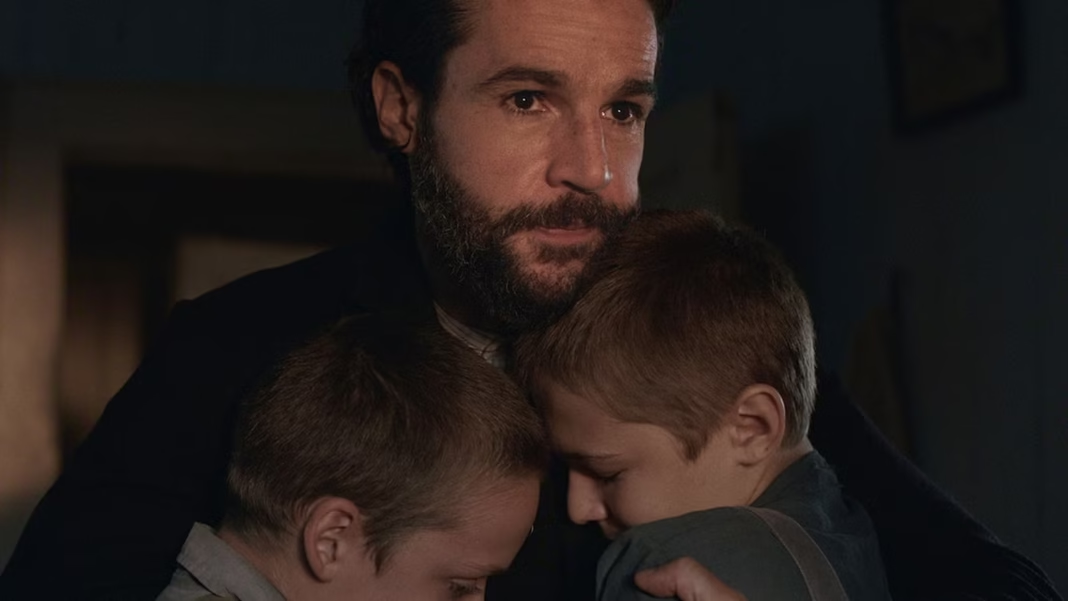
The 1952 novel East of Eden is regarded as John Steinbeck’s magnum opus, and Zoe Kazan’s acclaimed seven-part Netflix adaptation certainly captures the scope and scale of the sprawling multigenerational narrative. Starring Florence Pugh, Christopher Abbott, and Mike Faist, East of Eden faithfully adapts much of Steinbeck’s iconic classic, although it notably breathes new life into the narrative by approaching its themes and characters from a different angle. Kazan’s interpretation comes a full 70 years after her grandfather, Elia Kazan, produced the (previously) most well-known movie adaptation starring James Dean.
Steinbeck’s novel is considered a masterpiece due to its complex themes and magnificent scope, and stands as a translation of the Book of Genesis from the Bible. East of Eden reimagines the relationship between Adam and Eve and the rivalry of their sons Cain and Abel, seen through the lens of multiple generations of two families in the Salinas Valley in California in the decades around the turn of the 20th century. While both the novel and Netflix show tackle similar themes of family trauma, free will, and the nature of good and evil, there are significant differences between the two interpretations of the core story.
7
Cathy Ames Is Placed at the Forefront
Florence Pugh’s dark antihero takes center stage in the adaptation.

The most noticeable difference between the book and the show is the prevalence of the character Cathy Ames, played by Florence Pugh in the Netflix series. Pugh delivers a career-defining performance as the beautiful young woman who stands as the personification of evil in Steinbeck’s novel. There she acts as a stand-in for Eve and Satan as a character who embodies pure, innate evil, as a monster who was simply born that way. She represents the path for those who choose to give in to sin in the lens of the novel’s biblical allegory, and while her twisted choices drive much of the narrative, she is sidelined for large chunks of the story.
In the show, she is given an even more central, if not the most significant role. Each of the show’s seven episodes spends significant time with Cathy, exploring how she evolved from a precocious and manipulative child into the twisted, wealthy madam of a sadomasochistic brothel. Her decisions still hold the same level of influence as they do in the book, but her motivations and actions are given far more depth.
6
Cathy Ames Is More Antihero Than Villain
The show explores the trauma that drove her actions.

The show’s emphasis on Cathy also completely reshapes how she came to be the character that Steinbeck treated as the personification of evil. In the critically-acclaimed Netflix adaptation, Kazan treats Cathy more as an antihero than an inherently evil monster, as it explores the conditions that would have driven her admittedly wicked choices. Her entire personality is rooted in childhood abuse, and that informs essentially all of her choices moving forward. As she grows, she does what she can to ascend in the male-dominated society of the late 19th and early 20th century, and her actions can be seen through a survival lens in that regard. Kazan brilliantly asks why Cathy Ames does what she does instead of accepting Steinbeck’s more abstractly evil villain.
5
The Show Spends Less Time With the Trask Brothers
We don’t see much of them rebuilding their relationship.

The relationship between Adam and Charles Trask is at the heart of the East of Eden narrative, no matter what interpretation you’re looking at. As the initial Cain and Abel stand-ins in the biblical allegory, the two brothers’ early rivalry and later reconciliation is a key tenet of the narrative. Partially due to its repositioning of the narrative’s center around Cathy, the show doesn’t spend nearly as much time with the brothers together as the book does, particularly when they make amends as adults years after their initial parting of ways. It’s neither a good nor a bad thing, it’s simply a by-product of how Kazan chose to frame the story.
4
The Show Narrows the Focus of the Narrative
The multi-generational saga is pared down to focus on Adam, Charles, and Cathy.

The true scope of Steinbeck’s original narrative is staggering, as it deals with two families across multiple generations, in a time span ranging from the end of the Civil War through World War I. The story of Cain and Abel is essentially told multiple times, and while the show does indeed show Adam’s sons’ rivalry in addition to his own, it is unquestionably a much narrower scope. The narrative hinges on Adam Trask, Charles Trask, and Cathy Ames as opposed to the more sprawling cast that is covered in the novel. That was influenced of course by Kazan’s desire to explore Cathy Ames in greater depth, but it also makes for a more focused story that’s easier to digest in TV form.
3
The Hamilton Family Is Mostly Omitted
The Irish-American family modeled after Steinbeck’s own family is barely present.

In focusing the narrative, Kazan largely omitted the second family that Steinbeck’s original story included. The Hamiltons act as the hard-working, good-natured balance to the dark biblical tragedy of the Trask family, with patriarch Samuel Hamilton in particular acting as a sort of wise moral center. Again as a result of keeping the focus more on Adam, Charles, and certainly Cathy, Kazan opted to minimize the role of the Hamiltons in the Netflix adaptation of East of Eden. Samuel Hamilton (played with pitch-perfect warmth by Ciarán Hinds) is still present in the early part of the show, and occupies his role as a source of wisdom, sense, and overall goodness, but the rest of the Hamiltons are left out of the show, minus a brief appearance from Samuel’s son Will.
2
Lee Is Given More Depth and Background
The show explores the character of the Chinese-American servant in greater detail.

Both the show and the novel include the character Lee, a Chinese-American immigrant who becomes a trusted member of the Trask family. In both translations he is a bright, kind, intelligent man who cares deeply for the Trask family (especially Adam’s sons Cal and Aron), acting as both Adam’s confidant and advisor and a second father to his sons. Hoon Lee’s stellar performance in the show really shines through in one of the major departures from the novel: Lee’s trip to San Francisco.
In the book, Lee leaves the Trasks to open his own bookshop and returns out of loneliness and homesickness. In the show, he finds nothing but rejection in San Francisco as a Chinese-American, and is turned away by white property owners who refuse to allow him to purchase and open his own storefront. Kazan uses this trip to comment on the systemic racism of the time period, particularly on the West Coast and specifically against Asian-American people. It’s a worthy addition to the overall narrative and gives the character of Lee even more weight.
1
Charles Haunts Cathy More Directly
The younger Trask brother is far more present in the show.

Both the novel and show imply that Charles might actually be the father of Cal and Aron, and his presence in the novel lingers long after his death. That presence is particularly heightened towards the end of Cathy’s life, when she feels Charles’ presence around her as she grows increasingly more paranoid believing Ethel will expose her for Faye’s murder. As the darker of the two brothers, Charles acts as a reflection of Cathy’s own internal guilt for a life of evil choices.
The show isn’t quite as subtle in its symbolism. In the final episodes of Kazan’s East of Eden, Mike Faist’s Charles returns as a hallucination that Cathy interacts with directly. Charles touches and speaks with her, which removes some of the subtlety but undoubtedly gives more weight to Cathy’s steady unraveling as she looks back on her dark and twisted life.

- Release Date
-
2026 – 2026-00-00
- Network
-
Netflix
- Directors
-
Garth Davis