Nobel Prize for Economics awarded to Hall and Woodford
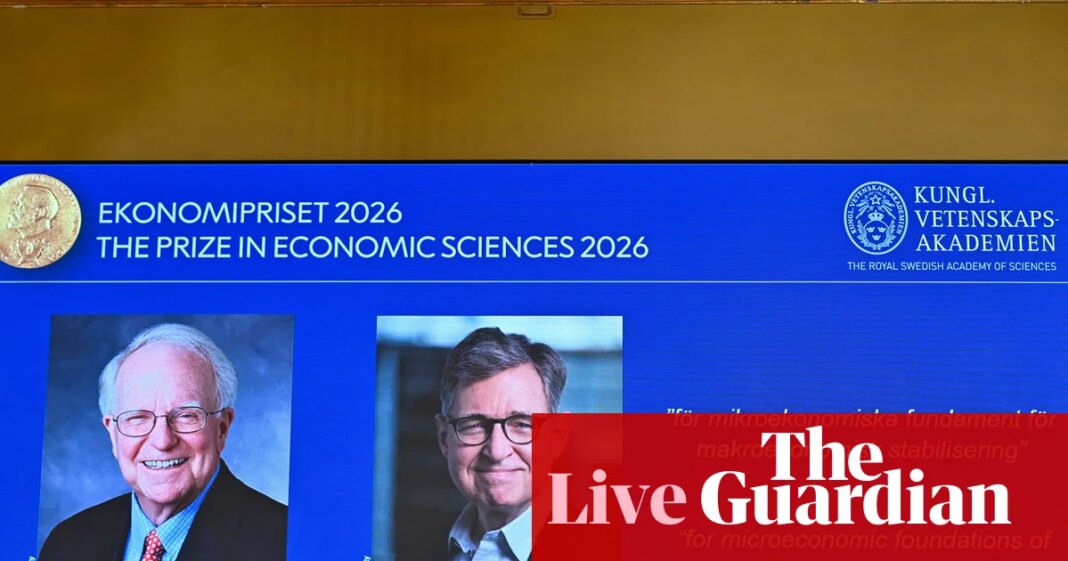
Newsflash: The Nobel Prize for economics has been awarded to Robert E Hall and Michael Woodford, for their work on the “microeconomic foundations of macroeconomic stabilisation”.
[Reminder: As we flagged earlier, Woodford was among the predicted winners – he’s one of the architects of modern forward guidance, the idea that central banks can control the economy through influencing public expectations about inflation, rather than just through interest rates.]
The Sveriges Riksbank Prize in Economic Sciences in Memory of Alfred Nobel is worth 12 million Swedish kronor (£900,000), plus the glory of course, and the knowledge that every pronouncement you make now comes with the authority of a Nobel Prize winner.

American economists Robert E. Hall and Michael Woodford were jointly awarded the 2026 Nobel Prize in Economic Sciences ‘for microeconomic foundations of macroeconomic stabilisation.’ Photograph: Anders Wiklund/EPA
Key events
Praise for Woodford and Hall is starting to pour in
Analytics company Clarivate, which had awarded both Robert Hall and Michael Woodford one of its Citations Laureate – given to those who are considered likely to win the Nobel Prize due to their research expertise – says today’s award is certainly merited.
David Pendlebury, head of research analysis, institute for scientific information at Clarivate, explains:
“We are delighted to see both Robert Hall and Michael Woodford recognized with this year’s Sveriges Riksbank Prize in Economic Sciences. Hall was named a Citation Laureate in 2017 and Woodford earlier this year in 2026, reflecting the exceptional influence of their research. Their work has fundamentally shaped modern thinking about economic stabilization, productivity, economic fluctuations and the role of monetary policy in supporting economic growth and stability.
Looking at the publication record in the Web of Science, we see the enduring impact of their contributions. Their research has influenced generations of economists and helped inform economic policymaking around the world, demonstrating how foundational ideas can shape both academic understanding and real-world decision-making for decades.”
Economics professor Costas Milas of the University of Liverpool says Woodford’s work has lessons for UK policymakers today, as they try to unwind the stimulus measures implemented since the financial crisis.
He tells us:
I am very pleased Robert Hall and Michael Woodford have been awarded the Nobel Prize in Economics.
Michael Woodford’s work on Quantitative Easing (QE) policies, in particular, is very informative as it assesses the benefits of QE for financial stability by taking into account different assumptions about macro-prudential stability and whether interest rates are close to zero or not.
In essence, this is a very useful scenario-type of analysis that my co-author Christopher Mahon (visiting fellow at the Open University Business School) and I are now advocating in our new LSE Business Review blog which argues that Quantitative Tightening policies in the UK should rely on scenario testing to assess how alternative balance-sheet strategies perform cost-wise if interest rates follow different paths.
How Hall created the fresh-water and salt-water economic divide
Robert Hall is also famous for coining the fresh water vs. salt water split in American macroeconomics.
This divide is both ideological and geographical.
A fresh water economist, Hall wrote 50 years ago, believes that economic fluctuations are largely attributable to supply shifts, and that the government is essentially incapable of affecting the level of economic activity. This leads to a belief in free markets, neoclassical price theory, rational expectations, and monetarism.
Freshwater economists tend to be based at inland universities located near the North American Great Lakes, such as the University of Chicago.
The salt water view holds shifts in demand responsible for fluctuations and thinks government policies (at least monetary policy) is capable of affecting demand, Hall argued.
Salt water economists thrive at the US coastal universities, such as Harvard, MIT, UC Berkeley, Yale, Princeton, UCLA, and Columbia.
On his page at Stanford, Hall writes:
In a 1976 paper, I introduced the distinction between fresh-water and salt-water economists. Bloggers using these terms are asked to contribute $1 to a fund that sends graduate students to MIT for one year and to the University of Minnesota for a second year.
[The cheque is in the post, sir].
Who are our latest Nobel Economics laureates?….
Michael Woodford was born in 1955 in Chicopee, Massachusetts.
He’s based at Columbia University, New York, where he’s the John Bates Clark Professor of Political Economy.
According to Columbia:
Woodford has been a MacArthur Fellow and a Guggenheim Fellow, and is a Fellow of the American Academy of Arts and Sciences, as well as a Fellow of the Econometric Society, of the Society for the Advancement of Economic Theory, and of the Society for Economic Measurement, a Research Associate of the National Bureau of Economic Research (Cambridge, Mass.), a Research Fellow of the Centre for Economic Policy Research (London), and a Fellow of the CESifo Research Network (Munich).
He was the 2007 recipient of the Deutsche Bank Prize in Financial Economics, the 2018 recipient of the Banque de France/TSE Prize in Monetary Economics, and the 2024 recipient of the Erwin Plein Nemmers Prize in Economics.
Robert Hall, the older of the pair, was born in 1943 in Palo Alto, California (the birth place of Silicon Valley).
Hall is based at Stanford University, California, where he’s the Robert and Carole McNeil Joint Senior Fellow, Hoover Institution, and professor in the department of economics.
On Stanford’s website, Hall describes himself as “an applied economist with interests in employment, inflation, technology, competition, and economic policy in the aggregate economy and in particular markets.”
That work has included developing a framework for equitable and efficient consumption taxation, research into economic fluctuations and growth, and advising a number of government agencies on national economic policy.
Woodford: I’m elated
Michael Woodford is now speaking to the Nobel prize commitee, by telephone.
He says he’s “elated”, as winning the prize is “a tremendous honour”.
“It’s a surprise, but I’m feeling very good about it,” he adds.
Woodford now explaining how the 2008 financial crisis stretched the limits of traditional monetary policy, as interest rates fell to record lows, while unemployment was too high and aggregate spending was too low.
This meant other tools were needed, and one was ‘forward guidance’ about policy – more explicit statements about the future path of interest rates.
How Hall and Woodford’s work on microfoundations won Nobel Prize
Robert Hall and Michael Woodford, who are both Americans, have been recognised for their work helping global policymakers to smooth out the highs and lows of economic cycles, through a branch of economics known as the New Keynesian paradigm.
Their models have “significantly improved our ability to implement effective stabilisation policy”, the Royal Swedish Academy of Sciences say.
This has allowed “well-timed fiscal and monetary policy measures” to reduce the economy’s peaks and troughs.
This work built on John Maynard Keynes’s work showing how policymakers could stimulate demand when it is too low and slowing it when it’s too high.
Keynes’s work struggled during the oil crises of the 1970s, which strained its assumption that the relationship between the macroeconomic variables was stable.
Hall and Woodford, though, showed that such models have to be built on microfoundations- ie, from the bottom up, based on the behaviour of individual actors.
The Royal Swedish Academy of Sciences say:
Robert E. Hall’s and Michael Woodford’s research has made us better equipped to manage economic downturns. They laid the foundation of the New Keynesian paradigm, in which models are built upon microfoundations, which means from the bottom up.
Economic outcomes are the result of millions of decisions made at the microlevel by households and businesses. Using models based upon this approach, rather than simply studying the economy from a macro perspective, like a bird’s eye view, Hall’s and Woodford’s research has generated a paradigm shift in the theory of stabilisation policy.
Explaining why Hall and Woodford have won the biggest prize in economics, the Royal Swedish Academy of Sciences say:
Economic development is characterised by alternating downturns and upturns. Stimulating or slowing down the economy at the right time can provide stability and allow us to avoid drawn-out recessions or runaway inflation. Robert E. Hall’s and Michael Woodford’s research has generated a paradigm shift in stabilisation policy.
New Keynesian models, a result of their research, allow us to explain and quantify how stabilisation policy affects business cycles and are now used by central banks and finance ministries around the world.
Nobel Prize for Economics awarded to Hall and Woodford
Newsflash: The Nobel Prize for economics has been awarded to Robert E Hall and Michael Woodford, for their work on the “microeconomic foundations of macroeconomic stabilisation”.
[Reminder: As we flagged earlier, Woodford was among the predicted winners – he’s one of the architects of modern forward guidance, the idea that central banks can control the economy through influencing public expectations about inflation, rather than just through interest rates.]
The Sveriges Riksbank Prize in Economic Sciences in Memory of Alfred Nobel is worth 12 million Swedish kronor (£900,000), plus the glory of course, and the knowledge that every pronouncement you make now comes with the authority of a Nobel Prize winner.
American economists Robert E. Hall and Michael Woodford were jointly awarded the 2026 Nobel Prize in Economic Sciences ‘for microeconomic foundations of macroeconomic stabilisation.’ Photograph: Anders Wiklund/EPA
Watch the Nobel economics prize announcement here
The winner of the Nobel memorial prize in economics, the final award in this year’s cycle, is expected to be announced in around 10 minutes time.
You can watch the announcement, at the Royal Swedish Academy of Sciences in Stockholm, here:
Reminder: The prize is formally known as the Sveriges Riksbank Prize in Economic Sciences in Memory of Alfred Nobel. Sweden’s central bank established it in 1968 as a memorial to Nobel, the 19th-century Swedish businessman and chemist who invented dynamite and established the five Nobel Prizes.
AFP: Nobel watchers guess who gets economics’ top prize
Monetary policy, technology, behavioural economics and development are among the fields tipped for this year’s Nobel economics prize, the AFP newswire report.
Last year, the economics award went to American-Israeli Joel Mokyr, France’s Philippe Aghion and Canada’s Peter Howitt for research into how technology drives and affects growth.
That makes another prize for the same field unlikely this year, according to experts interviewed by AFP.
“There is obvious horse-trading between factions in the (Nobel) committee: ’I support your candidate this year if you support mine next year,’” Richard Tol, an economics professor at the University of Sussex, told AFP.
For Tol, the committee has been “signalling” that Americans Colin Camerer and George Loewenstein will win this year, “perhaps with Matt Rabin”, pioneers in behavioural economics and how we make decisions.
Another “strong candidate” is Michael Woodford in the field of monetary policy, said David Pendlebury of research firm Clarivate, which predicts potential laureates by tracking highly cited academic work.
“It has been a while since that particular area has been recognised,” Pendlebury noted.
Looking at past laureates also shows that the Nobel committee tends to honour research about 20 to 25 years after publication, and Woodford’s key work was “a book published in 2003”.