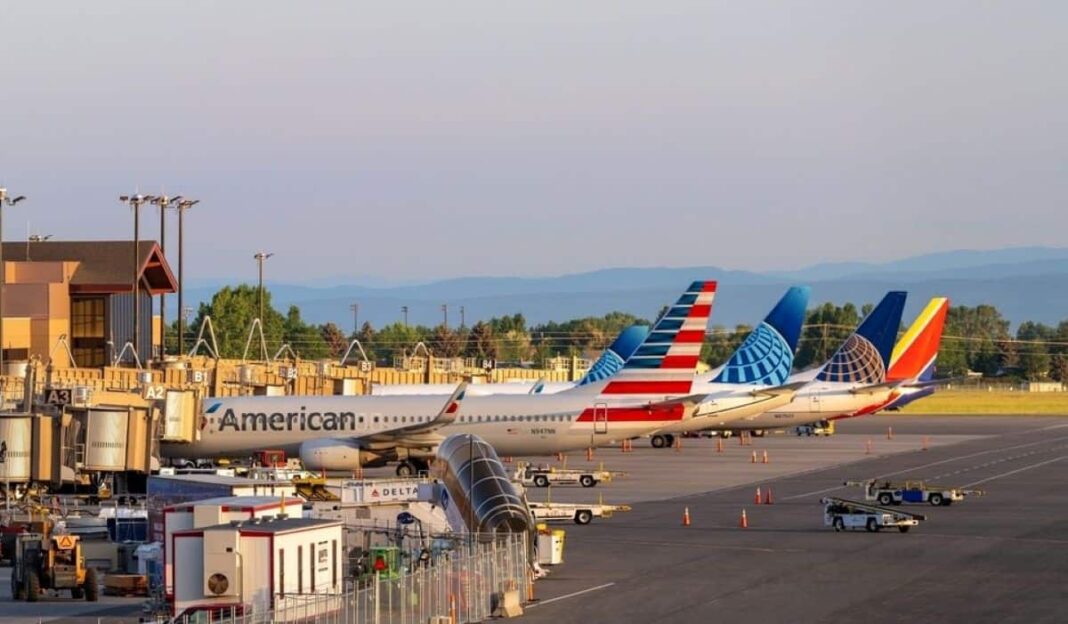

Bozeman, Montana, is experiencing a major aviation milestone as Bozeman Yellowstone International Airport recorded 3,004,991 terminal passengers between October 2025 and September 2026. Announced on 19 October 2026, the achievement exceeded its projected annual target of approximately 2.9 million passengers. Traffic also increased by 8.7% between January and September 2026, strengthening the airport’s position as Montana’s leading commercial aviation gateway. The development carries wider implications for Yellowstone National Park, Big Sky Resort, regional accommodation and business travel. However, the passenger figures reveal something more significant: Montana’s aviation market increasingly serves a diversified economy beyond conventional holiday tourism.
Montana’s Aviation Growth Takes Centre Stage
The three-million-passenger milestone represents a significant development for southwest Montana’s transport infrastructure. It also reflects the expanding role of Bozeman as an entry point for residents, holidaymakers, business travellers and people visiting family.
Advertisement
Advertisement
The airport recorded 1,504,450 departing passengers and 1,500,541 arriving passengers during the 12-month reporting period. Together, these movements produced 3,004,991 terminal passengers.
The distinction between passenger movements and individual visitors remains essential. Arriving and departing passengers are counted separately, meaning the milestone does not represent three million different tourists.
The airport’s passenger composition also reveals a broader travel market.
- 38%: Montana residents using the airport.
- 35%: Passengers associated with tourism.
- 27%: Non-residents travelling for business, personal reasons or visits to friends and relatives.
This distribution demonstrates that airport demand extends beyond leisure travel. Business connections, family visits and regional mobility also support passenger volumes throughout the year.
Advertisement
Advertisement
The airport had initially projected approximately 2.9 million passengers for 2026. Its October announcement also highlighted an 8.7% increase in monthly passenger traffic between January and September.
However, the airport anticipated relatively flat autumn and winter demand. Airlines had adjusted flight frequencies amid elevated fuel prices and other operating considerations.
Advertisement
Advertisement
Three Gateways Shape Montana’s Tourism Map
Bozeman’s growing aviation influence becomes clearer when compared with two other important regional gateways. Glacier Park International Airport in Kalispell and Missoula Montana Airport serve distinct visitor markets across the state.
Montana Department of Transportation statistics recorded the following year-to-date airline enplanements through September 2026.
| Airport | Passenger boardings |
|---|---|
| Bozeman Yellowstone International | 1,218,831 |
| Glacier Park International, Kalispell | 442,900 |
| Missoula Montana | 420,550 |
Bozeman recorded nearly three times the departing passenger volume of either competing gateway. Its position reflects its extensive airline network and access to several important tourism and commercial centres.
Nevertheless, the other airports retain substantial regional importance.
Advertisement
Advertisement
Glacier Park International Airport provides convenient access to Glacier National Park, Whitefish and Flathead Lake. These destinations attract visitors interested in alpine landscapes, lakeside accommodation and outdoor recreation.
Missoula Montana Airport supports western Montana’s university, cultural and commercial economy. Its connections also serve visitors exploring surrounding forests, rivers and recreational areas.
Bozeman has a different geographical advantage. Its catchment includes Yellowstone’s northern and western access corridors, Big Sky Resort, Bridger Bowl and the Gallatin Valley.
For travellers planning multi-destination holidays, these airports offer different starting points.
Which airport should travellers choose?
- Bozeman: Big Sky, Yellowstone’s northern and western approaches, and the Gallatin Valley.
- Kalispell: Glacier National Park, Whitefish and Flathead Lake.
- Missoula: Western Montana, university-related travel and regional outdoor recreation.
These gateways complement one another rather than compete for exactly the same visitor market.
Advertisement
Advertisement
United and Delta Lead Bozeman’s Airline Network
Airline distribution offers another indication of the airport’s commercial importance. United Airlines and Delta Air Lines occupy the leading positions in Bozeman’s year-to-date passenger boarding statistics.
Montana’s September 2026 report records the following carrier figures for January through September.
| Airline | Enplanements | Market share |
|---|---|---|
| United Airlines | 365,544 | 32.4% |
| Delta Air Lines | 288,800 | 26.1% |
| Southwest Airlines | 206,883 | 7.6% |
| American Airlines | 158,207 | 12.0% |
| Alaska Airlines/Horizon | 126,470 | 14.1% |
| Allegiant Air | 36,753 | 5.0% |
| JetBlue | 26,541 | 1.0% |
| Sun Country Airlines | 7,635 | 0.7% |
| Charter operations | 1,998 | 0.1% |
| Total | 1,218,831 | 100% |
The market-share figures represent the published Montana Aeronautics statistics. They are rounded to one decimal place.
United’s 365,544 boardings give it the largest share of Bozeman’s departing passenger market. Delta follows with 288,800, reinforcing the importance of both airlines to the region’s domestic connectivity.
Alaska Airlines/Horizon and American Airlines also provide substantial capacity. Southwest contributes another important element of the network, particularly for travellers comparing domestic holiday options.
What makes this network important?
Advertisement
Advertisement
- Major connecting hubs give visitors access from numerous American cities.
- Multiple airline operators provide greater choice across different fare categories.
- Seasonal services accommodate stronger leisure demand during selected travel periods.
- Year-round connections support residents, business travellers and regular visitors.
Bozeman’s route network includes connections to important American aviation markets. Denver, Chicago, Seattle, Los Angeles, San Francisco, Minneapolis, Dallas–Fort Worth and Salt Lake City are among the significant destinations serving the region.
The airport’s published network also includes seasonal services from selected eastern and southern American markets. However, seasonal availability varies, and advertised destinations should not be interpreted as daily or year-round flights.
Seasonal Routes Broaden Visitor Access
Airline scheduling plays an important role in determining how easily visitors can reach Montana’s mountain destinations. During the summer, stronger leisure demand encourages airlines to adjust capacity and offer additional seasonal connections.
Bozeman’s 2026 summer programme highlighted 27 destinations across eight airline brands. The airport identified Austin, Long Beach and Phoenix Sky Harbor among its new destinations for that programme.
These additions offer access from important American metropolitan markets. They also provide travellers with more options when planning holidays around national parks, mountain resorts and outdoor recreation.
However, the number of destinations alone does not establish the scale of additional capacity. Flight frequency, aircraft size, seat availability and seasonal operating periods matter equally.
Advertisement
Advertisement
For the tourism industry, these distinctions influence booking patterns and accommodation planning. A route operating several times weekly can generate different visitor flows from a daily service.
Travellers should also distinguish Phoenix Sky Harbor from Phoenix–Mesa. These are separate airports serving the wider Phoenix metropolitan area, with different airline networks and ground transport arrangements.
Useful flight-planning considerations
- Check whether the selected route operates throughout your intended travel dates.
- Compare connecting itineraries against available nonstop services.
- Check baggage allowances and aircraft-specific restrictions.
- Consider the distance between the arrival airport and your accommodation.
- Review return-flight availability before committing to resort bookings.
The expansion of airline options strengthens Montana’s accessibility. Nevertheless, sustainable year-round connectivity will depend on whether airlines can maintain sufficient demand outside peak holiday periods.
A $1.468 Billion Visitor Economy Emerges
The most compelling economic evidence comes from Montana’s 2026 Airport Economic Impact Study. Prepared for the Montana Department of Transportation by Zenith Economics, the report examines aviation’s contribution to employment, business activity and regional development.
Its airport-specific analysis estimates $1.468 billion in visitor-spending-related economic output for Bozeman during 2025. This makes Bozeman the largest contributor among Montana’s commercial airports in this category.
Advertisement
Advertisement
The comparison with other regional gateways is particularly revealing.
| Commercial airport | Visitor-spending-related output |
|---|---|
| Bozeman Yellowstone International | $1.468 billion |
| Missoula Montana | $678 million |
| Glacier Park International | $642 million |
| Billings Logan International | $395 million |
| Helena Regional | $168 million |
| Great Falls International | $139 million |
Bozeman’s economic contribution substantially exceeds those of the other airports listed. It reflects the wider spending generated by air-arriving visitors across accommodation, dining, transport, retail and recreational services.
The statewide study estimates that Montana’s eight commercial service airports connected approximately 2.6 million arriving visitors during 2025. Those visitors spent an estimated $1.9 billion during their trips.
The broader economic effects reached approximately $3.6 billion in statewide output. Visitor spending supported around 25,000 jobs and generated approximately $1.2 billion in labour income.
These estimates include direct, indirect and induced economic effects. They should not be interpreted as direct airport revenue or money collected exclusively by tourism businesses in Bozeman.
Where does the economic activity reach?
Advertisement
Advertisement
- Hotels and holiday accommodation benefit from overnight stays.
- Restaurants and bars capture spending from visitors and business travellers.
- Rental-car companies and transport providers support regional mobility.
- Retail businesses benefit from shopping and essential travel purchases.
- Guides and recreational operators receive expenditure from outdoor activities.
This economic relationship explains why airport infrastructure matters to tourism destinations. Better connectivity can widen the potential visitor market, while accommodation and transport businesses capture spending beyond the airport itself.
Montana’s Tourism Economy Reveals Another Story
The airport milestone arrives during a period of substantial statewide tourism activity. Research published by the University of Montana’s Institute for Tourism and Recreation Research estimates that Montana welcomed approximately 13.2 million non-resident visitors in 2025.
These travellers spent around $5.6 billion across the state. Tourism supported approximately 52,610 jobs and generated $360 million in state and local taxes.
However, visitor numbers declined by 4% compared with 2024. The expenditure figures moved in the opposite direction, with inflation-adjusted traveller spending increasing by 11%.
This contrast suggests that Montana’s tourism economy is not dependent on visitor volume alone. Spending patterns, trip duration, accommodation choices and visitor profiles also influence economic performance.
The typical visitor stayed approximately 5.2 nights and travelled in a group of 2.2 people. Around 74% arrived primarily by car, highlighting the continuing importance of road travel.
Advertisement
Advertisement
The third quarter accounted for 45% of annual visitation and 54% of total visitor expenditure. This concentration demonstrates the commercial importance of summer and early autumn.
| Montana tourism indicator | 2025 estimate |
|---|---|
| Non-resident visitors | 13.2 million |
| Visitor expenditure | $5.6 billion |
| Tourism-supported employment | 52,610 jobs |
| State and local tax revenue | $360 million |
| Average stay | 5.2 nights |
| Visitors arriving primarily by car | 74% |
| Third-quarter share of annual expenditure | 54% |
The figures provide important context for interpreting airport growth. Bozeman’s rising passenger movements form part of a much larger visitor economy, where road journeys continue to dominate.
They also reveal an opportunity for destination businesses. Visitors arriving by air may require accommodation, rental vehicles and organised transport, creating different spending patterns from road-trippers.
Big Sky Strengthens the Mountain Holiday Market
Bozeman’s tourism significance extends well beyond its role as a Yellowstone gateway. Its location also provides access to Big Sky Resort, Bridger Bowl and the wider Gallatin Valley.
Big Sky is particularly important to Montana’s premium mountain tourism proposition. Its winter activities, accommodation facilities, restaurants and outdoor experiences attract visitors seeking extended mountain holidays.
Better airline accessibility can make these destinations more convenient for travellers from major American cities. It can also support shorter leisure breaks, particularly when flight schedules match resort operating periods.
Advertisement
Advertisement
However, air connectivity is only one part of the visitor journey. Travellers still need suitable transfers, accommodation and local transport to reach mountain destinations.
The economic benefits also extend to surrounding communities. Resort visitors generate demand for restaurants, equipment rentals, guides, transport operators and seasonal workers.
What travellers should consider when visiting Big Sky:
- Compare airport transfers with rental-car costs before booking.
- Check resort operating dates and seasonal activity schedules.
- Reserve accommodation early during popular winter and summer periods.
- Allow additional time for mountain-road journeys during winter weather.
- Confirm whether accommodation provides transport to ski facilities.
Bozeman itself also deserves recognition as an independent visitor destination. Its downtown restaurants, cultural attractions, university environment and access to outdoor recreation create reasons to extend a stay.
This distinction is important for the region’s hospitality sector. Visitors who spend additional nights in Bozeman can distribute expenditure across more local businesses rather than treating the city exclusively as a transit point.
Yellowstone Retains Its International Appeal
Yellowstone National Park remains one of the strongest tourism assets supporting southwest Montana’s international profile. The National Park Service recorded 4,762,988 recreation visits during 2025, making Yellowstone the third-most-visited national park in the United States.
Advertisement
Advertisement
The park also recorded 1,238,983 overnight stays. These figures demonstrate the scale of accommodation demand, visitor services and recreational activity associated with the destination.
Bozeman offers access to Yellowstone’s northern and western tourism corridors. Visitors can use the city as a starting point for park excursions, guided experiences and accommodation outside the national park.
However, Yellowstone’s visitor figures should not be confused with airport passenger statistics. Park recreation visits count visits to the park, while airport passenger movements count arrivals and departures. Neither measure establishes how many individual Yellowstone visitors flew into Bozeman.
The airport also reported relatively stable visitation across Yellowstone’s entrances. This suggests its passenger growth reflects several travel markets rather than a substantial increase in national park demand alone.
Important Yellowstone travel information
- Check seasonal road openings before planning a driving itinerary.
- Review entrance conditions and potential weather-related closures.
- Book accommodation well ahead of peak summer travel.
- Allow sufficient time between park attractions because driving distances can be considerable.
- Consult National Park Service alerts before departure.
Glacier and Missoula Offer Different Experiences
Montana’s tourism appeal extends considerably beyond Yellowstone. Glacier National Park recorded 3,136,557 recreation visits in 2025, reinforcing northwestern Montana’s importance to the national outdoor recreation market.
Advertisement
Advertisement
Kalispell’s Glacier Park International Airport provides access to this region. Whitefish and Flathead Lake further diversify its visitor proposition through mountain recreation, lakeside accommodation and seasonal outdoor activities.
Missoula offers a different experience. Its cultural attractions, university environment and access to western Montana’s recreational landscapes support a broader mixture of leisure and commercial travel.
These destinations demonstrate why Montana needs several strong aviation gateways. Each airport serves a different geographical market, and travellers can use them strategically when planning longer itineraries.
| Destination | Most relevant airport | Main visitor appeal |
|---|---|---|
| Yellowstone’s northern and western corridors | Bozeman | National park access and outdoor recreation |
| Big Sky Resort | Bozeman | Skiing and mountain holidays |
| Glacier National Park | Kalispell | Alpine scenery and hiking |
| Whitefish | Kalispell | Mountain recreation and lakeside holidays |
| Flathead Lake | Kalispell | Water-based recreation |
| Western Montana | Missoula | Cultural tourism and outdoor activities |
For visitors exploring multiple regions, an itinerary using different arrival and departure airports may reduce unnecessary driving. However, travellers should compare rental-car arrangements and any additional one-way vehicle charges before choosing this option.
Winter Capacity Remains an Important Test
Despite the strong passenger milestone, the outlook for autumn and winter requires closer attention. The airport anticipated relatively flat traffic during these seasons and identified airline frequency adjustments amid elevated fuel prices and operational considerations.
This introduces an important question for Montana’s tourism industry: Can the region maintain stronger visitor demand beyond its traditional summer peak?
Advertisement
Advertisement
Winter tourism depends heavily on ski conditions, resort operations, accommodation availability and airline scheduling. Big Sky and other mountain destinations attract winter visitors, but their demand patterns differ from Yellowstone’s summer-heavy travel market.
Airlines must also balance aircraft utilisation against operating costs. Consequently, strong summer demand does not automatically justify identical winter flight frequencies.
For hotels, restaurants and resort operators, seasonal fluctuations influence staffing, inventory and investment decisions.
The most useful indicators to monitor include:
- Monthly passenger boardings and terminal movements.
- Airline seat capacity and winter flight frequencies.
- Hotel occupancy and average daily room rates.
- Resort bookings and seasonal employment.
- Visitor expenditure across summer and winter quarters.
These measurements will provide a clearer picture of whether aviation growth is supporting a genuinely diversified tourism economy.
What Montana’s Growth Means for Travellers
The expanding aviation network gives visitors additional ways to reach Montana’s national parks, mountain resorts and regional destinations. Nevertheless, travellers should plan around geography rather than simply choosing the cheapest available airfare.
Advertisement
Advertisement
Bozeman is particularly useful for visitors combining Yellowstone, Big Sky and the Gallatin Valley. Kalispell provides more direct geographical access to Glacier Country, while Missoula serves western Montana.
For international travellers, connections through major US aviation hubs can simplify access to the region. However, the number of available connections and total journey time will depend on the departure city, airline and travel season.
Practical advice before travelling
- Compare Bozeman, Kalispell and Missoula before finalising an itinerary.
- Check whether seasonal routes operate on your exact travel dates.
- Compare nonstop flights with connecting services and total journey times.
- Reserve rental vehicles and airport transfers early during peak periods.
- Check national park entrance conditions and seasonal restrictions.
- Consider additional overnight stays to explore destinations beyond Yellowstone.
Travellers should consult official airport information and National Park Service updates before departure. This is particularly important during winter, when weather can affect mountain roads and flight schedules.
Bozeman’s Expanding Role in Montana
Bozeman’s three-million-passenger milestone highlights a significant change in Montana’s aviation landscape. Its leading passenger volumes, extensive domestic airline network and $1.468 billion visitor-spending-related economic output demonstrate its growing commercial importance.
However, the airport’s future influence will depend on more than passenger totals. Consistent airline capacity, stronger winter demand, accommodation investment and regional visitor expenditure will determine whether its growth supports a genuinely year-round tourism economy.
Advertisement
Advertisement
Montana’s other gateways remain equally important to their respective regional markets. Kalispell and Missoula provide access to destinations that Bozeman cannot replace geographically.
The bigger development is therefore not simply the rise of one airport. It is the growing importance of aviation infrastructure in connecting Montana’s mountain resorts, national parks, business centres and outdoor recreation destinations with the wider United States.