Published on
March 9, 2026

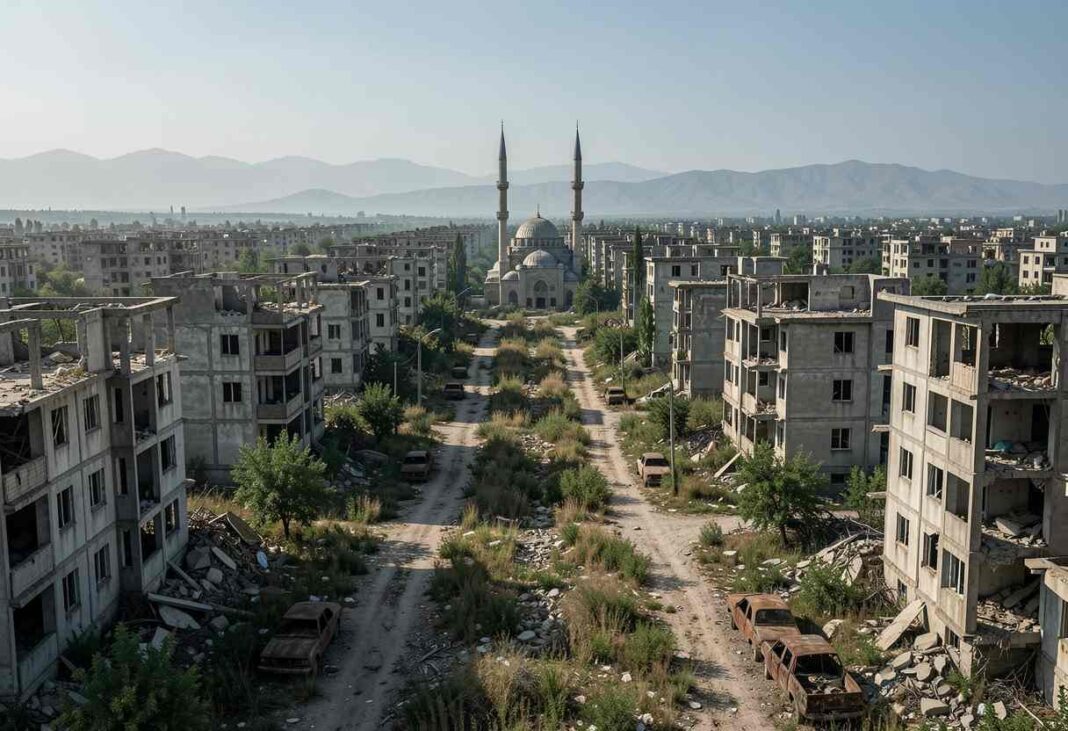
Image generated with Ai
Aghdam in Azerbaijan is being positioned for Americans as one of the most controlled yet compelling dark‑tourism cities in the world, a former town of tens of thousands that was devastated and emptied during the Nagorno‑Karabakh conflict in the 1990s and left as an immense, haunting landscape of ruins. The destination is now being opened in phases under a permit system, so any visit from the United States would require advance authorizations, careful planning and a high tolerance for post‑conflict realities.
A hidden dark‑tourism city for Americans
Aghdam was once a substantial Soviet‑era town in western Azerbaijan, complete with industry, residential districts and cultural facilities that supported tens of thousands of inhabitants before the First Nagorno‑Karabakh War. It has since been left as a sprawling ghost city of shattered apartment blocks, gutted public buildings and overgrown infrastructure, offering an unusually large‑scale, immersive experience of urban obliteration rather than a single memorial or museum. Specialist dark‑tourism platforms have been describing Aghdam as one of the world’s largest ghost towns, emphasizing its appeal for so‑called hardcore or extreme dark tourists who seek post‑war ruins, former front lines and abandoned cityscapes rather than conventional sightseeing. Regional travel and expedition operators have noted for years that Aghdam has had no standard tourist services, no signposted attractions and long periods during which the area was officially off‑limits or accessible only in highly restricted ways, which has naturally kept it far from the itineraries of mainstream holidaymakers.
For typical American travelers, Aghdam remains almost entirely unknown, as it tends to be discussed in conflict reporting, specialist dark‑tourism sites and niche blogs rather than on large consumer travel platforms and destination marketing channels. Mainstream dark‑tourism lists aimed at international leisure travelers routinely highlight Chernobyl, Auschwitz, Ground Zero, the Paris catacombs or Cambodia’s Killing Fields, and Aghdam is not mentioned in these round‑ups. Popular global features on dark‑tourism cities and sites generally focus on destinations such as Paris, Vienna, Budapest, Beijing or Bodie in the United States, while ghost‑town and abandoned‑city articles give space to places like Kolmanskop in Namibia or Craco in Italy but omit Aghdam. This pattern explains why Aghdam fits the profile of a hidden dark‑tourism city: it has been documented by experts and on the ground, but it has not been brought into the usual dark‑tourism canon presented to American readers.
How the destination is verified and framed
Aghdam is identified in encyclopedic references as a town and former city in western Azerbaijan’s Karabakh region that suffered heavy damage and depopulation during the Nagorno‑Karabakh War, with large‑scale destruction and displacement of its Azerbaijani residents. A well‑known dark‑tourism guide maintains a full entry on Aghdam and treats it as one of the largest ghost cities in the Caucasus, explaining that the town was left in ruins for decades and that access, after 2020, would only be possible from within Azerbaijan under changing restrictions. Regional overland and rally operators have described Aghdam as totally abandoned and used for years as a buffer zone near a militarized front line, officially off‑limits to tourists and occasionally visited only in tightly controlled or unofficial ways. When Aghdam is included in dark‑tourism round‑ups, the descriptions usually stress that the destination has not been open to regular tourist visits because of security and unresolved political issues, which reinforces its image as an extreme, specialist site rather than a casual stop.
Advertisement
Advertisement
Government travel advisories dealing with Azerbaijan have warned consistently that conflict‑affected districts, including Aghdam, are sensitive and may be subject to entry bans, restricted zones or higher security risks, and that travel in these areas must be approached with great caution, if it is allowed at all. At the same time, a leading dark‑tourism guide’s flagship list of the ten most popular dark‑tourism sites includes high‑profile places such as the 9/11 Memorial in New York, Auschwitz, Hiroshima Peace Memorial Museum and the Paris catacombs, but Aghdam does not appear anywhere in that ranking. The same guide’s overview and top‑ten pages cover a wide spectrum of global sites yet still omit Aghdam from the headline selections, even though a separate technical page has been devoted to the city. In combination, these sources confirm that Aghdam is a real war‑ruined city, treated in official and expert discourse as a sensitive post‑conflict area and an advanced dark‑tourism subject, but it is not presented as a mainstream destination to general audiences in the United States or elsewhere.
Dark‑tourism profile and on‑the‑ground reality
Aghdam is situated in western Azerbaijan and was heavily damaged and emptied during the early 1990s fighting, leaving behind an urban area filled with collapsed buildings, gutted interiors and infrastructure that has been gradually reclaimed by vegetation. The city lies in the Karabakh region, in territory that remained under Armenian control for many years after the war and that was retaken by Azerbaijan in 2020 under a ceasefire agreement, after which large‑scale reconstruction works and de‑mining operations were initiated. Dark‑tourism specialists have long emphasized Aghdam’s position as one of the largest ghost cities in the Caucasus and have suggested that the destination speaks most strongly to travelers interested in post‑war landscapes, abandoned urban zones and the physical traces of violence in the built environment. Since approximately 2021, visits to Karabakh and East Zangezur, including Aghdam, have been deliberately framed by Azerbaijan under a dark‑tourism banner, with state‑aligned media coverage focusing on delegations of international extreme travelers and specialized travel clubs brought in to see the destruction and the reconstruction.
Advertisement
Advertisement
For American visitors, it must be understood that Aghdam is not being presented as a normal city‑break location with cafes and nightlife, but as a politically sensitive former war zone where security considerations, mine clearance and major rebuilding projects are all happening simultaneously. The appeal lies in the ability to see both the ghost‑town legacy of the conflict and the state‑led effort to reshape the city and the region, rather than in conventional tourist amenities.
Historical background for context
Before the outbreak of war, Aghdam functioned as a typical Soviet regional center, with industrial plants, housing estates and cultural venues serving a substantial local population within Soviet Azerbaijan. When the First Nagorno‑Karabakh War escalated, Azerbaijani civilians were forced to flee or were displaced and the town came under Armenian control; in the subsequent period, large parts of Aghdam were looted for building materials or destroyed outright, leaving mostly roofless shells and a damaged central mosque as recognizable features. For many years after the ceasefire, the remains of the city lay in a militarized zone near the line of contact between Armenian and Azerbaijani forces, surrounded by trenches, minefields and military positions and effectively sealed off from ordinary visitors. A small number of highly adventurous travelers and bloggers managed to access the ruins via Nagorno‑Karabakh, but such visits were carried out despite official warnings and in the knowledge that the area was not intended for tourism.
Control over Aghdam was transferred back to Azerbaijan in 2020 as part of a ceasefire agreement after renewed fighting, and the city has since been incorporated into ambitious reconstruction and infrastructure plans for Karabakh’s so‑called liberated territories. In official narratives, Aghdam is being used as a symbol both of Armenian vandalism and of Azerbaijani resilience and rebuilding, so dark‑tourism visits are being described as opportunities to witness, in one place, massive war damage and an equally large reconstruction effort.
Access, safety and permits for Americans
For many years, Western foreign ministries, including those serving American travelers, have advised against all but essential travel to the conflict‑affected districts of south‑western Azerbaijan, and Aghdam has been explicitly named as an area where unexploded ordnance, instability and military sensitivities increase risk. Azerbaijan’s Ministry of Foreign Affairs has made it clear that any entry into Azerbaijani territory from Armenia or through unofficial routes is treated as a violation of national law, which can lead to criminal proceedings, fines and long‑term entry bans, a point that is particularly important for anyone who might consider using the Armenian side of Nagorno‑Karabakh as a back door.
In July 2025, a policy shift was announced by the State Tourism Agency and other Azerbaijani authorities, under which foreign nationals would be allowed to visit the liberated territories, including Aghdam, by private vehicle or as part of organized tours, provided that special regional permits were obtained through a designated online portal. Official and media reports have indicated that, between 2021 and 2025, more than a dozen dark‑tourism‑focused journeys were organized by international travel clubs into Karabakh and East Zangezur, with itineraries that specifically cited Aghdam on routes linking Aghdam, Khankendi, Lachin, Shusha and Fuzuli. As of early 2026, a national special quarantine regime is still being applied and land borders remain closed to general passenger traffic, so most Americans would be expected to arrive by air in Baku and then continue overland under domestic rules.
Because of these overlapping health, political and security constraints, any American traveler considering a visit to Aghdam would need to treat the region as a high‑risk, tightly controlled post‑conflict destination. Up‑to‑date travel advisories from the US Department of State would need to be checked, legal entry from the Azerbaijani side would need to be confirmed and permits and guided access would need to be arranged in advance with reputable operators.
Visa procedures and entry formalities
Azerbaijan operates a visa regime for most foreign nationals, and, although the exact category would vary by passport, Americans would generally be expected to obtain a visa before travel rather than rely on any last‑minute arrangements. Official and government‑linked sources explain that tourist visas can be obtained online through the ASAN e‑Visa system, with a typical tourist visa being valid for stays of up to 30 days and requiring a passport with at least six months’ validity beyond the intended date of entry. The standard documentation requested by the e‑Visa system includes a completed application, a passport scan, a recent photograph, evidence of accommodation (such as hotel bookings), a return or onward ticket and some indication of sufficient funds to cover the stay.
Many travelers are reminded by third‑party visa information services that those who plan to remain in Azerbaijan for more than 14 days must register with the State Migration Service to avoid fines for failure to register. It is also highlighted in travel resources that any traveler who has previously visited Nagorno‑Karabakh via Armenia may be refused entry or placed on a blacklist by Azerbaijan, so any dark‑tourism visit to Aghdam must be planned exclusively via the Azerbaijani side with clean, legal documentation. For Americans, the safest approach would be to consult the official e‑Visa platform, the Azerbaijani embassy or consulate and US government travel updates shortly before departure.
Getting there from the United States
Most American visitors would be expected to reach Azerbaijan by air, flying into Baku’s Heydar Aliyev International Airport via European, Middle Eastern or Eurasian hubs, since the extended quarantine regime and political decisions have kept land borders closed for regular passenger movements. From Baku, the opening of Karabakh’s liberated territories has been structured around road access by private vehicle or organized tour transport, both of which require the special regional permit issued through the government portal referenced in official communications. Reports on recent dark‑tourism and extreme‑travel delegations describe multi‑day road circuits that cover multiple districts, including stops in Aghdam, Khankendi, Lachin, Shusha and Fuzuli under strict guidance and supervision.
State‑aligned media have indicated that travelers who book accommodations in the liberated territories can have the necessary entry permits generated alongside their hotel confirmations, which is intended to streamline the process and encourage tourism to these politically significant areas. Because infrastructure, services and cleared safe zones within Aghdam are still being developed, it is likely that Americans would be accommodated in Baku or other established cities and would then visit Aghdam as part of guided day‑trips or tightly planned multi‑day excursions rather than staying in the city itself in a conventional way.
What can be seen in Aghdam
The attractions in Aghdam are shaped almost entirely by war damage, abandonment and reconstruction, not by the usual urban tourism mix. The ruined residential quarters and public buildings show the long‑term effects of shelling, looting, structural collapse and decades of neglect, creating an urban landscape that reflects both sudden destruction and slow decay. The surviving mosque, with its damaged but still standing twin minarets, has often been photographed rising above empty streets and has become a visual symbol of devastation and cultural endurance. Former front‑line positions, overgrown infrastructure and terrain marked by trench lines illustrate the scale of the militarized no man’s land that once surrounded the city.
Alongside these remnants, new construction sites, highways and civic projects are being showcased by the Azerbaijani state as evidence of the rebirth of Karabakh, so visitors are being shown both the ruins and the rebuild. State news coverage of recent dark‑tourism delegations has emphasized that these groups are being brought to observe both the traces of vandalism attributed to the conflict and the active restoration works, in order to understand the human and material cost of the war. Because of mine risks, unexploded ordnance and ongoing construction, independent wandering has been strongly discouraged, and travelers are being advised to expect escorted movements, fixed viewing points and structured commentary rather than free exploration.
When to go and what it might cost
There is no dedicated tourist season for Aghdam itself, but broader guidance for travel in Azerbaijan indicates that spring, roughly April to June, and autumn, roughly September to October, usually provide the most comfortable conditions for overland journeys. For a dark‑tourism visit, however, the key factors are the operational status of permits, security conditions, road accessibility and the availability of organized tours. Official statements from 2025 and 2026 have portrayed the opening of the liberated territories as a phased process, which suggests that access conditions and available infrastructure are likely to evolve. With a special quarantine regime extending to at least April 2026 and land borders remaining closed to normal passenger flows, Americans would need to track Azerbaijani government communications and US travel advisories while selecting dates.
Exact price data for Aghdam is not being published yet, so American travelers must rely on general costs for Azerbaijan. Baku is served by a range of airlines, and return economy fares from major European or Middle Eastern hubs are commonly placed in the low‑ to mid‑hundreds of US dollars, with higher fares from North America due to longer routes and connections. The ASAN e‑Visa fee for a standard tourist visa is usually cited as around 25 US dollars for regular processing, with a three‑working‑day turnaround and a higher charge for urgent processing. Hotels in Baku range from budget guesthouses to international chains, typically at lower price levels than equivalent properties in Western European capitals, while new properties are being developed in the liberated territories but without broad, reliable pricing data yet for the Aghdam area. Domestic transport within Azerbaijan is generally affordable, with modern intercity buses and shared taxis in use, but access to Karabakh, including Aghdam, is being organized around private vehicles and tour buses operating under the permit system, which will likely command a premium over standard domestic routes. Government and media sources have not provided fixed permit fees for Aghdam, and most visits so far appear to be embedded in multi‑day, higher‑cost extreme‑travel or dark‑tourism packages rather than inexpensive day excursions.
For an American planning a research or feature‑driven visit, budgeting is best approached by combining typical Baku flight and hotel costs with a significant additional allowance for specialized Karabakh touring and permit logistics, acknowledging that the market is still in rapid development.
Why Aghdam may appeal to American dark‑tourism travelers
Aghdam offers a combination of factors that is rarely encountered in a single destination. The city constitutes a complete destroyed urban area rather than a single ruin, allowing an unusually deep immersion in the physical consequences of war and displacement. The location lies at the intersection of very recent armed conflict, ongoing political tension and intense reconstruction, so visitors are able to observe both decayed ruins and new state‑driven projects in the same place. The Azerbaijani government has chosen to label certain visits as dark tourism and to invite international extreme travelers and delegations into the area, creating a curated narrative and a structured system of access rather than unregulated exploration. For American audiences, Aghdam remains largely absent from mainstream dark‑tourism and ghost‑city lists, which gives travel writers, documentary makers and highly motivated travelers an opportunity to cover a destination that has official, encyclopedic and specialist documentation but very little consumer‑level storytelling.
At the same time, the ethical dimension is central: this is a location where civilians were displaced and lives were lost, and where present‑day narratives are strongly contested. Any American traveler approaching Aghdam as a dark‑tourism site would be expected to adopt a respectful, non‑sensational tone, acknowledge the political context and be transparent about the ongoing impacts of the conflict. In practical terms, travelers would need to stay informed about official US and Azerbaijani travel advisories, enter only via authorized checkpoints on the Azerbaijani side with the correct permits and rely on Baku or other cities for full‑service accommodation, health care and support rather than expecting a functioning tourist infrastructure on the ground in Aghdam.