As Prime Minister Mark Carney heads to India this week for trade talks, police have warned a Canadian Sikh leader about a “credible threat” to his life.

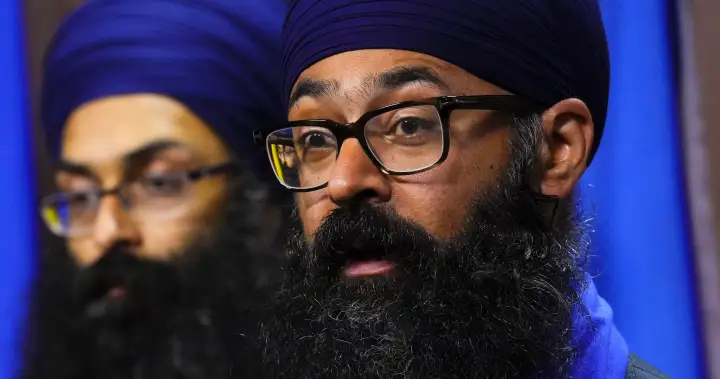
Moninder Singh, who heads the Sikh Federation of Canada, said a member of the Vancouver Police Department delivered the caution on Sunday.
The tip about the threat came from a confidential informant, the officer told Singh, whose wife and children were also deemed to be at risk.
The Sikh activist, who lives in Surrey, B.C., shared an audio recording of the police visit, as well as a photo of the officer’s business card, with Global News.
“From time to time, the VPD conducts what is called a ‘Duty to Warn’ when we receive information regarding a threat to someone,” a police spokesperson said.
“I can’t comment on if any ‘Duty to Warn’ incidents happened over the weekend as there would be an ongoing criminal investigation associated.”
Police did not share any further details but Singh believes it is the latest attempt by the government of India to silence its Canadian opponents.
in 2022, Singh and fellow activist Hardeep Singh Nijjar were the first to receive a duty to warn notice. Nijjar was gunned down the following year, allegedly by the Indian government.
Since then, police have warned Singh periodically about new threats against him but last weekend’s was the first to include his family.
Since he is not a business person like those typically preyed upon by India’s extortion gangs, he suspects he is being targeted because of his activism.
Singh is an outspoken critic of human rights in India, and an advocate of the Khalistan movement that supports independence for India’s Sikh-majority Punjab.
The RCMP has previously linked such threats to the Indian government, and Singh believes that is also the case for this latest caution from police.
“India uses criminal syndicates, gangs in Canada, to carry out their dirty work for them,” he said. “India taps them and then they go out and carry these political assassinations out.”
“So I feel like the reason why they’re targeting me, for my political expression, my support for a Sikh homeland, Khalistan, or unveiling India’s horrible human rights record, I think it comes back to India.”

Carney’s India visit a ‘slap in the face’
For Singh, the incident has underscored concerns that Carney is re-engaging with India without regard to the safety of Canada’s large Sikh community.
Under pressure to diversity Canada’s trade partners amidst U.S. President Donald Trump’s unpredictable tariffs, Carney has turned to India.

Get daily National news
Get the day’s top news, political, economic, and current affairs headlines, delivered to your inbox once a day.
But national security officials have reported that the government of India is behind foreign interference, disinformation and transnational repression in Canada.
The RCMP believes the Indian government has collaborated with the Bishnoi gang to attack political opponents, notably Nijjar, who was killed outside a Surrey Sikh temple in 2023.
Gang leader Lawrence Bishnoi and his Canadian lieutenant Goldy Brar allegedly carried out the killing for India. The crime group is also partly responsible for the current extortion crisis in Canadian cities.
Following Nijjar’s murder, the FBI uncovered a similar plot by an Indian intelligence officer to kill Canadian lawyer and activist Gurpantwant Singh Pannun in New York.
Then, RCMP Commissioner Mike Duheme accused India of orchestrating a broader array of violent crimes, prompting Canada to expel six India diplomats in October 2024.
Indian diplomats and agents were engaging in “clandestine activities” such as collecting information on members of Canada’s South Asian community, he said.
“This information is shared with senior levels of the Indian government, who then direct the commission of serious criminal activities against Indo-Canadians through the kinetic use of Lawrence Bishnoi’s organized crime network,” National Security Advisor Nathalie Drouin testified.
“Bishnoi is currently in jail in India, and he is able to order these actions through his gang, which has extensive criminal networks in India and internationally,” she said.
“Serious crimes committed in Canada include homicides, assassination plots, perpetrated extortions and other extreme violence.”
At the same time, Canada’s foreign interference inquiry called India the “second most active country engaging in electoral foreign interference in Canada.”


In an interview on Monday, Singh said he had received no assurances from Canadian officials that those issues had been resolved, or that India had promised to stop.
Deepening ties with Indian Prime Minister Narendra Modi’s government without having dealt with the underlying national security threats was premature, he said.
“There’s a lot of unfinished business,” Singh said, adding that many Canadian Sikhs felt betrayed to see Carney and his officials meeting their Indian counterparts.
“It’s a bit of a slap in the face of the Sikh community that we have all these ongoing issues and we’re talking to a country that’s behind all of that.”
“We’re not holding them accountable in any which way.”

‘Proof lies on the accuser,’ Indian diplomat says
Throughout Canada’s various disclosures of India’s actions, New Delhi has denied them and put the blame on former prime minister Justin Trudeau, while claiming it needs to see evidence before taking action.
“The burden of proof lies on the accuser, not on the accused,” Indian High Commissioner Dinesh Patnaik told Global News in an interview on Monday.
Patnaik vowed that if such evidence surfaced, India would take action, even if it implicated senior officials in Modi’s government.
He said he had no response to latest Canadian Security Intelligence Service annual report, which referred to India’s role in the Nijjar murder.
The killing signalled “a significant escalation in India’s repression efforts against the Khalistan movement and a clear intent to target individuals in North America,” CSIS wrote.
“I cannot say anything about it,” said Patnaik, who replaced the previous high commissioner expelled from Canada for his role in violence against Canadians.
“Same way when we have our own report, it says that Canada supports separatist movements in India, that Canada support Khalistani movement in India,” he said.
“That’s the way our agencies look at it.”
Asked about extortions by Indian nationals working for India-based crime groups such as the Bishnoi gang, he said that was Canada’s problem.
An RCMP report released to Global News under the Access to Information Act said the Bishnoi gang was “acting on behalf of the Indian government.”
“You have to deal with it. If you start pointing fingers outside, that’s a different matter. It’s very easy to point fingers outside,” the high commissioner said.
Stewart.Bell@globalnews.ca