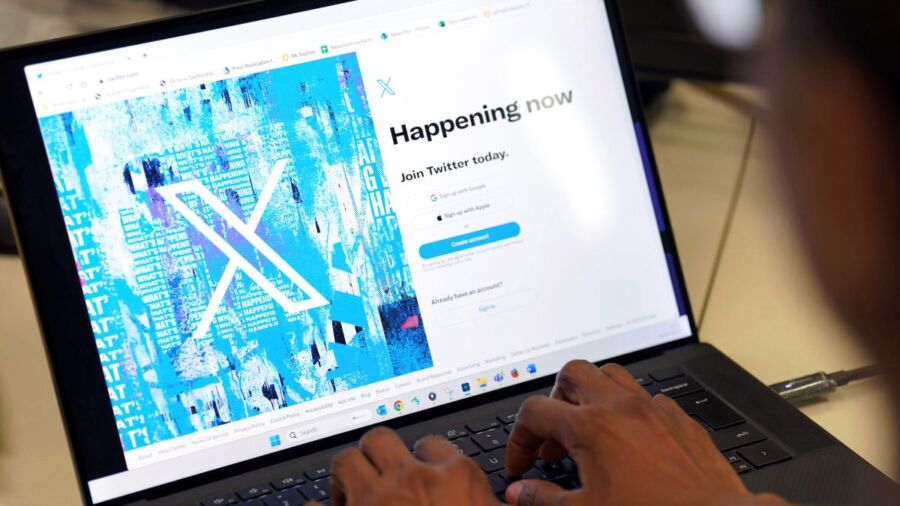
Nikita Bier, X’s head of product, accused the Chinese Communist Party of flooding Chinese-language search results on the platform with pornographic spam during periods of political unrest, saying the tactic is intended to obscure real-time information on the platform.
Bier made the allegation on Jan. 30 in response to a user complaint that Chinese-language searches were nearly unusable because of spam and illicit ads, with some recent posts missing from results. He said the disruption was deliberate.
“The Chinese government floods X search results with porn whenever there is political unrest—to prevent their citizens from finding out real-time information,” he wrote. “This has been a difficult problem to solve, but we are aware and working on it.”
NTD observed similar patterns in Chinese-language searches on X for place names such as “Beijing,” “Tianjin” and “Shanghai,” which returned waves of spam and illicit posts from Chinese-language accounts, many featuring QR codes linking to unrelated Chinese websites.
In a follow-up post, Bier said the activity appeared to originate from a “pool of 5 to 10 million accounts” created before X tightened restrictions on new account sign-ups. He did not provide details on how the accounts were identified or how the company plans to address the issue.
The comments stand out as one of the most explicit public allegations against Beijing by a senior X executive since Elon Musk acquired the platform in 2022.
Influence Operations Beyond the Firewall
X has been blocked in China since 2009 under the country’s “Great Firewall.” Still, it remains accessible through virtual private networks (VPNs), and plays an outsized role in the Chinese diaspora and among activists, journalists, and academics seeking to share uncensored information.
That role has also made the platform vulnerable to manipulation.
During the nationwide protests against Beijing’s “zero-COVID” policy in late 2022, media reports said Chinese-language searches on Twitter began returning large volumes of adult content and escort advertisements, pushing protest-related posts out of view. At the time, some analysts said it was unclear whether the surge was coordinated by the state or driven by commercial spam networks exploiting heightened traffic.
Before Elon Musk acquired Twitter in 2022, Twitter documented multiple efforts to take down tens of thousands of fake accounts that it believed were being coordinated by China.
In 2019, Twitter said it uncovered hundreds of accounts working to inflame political tensions during the Hong Kong protests. A year later, the company disclosed a far larger operation—a “highly engaged core network” of 23,750 accounts, backed by roughly 150,000 amplifiers designed to push their messaging at scale.
“In general, this entire network was involved in a range of manipulative and coordinated activities,” Twitter said in a June 2020 disclosure. “They were Tweeting predominantly in Chinese languages and spreading geopolitical narratives favorable to the Communist Party of China.”
Public disclosures of state-linked Chinese networks largely stopped after Musk’s takeover, following deep cuts to teams responsible for trust, safety, and foreign influence monitoring. In its most recent transparency report, X said it removed 335 million accounts for suspected manipulation and spam in the second half of 2024.
New X Feature Spotlights China-Linked Activity
A recently introduced X feature may offer the public a new way to spot accounts linked to China.
The platform has rolled out an “About this account” panel that shows where an account was created and where it is currently “based,” using aggregated IP address data. If a user connects through a virtual private network, the account will appear as being “based in” the location of the VPN server.
Researchers and watchdog groups say the feature has revealed hundreds of accounts listed as “based in” China, suggesting they are connecting from Chinese IP addresses without using VPNs—something experts say should not be possible for ordinary users, given that X is blocked in the country.
Concerns about possible privileged access are not new. In 2019, Twitter said that while many China-linked accounts relied on VPNs to reach the platform, some accessed Twitter from “specific unblocked IP addresses originating in mainland China.”
The Epoch Times reported that accounts listed as based in China may have been granted direct access to the platform from Beijing. Analysts cited in the report said many of the accounts post at unusually high volumes and amplify Chinese Communist Party messaging, often in coordinated bursts around politically sensitive topics.
The comments by a senior X executive contrast with the more cautious approach typically taken by the platform’s owner, Elon Musk. Musk has typically been cautious on China, where Tesla operates its largest factory, and has criticized U.S. efforts to restrict Chinese tech firms or ban platforms such as TikTok.
While Musk has previously called China’s ban on X “unbalanced,” he has rarely accused Beijing of covert manipulation of his platform.
China has not responded publicly to the comments by X product chief Nikita Bier.