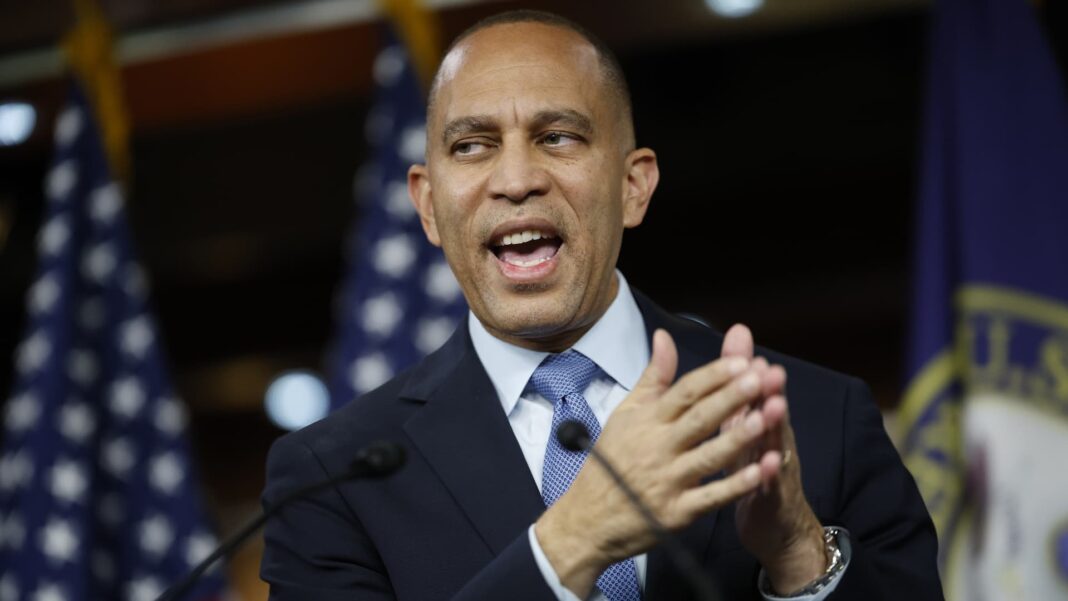
U.S. House Minority Leader Hakeem Jeffires (D-NY) speaks at a press conference on the government shutdown at the U.S. Capitol on Oct. 8, 2025 in Washington, DC.
Kevin Dietsch | Getty Images
Congressional Democrats will force a vote on a war powers resolution relating to Iran next week, Democratic leadership announced Thursday, as President Donald Trump engages in a massive military buildup in the region. The resolution would limit Trump’s ability to conduct military action there.
Reps. Ro Khanna, D-Calif., and Thomas Massie, R-Ky., have introduced a measure known as a war powers resolution that would compel the administration to seek congressional approval before engaging in any further activity in Iran. Congress has the sole authority to declare war under the U.S. Constitution, though that authority has been stretched in recent years by the executive branch.
“As soon as Congress reconvenes next week, we will compel a vote of the full House of Representatives on the bipartisan Khanna-Massie War Powers resolution,” the Democratic leaders led by House Minority Leader Hakeem Jeffries, D-N.Y., said in a statement.
“The Iranian regime is brutal and destabilizing, seen most recently in the killing of thousands of protestors,” the statement read. “However, undertaking a war of choice in the Middle East, without a full understanding of all the attendant risks to our servicemembers and to escalation, is reckless.”
The war powers resolution would also need to be approved by the Senate if it is passed by the House. But passage from the House is far from a guaranteed outcome as bipartisan lawmakers have recently lined up against the resolution.
Reps. Mike Lawler, R-N.Y., and Josh Gottheimer, D-N.J., released a statement last week opposing the measure, citing concerns about Iran’s nuclear and ballistic missile capabilities.
“We respect and defend Congress’s constitutional role in matters of war. Oversight and debate are absolutely vital,” the pair wrote. “However, this resolution would restrict the flexibility needed to respond to real and evolving threats and risks, signaling weakness at a dangerous moment.”
Trump has overseen a massive military buildup in the Middle East and has threatened strikes against Iran. His administration is also negotiating with Tehran over the country’s nuclear program. The two countries held a third round of talks in Geneva on Thursday.
Omani Foreign Minister Badr Albusaidi in a post on X described the day’s negotiations as having made “significant progress.” He said technical discussions will continue next week in Vienna and that the principals would reconvene “soon after consultation in the respective capitals.”
The president said during his State of the Union address Tuesday that he prefers to resolve the Iran situation diplomatically but did not take military force off the table.
“I will never allow the world’s No. 1 sponsor of terror, which they are by far, to have a nuclear weapon,” Trump said.