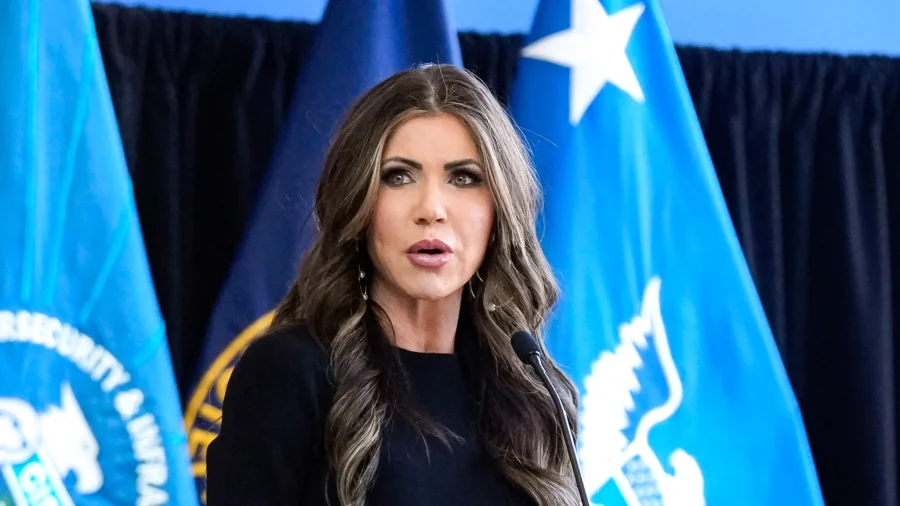
Secretary of Homeland Security Kristi Noem said Harvard University is “beginning to regret” picking a fight with the Trump administration over international students.
In an op-ed for the Washington Post Monday, Noem maintained that she is still prepared to withdraw Harvard’s Student and Exchange Visitor Program certification, despite an ongoing battle in the courts. Noem cited Harvard’s failure to crack down on anti-Semitic discrimination and its alleged collaboration with the Chinese Communist Party as reasons for the withdrawal.
Noem called the SEVP program a “cash cow” for Harvard, noting that by its own estimates, 27 percent of its students are international. She also cited data showing that international students contribute some $383.6 million to the surrounding community’s economy. International students also pay more in tuition than outside students, and often account for shortfalls in state funding for research universities, a recent study found.
Noem noted that the SEVP-certified schools are required to comply with all applicable federal laws, regulations and Department of Homeland Security (DHS) requirements. She also said these schools have “a moral obligation to provide basic safety” for domestic and foreign students alike. But Harvard’s failure to put a stop to anti-Semitic discrimination against Jewish students since the Oct. 7, 2023 attacks by Hamas against Israel; and its efforts to stonewall federal investigations into student activists suspected of criminal activity, represented a failure in both obligations.
Futhermore, Noem pointed out that Harvard is under investigation by the House of Representatives for allegedly collaborating with groups tied to the Chinese Communist Party. A May 19 letter from the House Select Committee on the CCP, the Committee on Education and the Workforce, and House Republican Conference Chairwoman Elise Stefanik accused Harvard of multiple instances of collaborating with Chinese academics in ways that pose significant risks to national security and enable the genocide of the Uyghurs in Xinjiang, including:
- providing services and training to members of the Xinjiang Production and Construction Corps—a Chinese paramilitary organization that is one of the primary implementers of the genocide in Xinjiang—at multiple conferences as recently as 2024 in partnership with the Chinese government, despite the fact that the group has been on the Treasury Department’s Specially Designated Nationals and Blocked Persons List since 2020;
- collaborating on research projects with researchers linked to the Chinese military, funded by grants from the government of Iran, in violation of U.S. sanctions;
- working with Chinese military-linked institutions on research projects funded by the Department of Defense;
- working with those same institutions on projects with military applications;
- working with Chinese researchers on organ transplant research.
“This pattern of behavior raised one simple question: Could DHS continue to allow Harvard to bring in foreign students without doing harm?,” Noem wrote. “The answer is a clear no.”
Immigration and Customs Enforcement acting director Todd Lyons sent a letter to Harvard in May notifying the university that its SEVP certification would be withdrawn by June 27. Noem said that in order to maintain its SEVP certification, Harvard must provide all the documents requested by DHS, stop collaborating with hostile foreign actors, and fall back in line with the other requirements of the program. If not, Harvard would no longer be allowed to accept foreign students, and current international students would have to transfer.
U.S. District Judge for the District of Massachusetts Allison Burroughs issued a preliminary injunction Friday preventing DHS from enforcing its withdrawal. Noem claimed that Burroughs “[took] no time to weigh the merits of the case,” and that DHS is within its authority to revoke Harvard’s SEVP certification. “We fully expect to prevail,” she wrote.
President Donald Trump also issued a separate proclamation on June 4 blocking any and all foreign students from entering the country to study at Harvard. Burroughs issued a temporary restraining order blocking the proclamation a day later. That order expired on Friday; Burroughs did not address the proclamation in her Friday injunction, and no injunction has been published as of the writing of this piece.
But amidst the legal battle, Trump said on Truth Social Friday that a deal between Harvard and the federal government could be reached in the coming days.
“Harvard no doubt is beginning to regret escalating its fight with the Trump administration,” Noem concluded. “Harvard must decide whether it wishes to be a partner to the United States, or an adversary to American values.”