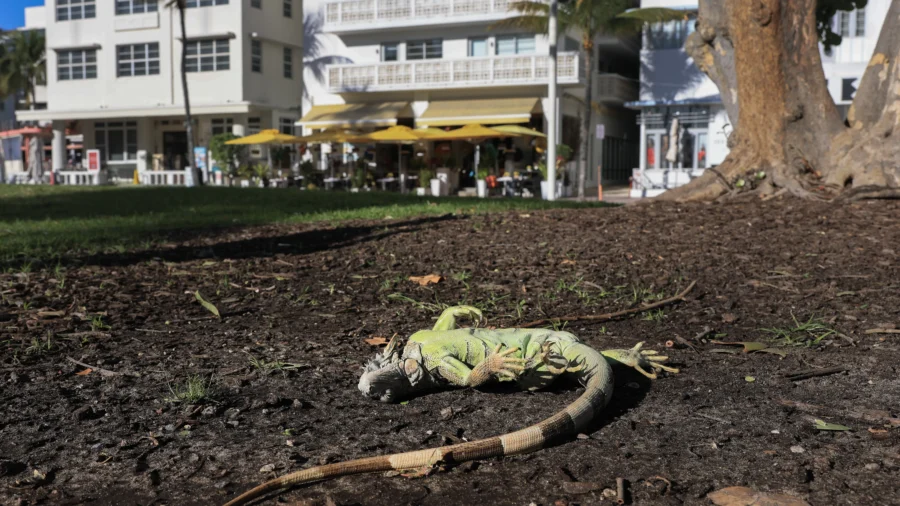
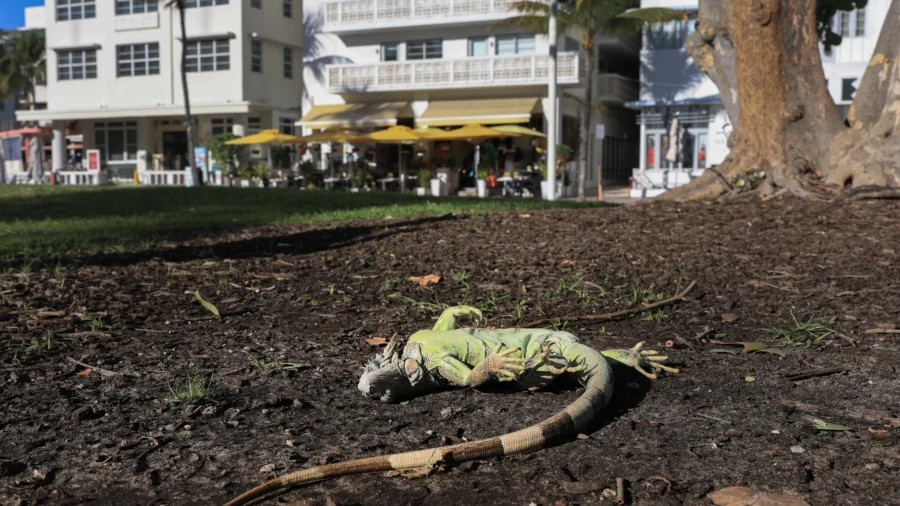
Florida’s unseasonable cold snap is creating an unusual opportunity for residents to help combat one of the state’s most persistent invasive species. Starting this weekend, the Florida Fish and Wildlife Conservation Commission (FWC) is allowing the public to collect cold-stunned green iguanas without permits and drop them off at designated facilities.
The FWC issued an executive order on Jan. 30 granting the temporary allowance starting on Sunday, Feb. 1 through Monday, Feb. 2. The initiative capitalizes on a biological phenomenon in which reptiles enter a state of reduced mobility when temperatures plummet.
“When temperatures drop and sustain to near-freezing or below, reptiles and amphibians, including nonnative green iguanas, can go into a state of torpor, where they temporarily lose muscle control and appear ‘frozen’—sometimes even falling out of trees,” the FWC said.
Torpor, by contrast, involves “brief periods of inactivity lasting from a few hours to several days” during which “animals are still responsive to external stimuli and must still find time to forage for food,” according to Turpentine Creek Wildlife Refuge.
Green iguanas have emerged as an environmental and economic threat to Florida. The reptiles are classified as a prohibited species in the state, and possession typically requires a permit.
Collection and Transport Requirements
The FWC has established five drop-off locations across South and Southwest Florida. Collection sites are open from Sunday, Feb. 1, from 9 a.m. to noon, and Monday, Feb. 2, from 8 a.m. to 4 p.m.
- FWC South Florida Regional Lab, 2796 Overseas Highway 119, Marathon, FL 33050
- FWC Office, 10052 NW 53rd, Sunrise, FL 33351
- FWC Tequesta Field Lab, 19100 SE Federal Highway (US 1), Tequesta, FL 33469
- FWC Law Enforcement Office, 2423 Edwards Drive, Fort Myers, FL 33901
- FWC Southwest Regional Office, 3900 Drane Field Road, Lakeland, FL 33811
The commission has issued specific safety guidelines for collection. Collectors should “wear protective gloves, pants and long-sleeved shirts to protect themselves from potential scratches.” The iguanas must be placed in cloth sacks or bags—materials chosen specifically “to ensure breathability”—which should then be secured in a locked transport container labeled “Prohibited Reptiles.”
“Collected iguanas should be transported to the FWC immediately to limit the likelihood of the iguanas regaining their ability to move freely,” the agency said.
Collection bags must remain sealed throughout transport to prevent the reptiles from escaping either into new locations or within the vehicle as they recover mobility.
“You should never bring it into your home or building to warm up and never put it into your vehicle unless specifically transporting to the FWC under the regulations of EO 26-03,” according to agency guidance.
“Iguanas can recover from cold-stunning more quickly than you might expect and, once recovered, can act defensively, with long tails that whip and sharp teeth and claws,” the agency said.
Addressing a Broader Invasion
Green iguanas represent just one facet of Florida’s invasive species crisis. According to the FWC, more than 600 nonnative fish and wildlife species have been documented in Florida, and about 80 percent arrived through the live animal trade; 139 of these are now considered established in the state, meaning they are successfully reproducing in the wild.
Invasive species management has become a priority because these animals “negatively impact native fish and wildlife, cause damage that is costly to repair, and can pose a threat to human health and safety,” according to the FWC.