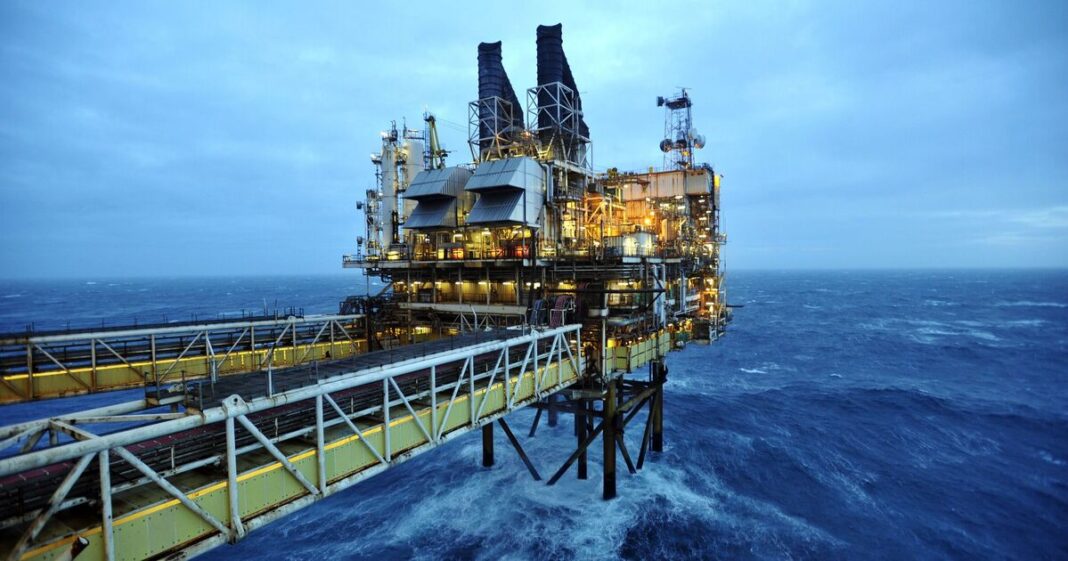

North Sea oil drilling won’t hand households as much as renewables (Image: Getty)
Every household in the UK could save £82 from their energy bills if North Sea Oil drilling was expanded, according to new analysis by academics.
But the saving pales in comparison with what could be saved with investment in renewable energy, says Dr Anupama Sen, co-author and Head of Policy Engagement at the University of Oxford’s Smith School of Enterprise and the Environment, which says households could get a £441 saving each instead.
Conservative Shadow Chancellor Mel Stride has renewed calls to expand drilling in the UK’s North Sea Oil fields in a bid to reduce the country’s dependence on imported energy and ease the burden of the looming energy bills crisis for households in the wake of the conflict in Iran, which is forecast to increase gas and electricity bills by as much as 20% from July.
A new OEUK report has called on the UK Government to back domestic oil and gas alongside renewables to secure energy supply, including drilling in the North Sea.
Read more: Older state pensioners handed £438 ‘additional’ boost from April
Read more: Martin Lewis urges everyone with a Cash ISA to act now
The 2026 business outlook report on the UK’s offshore energy system claims the UK will continue to need ‘significant volumes’ of oil and gas for decades to come, even with accelerating use of renewables.
The report warns that without more domestic production the UK risks becoming increasingly reliant on energy imports at a time of rising global instability.
Enrique Cornejo, director of energy policy at OEUK, said the trade body is still considering climate targets while pointing to the UK’s need for domestic oil and gas. He said: “We are continuing to support the development of renewable energies, we think that’s important.
“However, our position remains the same; for as long as the UK needs oil and gas, it makes sense to produce as much of that here.
“Our position is, obviously, climate change is important, and what we’re setting out here is that there is a pathway to meet climate targets that makes a responsible use of our homegrown resources, and that also ensures that we do not offshore those emissions to other countries.
“Because of how accounting of carbon emissions works for every country, it would be very easy for us to just say we will not produce our energy in the UK, or we will not produce our steel in the UK, and we’re just pushing that problem elsewhere.”
Analysis released on March 16 by the University of Oxford’s Smith School of Enterprise and Environment suggests that ‘maximising’ oil and gas extraction from the North Sea could save households between £16 and £82 a year each, if the tax revenues collected from the extra drilling were then redistributed to household bills.
But focusing instead on renewable energy would hand every household £441 a year under the same redistribution, says Dr Sen.
She said: “We show that regardless of the remaining lifetime of North Sea oil and gas, a ‘drill baby drill’ approach to extraction would actually cost households more money versus continuing on our path to clean energy.”
The estimated savings to households from maximised North Sea extraction assume that the Government would use the extra tax revenues solely to help lower household bills.
“If the Government did not choose to do this, there would be no discernible benefit to UK households at all, because oil and gas prices are set on and influenced by international markets – and we can see from recent events just how volatile they are,” warns Dr Sen.
The analysis used oil and gas prices from January 2026 before the recent spike caused by the conflict in Iran.
“Our analysis represents a conservative scenario, in which renewable energy competes against cheap fossil fuels. Even in this ‘worst case’ scenario, renewables are shown to be significantly more cost competitive,” says co-author Nadia Schroeder.
The authors stress that the savings gained from the clean energy transition are recurring annual reductions in bills which would continue indefinitely, whereas North Sea oil and gas is a finite resource that would run out around 2040.
“With the right mix of policies, households in the UK could benefit from lower bills and stable energy prices long into the future,” says Dr Sen.
A UK Government spokesperson said: “Issuing new licences to explore new fields cannot give us energy security and will not take a penny off bills.
“Regardless of where it comes from, oil and gas is sold on international markets, which set the price for British billpayers – making us a price taker.
“The only way to truly protect ourselves from these price spikes is to get off the rollercoaster of fossil fuel markets.”