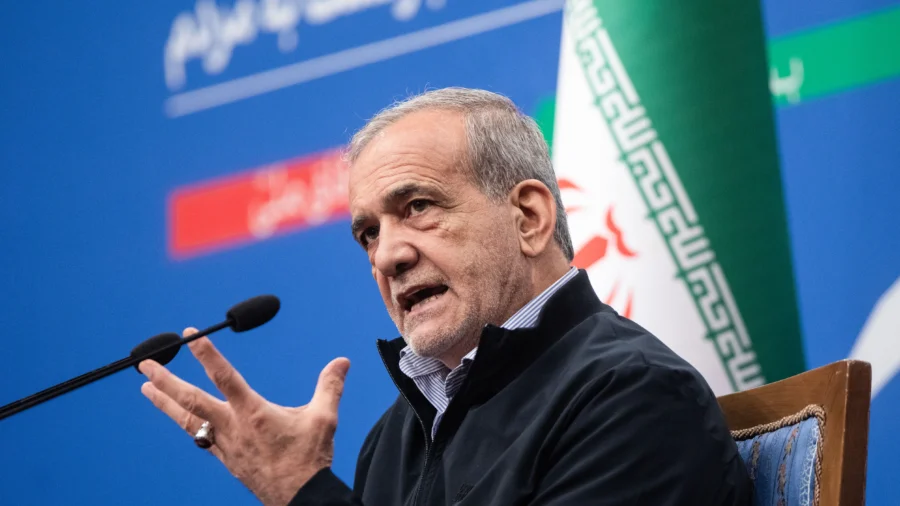
Iranian President Masoud Pezeshkian said on Dec. 27 that the Iranian regime is in a full-scale war with the United States, Europe, and Israel—months after his country’s nuclear facilities were bombed during a 12-day-long aerial war.
“In my opinion, we are in a full-fledged war with America, Israel, and Europe; they do not want our country to stand on its feet,” Pezeshkian said. “This war is worse than Iraq’s war against us; if one understands it well, this war is far more complex and difficult than that war.”
The 1980–1988 war with Iraq left more than 1 million casualties on both sides and included reports of chemical weapon and gas attacks.
The U.S. and Israeli militaries both launched strikes on Iranian nuclear facilities and other areas during a nearly two-week-long conflict in June. Iran launched a barrage of missiles at Israel and at a U.S. air base in Qatar in response.
The Trump administration and Israeli officials have long said the Iranian regime is seeking to manufacture nuclear weapons and long-range missiles with its nuclear program.
In mid-November, Iranian Foreign Minister Abbas Araghchi said that Tehran is no longer enriching uranium at any site in the country, giving the most direct response yet from the Iranian government regarding its nuclear program following the June bombing of its enrichment sites.
The minister then reiterated Iran’s longtime narrative that its nuclear program is for peaceful purposes, which the United States, Israel, and the UK have all refuted. The U.N.’s nuclear watchdog, the International Atomic Energy Agency (IAEA), has long said that Iran has displayed a lack of transparency around its program and restricted international inspectors from monitoring the country’s facilities.
“We have this right, and we continue to exercise that, and we hope that the international community, including the United States, recognize our rights and understand that this is an inalienable right of Iran,” Araghchi said. “And we would never give up our rights.”
Iran’s nuclear chief, Mohammad Eslami, recently prohibited officials from the IAEA from inspecting the bombed nuclear facilities.
The Associated Press contributed to this report.