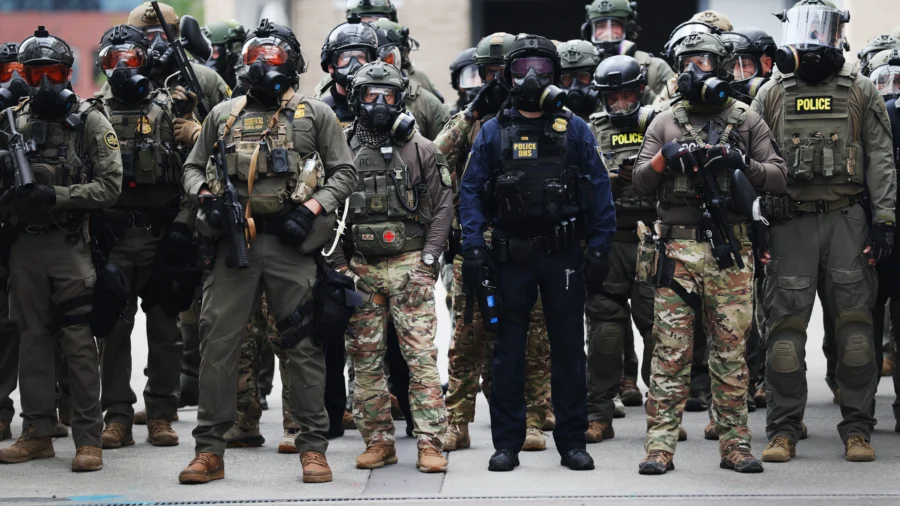
A federal judge temporarily blocked the deployment of 200 National Guard troops to Portland on Oct. 4, as violent protesters continue to target federal immigration officers. The judge ruled that the action is outside of the president’s executive authority.
“This country has a longstanding and foundational tradition of resistance to government overreach, especially in the form of military intrusion into civil affairs,” U.S. District Judge Karin J. Immergut wrote in her order.
“This historical tradition boils down to a simple proposition: this is a nation of Constitutional law, not martial law. Defendants have made a range of arguments that, if accepted, risk blurring the line between civil and military federal power—to the detriment of this nation,” she added.
At the request of the president, War Secretary Pete Hegseth issued a memo on Sept. 28 to the leader of the Oregon National Guard saying that 200 members would be called into federal service for a period of 60 days under Title 10, Section 12406 of the U.S. Code.
That same day, Oregon filed a lawsuit seeking to block that federalization, arguing that the president was exceeding his executive authority.
Immergut sided with Oregon, finding the state would “suffer an injury of sovereignty.” She granted a temporary restraining order that will last until Oct. 18.
“Because Oregon is likely to succeed on its Tenth Amendment claim, it will also likely suffer irreparable harm in the absence of a temporary restraining order,” the judge wrote.
The White House said on Sept. 28 that the president was acting within his authority, citing months of violent unrest outside federal immigration facilities in Portland.
“The President’s lawful actions will make Portland safer.”
However, Immergut stated “the deployment of federal law enforcement officers to Portland in 2020 “reignited” protests and riots that had “largely self-extinguished.”
She is not the first federal judge to reach this decision. U.S. District Judge Charles Breyer came to the same ruling on Sept. 2 when the state of California sued to stop the federalization of the National Guard and deployment of Marines in Los Angeles. That ruling was subsequently blocked by an appeals court.
The White House will now appeal the decision.
“President Trump exercised his lawful authority to protect federal assets and personnel in Portland following violent riots and attacks on law enforcement,” Jackson said. “We expect to be vindicated by a higher court.”