
MEMPHIS, Tenn.—President Donald Trump on March 23 informed National Guard members deployed to combat violent crime in Memphis, New Orleans, and Washington, as well as along the U.S. border, that they will receive the same benefits as active duty personnel.
Trump said the perks were awarded because they “deserve it.”
Secretary of War Pete Hegseth thanked the president for approving the directive, suggesting that it sends a message about the administration’s priorities.
“No longer will we sit idly by while savage criminals rape, murder, and poison the good people of this country,” he said. “Every American, without exception, is entitled to safe, clean, and beautiful cities.”
Trump announced the change during a gathering of administration officials in Memphis overseeing the Memphis Safe Task Force on March 21.
The roundtable discussion focused on law enforcement leaders’ objectives and achievements following joint federal and local efforts launched in October.
“This is like an entirely different place,” Trump said, emphasizing the 5,100 National Guard members and 22 partnering organizations that joined the initiative after Tennessee Gov. Bill Lee requested federal support in the city.
“Look at the results you got,” he said.
Operations netted 7,342 arrests—including 757 gang members—removed 811 illegal aliens, seized more than 1,200 firearms, and recovered 150 missing children.
Murders fell by 37 percent, sexual assault declined by 40 percent, robbery slid by 56 percent, and vehicle theft dropped by 68 percent, according to statistics presented at the event.
Criminal cases were cleared at a rate 68 percent higher than that of the previous year.
The president predicted more success in the near future.
“In a few more months, you’ll have almost no crime,” Trump said.
State leaders applauded the task force’s efficacy and pledged to strengthen efforts moving forward.
“We’re not done, but the statistics speak for themselves,” Lee said.
More than 1,000 people, primarily members of the National Guard and various law enforcement organizations, attended the event held at the 164th Airlift Wing.
Federal agencies represented included the Drug Enforcement Administration, the FBI, and the Bureau of Alcohol, Tobacco, Firearms, and Explosives.
Task force members in attendance included Hegseth, Attorney General Pam Bondi, FBI Director Kash Patel, and White House deputy chief of staff Stephen Miller.
Leaders highlighted interagency coordination and communication as keys to success.
“You are more than a task force,” Bondi said. “This is a statement, not just in the city, but across the nation.”
Officials were seated in front of a large blue banner bearing the words “Making America Safe Again.”
Vacuum-sealed bags of cannabis and various baggies of seized narcotics were displayed near the panel, with dozens of recovered firearms displayed in front of the group.
Authorities seized enough fentanyl to kill 20 million people, with another investigation netting 25 million potentially deadly doses headed to Memphis, Drug Enforcement Administration Administrator Terry Cole said during the event.
Residents told the president about the impact his policies are having on the area.
“For the first time in five years, there are no gunshots in my backyard,” said panel member and Memphis local Dalisia Ballinger, whose family home was once struck by a stray bullet.
“That silence means everything to me. It means peace.”
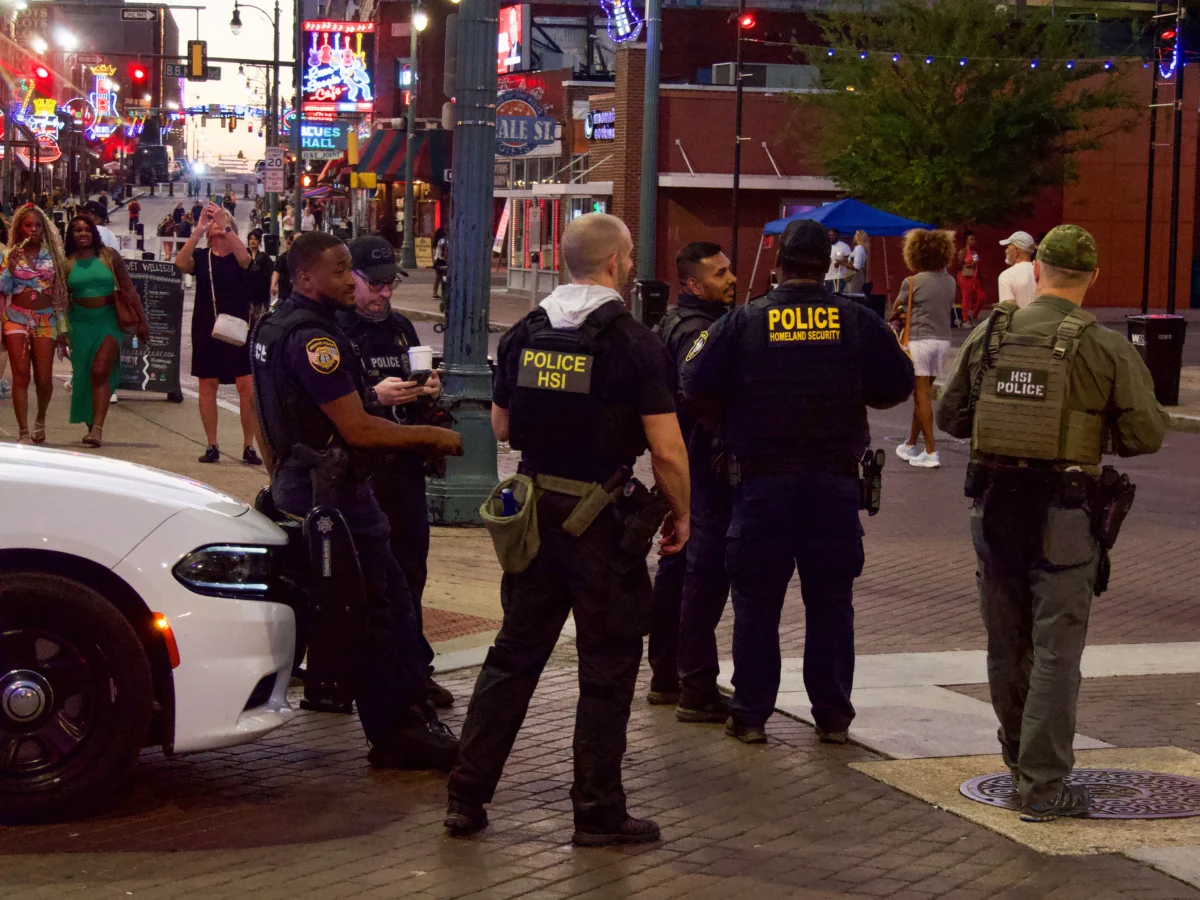
Police and Homeland Security agents patrol Beale Street in Memphis, Tenn., on Oct. 5, 2025. Travis Gillmore/The Epoch Times
Other Memphis residents whom The Epoch Times spoke with in recent months said they overwhelmingly supported the increased law enforcement presence.
On March 23, one couple, who asked not to be named out of fear of reprisal, called for new tactics, saying that criminals are avoiding detection because patrol patterns are identifiable.
Some others expressed mixed feelings about the heavy police presence in the city.
One law enforcement analyst questioned the task force’s impact, suggesting that certain criminal categories, including murder, were already trending downward.
“That means we should be careful not to confuse a visible enforcement push with proof of causation,” Thaddeus Johnson, senior fellow at the Washington-based policy think tank the Council on Criminal Justice and a former Tennessee law enforcement official, told The Epoch Times by email on March 23.
“If the goal is durable violence reduction, the focus should be not just on how many arrests were made, but on whether those cases are prosecuted effectively and whether any gains can actually be sustained.”