The day after Lord Rothermere was gazumped in his pursuit of the Telegraph by Axel Springer’s £575m knockout offer, the Daily Mail owner was pictured beaming at Rupert Murdoch’s 95th birthday party in New York.
As guests at the star-studded black tie celebration at The Grill in Manhattan listened to Hollywood actor Hugh Jackman sing numbers such as Fly Me to the Moon, the 58-year-old media mogul may have been wondering how his almost three-decade dream to unite the titles within one right-leaning stable had fallen at the final hurdle.
Rothermere, who took over running the Daily Mail and General Trust (DMGT) group in 1998 at the age of 30 after the death of his father, first looked at acquiring the Telegraph in 2004, when the Barclay family prevailed with a then eye-watering £665m takeover.
And by Friday 6 March, after three prospective buyers had been thwarted – Abu Dhabi-backed RedBird IMI which was forced to resell, a consortium led by New York Sun owner Dovid Efune and another led by Gerry Cardinale’s RedBird Capital – Rothermere’s lawyers and financiers had been poised to sign the final papers to push his £500m deal to fruition, bar a lengthy regulatory process.
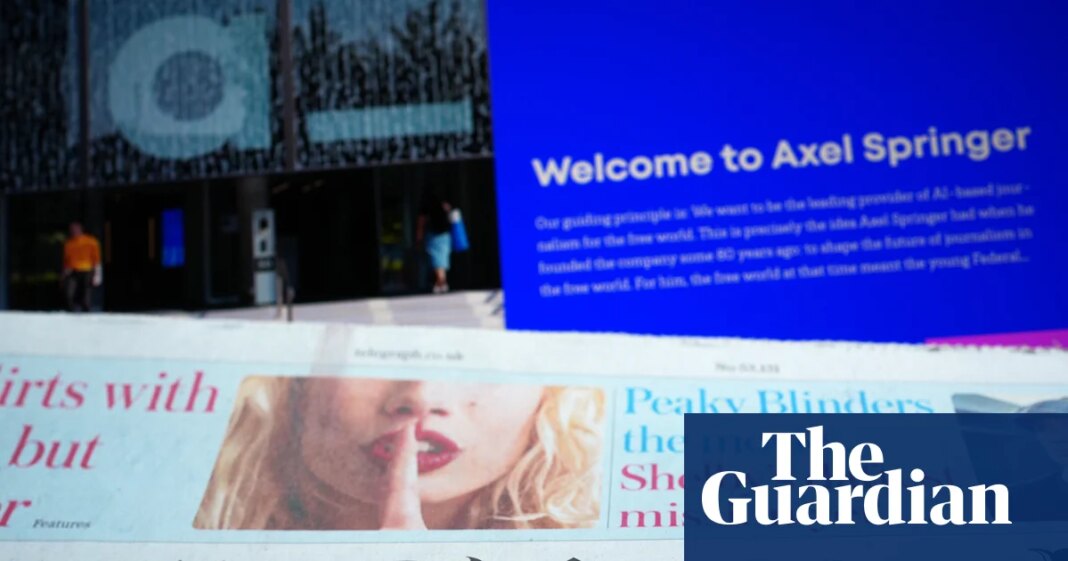
Instead, Germany’s Axel Springer swooped in at the last minute to complete its own equally long pursuit of a British crown jewel to bolster its transatlantic media empire, having also lost out to the Barclays in 2004 and to Nikkei in a battle for the Financial Times a decade later.
The ink may barely have dried on the deal, but the chief executive of the new owner has already paid multiple visits to the Telegraph’s London office espousing his mission to make it the “leading centre-right media outlet in the English-speaking world”.
At 6ft 7in, Mathias Döpfner cut an imposing figure in the newsroom as he visited management and staff, including editor Chris Evans, keen to allay any fears. The 63-year-old has promised editorial independence, although this has not stemmed speculation that he may be considering changes at the top.
However, the track record of Bild, Europe’s biggest-selling newspaper, raises some cause for concern. Axel Springer’s eponymous founder established the tabloid in 1952, partly basing it on the Daily Mirror, with an ideology that newspaper coverage should be partisan and pursue political agendas.
The title has a history of pushing rightwing populism with coverage that has regularly resulted in penalties from the German press regulator for violating journalism ethics.
Since the late 1960s, Axel Springer staff have had to sign a pledge to support the principles of its corporate constitution – internally known as The Essentials – including support for Israel’s right to exist, a free-market economy and the alliance between Germany and the US.
The requirement to back a united Europe could lead to friction with the staunchly anti-Brussels Telegraph staff and readership, especially if calls to re-run the Brexit referendum ever come to fruition in future years. Andrew Neil, the former chair of the Spectator, noted wryly on X that the “very English and Eurosceptic Telegraph [will be] owned by the German and very Europhile Springer”.
After Axel Springer acquired US-based Politico in 2021, Döpfner said in an interview that he expected its journalists to adhere to The Essentials, but that they would not have to sign a commitment letter. “These values are like a constitution, they apply to every employee of our company,” he told the Wall Street Journal.
There has been something of a generational split among Telegraph staff, insiders say, with younger staff welcoming the German company’s 11th-hour triumph. Among older staffers, many of whom have history working at the Mail titles, a DMGT victory offered a more predictable future.
Under Döpfner, a digital-first strategy and artificial intelligence have become something of an obsession. Last year, he told employees his new mantra was “embrace AI or die”.
“No one saw this coming, not even the top brass, but all things considered it feels like a good outcome,” said one Telegraph source. “Springer’s promises of investment are a lot more believable than DMGT. Döpfner’s fixation with AI is a bit concerning so we’ll have to see what he’s got planned.”
Three years ago, Döpfner, who sits on the boards of Netflix and Warner Music and was once described in a profile as “part Murdoch, but also part Musk”, says he will digitally “turbocharge” the expansion of the Telegraph to the US with the support of Politico and Business Insider, which the group bought for $343m in 2015.
On Friday afternoon, hours after triumphing over Rothermere, Döpfner hosted a call with senior executives from Axel Springer’s Berlin headquarters where he popped a bottle of champagne and encouraged those not present to treat themselves to a drink that evening.
Not long after, Rothermere’s camp put out its final statement, saying the Telegraph would have “thrived” under DMGT ownership, and took a swipe at the regulatory system that it said put UK proprietors at a disadvantage in takeovers.
For Rothermere, the failure to get the deal over the line could have significant longer-term commercial ramifications in the AI era.
“An asset like the Telegraph only becomes available for sale once every generation. He needed this deal, and now it’s gone,” said one media analyst. “The Mail revenue streams are potentially quite precarious. It doesn’t have a meaningful digital subscription business, digital advertising is an increasingly hard market, very vulnerable to algorithm changes and AI usage.
“And that’s without factoring in that the well-resourced Axel Springer will look to hoover up some of the Mail’s market share, especially as the market goes more online. A deal would have really helped future-proof the business. This is a bad outcome for the Mail.”
However, for RedBird IMI, the bidding war means it has far exceeded its aim of recouping the £600m it fronted up to take control of the Telegraph titles and the Spectator when it took control by repaying the Barclay family’s debts in 2023.
The investment vehicle – a partnership between the UAE’s vice-president Sheikh Mansour bin Zayed al-Nahyan and US private equity firm RedBird Capital – was forced to put the titles up for sale after the introduction of legislation blocking foreign state ownership of newspaper assets in the UK.
GB News investor Sir Paul Marshall snapped up the Spectator magazine for £100m in 2024, but most analysts had estimated the Telegraph titles were worth about £350m. Axel Springer’s offer takes the total paid for the titles to £675m.
However, after almost three years of instability, and now on to a fifth prospective owner, the Telegraph’s almost 900 staff just want stability and certainty over who will finally be their new proprietor. One source said: “Everyone’s just hoping this gets wrapped up without another dramatic twist.”