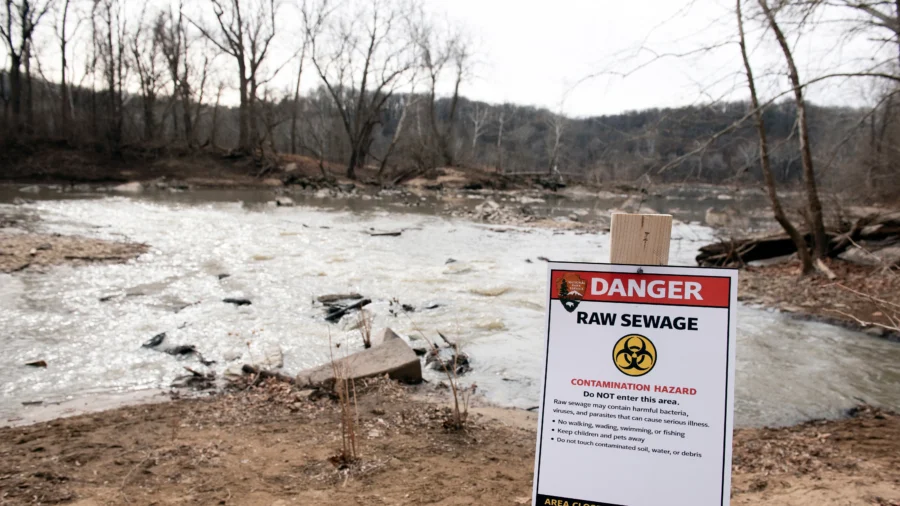
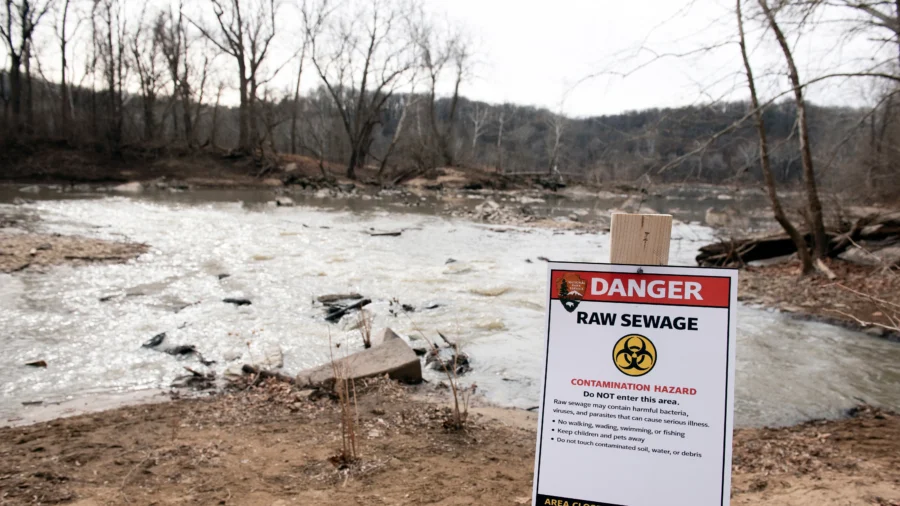
According to Betsy Nicholas, PRKN President, the data show a far worse impact than originally thought.
Nicholas said that, as of Jan. 27, “almost 300 million gallons have entered the Potomac River” since a major interceptor pipe failed near Lockhouse 10 on Jan. 19.
DC Water’s Response
DC Water, which operates the sewer system, said on Jan. 30 that the situation has stabilized in recent days. In its update, the utility reported no sewer overflows from the collapsed Potomac Interceptor pipe for two consecutive days, marking a key milestone after wastewater had been flowing into the river since the Jan. 19 rupture.
The affected areas include Clara Barton Parkway, the I-495 interchange, and the C&O Canal National Historical Park.
“As work progresses at the site, efforts are underway to begin the environmental assessment and cleanup,” DC Water said in its update.
DC Water is conducting water-quality tests and surveying affected areas to assess environmental effects and determine effective cleanup strategies. DC Water said the incident did not affect drinking water.
“The Washington Aqueduct’s primary intakes for drinking water are upstream from the overflow,” DC Water said, urging the public to observe posted warning signs and avoid contact with affected waterways until cleanup is complete.
Extreme Contamination Downstream
PRKN reported that tests at public access sites found E. coli contamination thousands of times over safe limits, with hazardous levels detected as far as four miles downstream in Washington.
“We sampled the sewage discharging from the broken interceptor pipe to the Potomac River near Cabin John at Lock 10 and the result was 4,884,000 MPN – Most Probable Number for E.coli – which is 11,900 times higher than the 410 MPN limit for safe human contact,” said Dean Naujoks of PRKN.
“Infrastructure failure is at the root of this disaster,” Naujoks said, warning that reliance on aging sewer systems close to the river continues to pose risks.
E. coli is widely used as an indicator of sewage contamination and can signal the presence of harmful pathogens. E. coli can cause gastrointestinal illness and, in severe cases, long-term health problems.