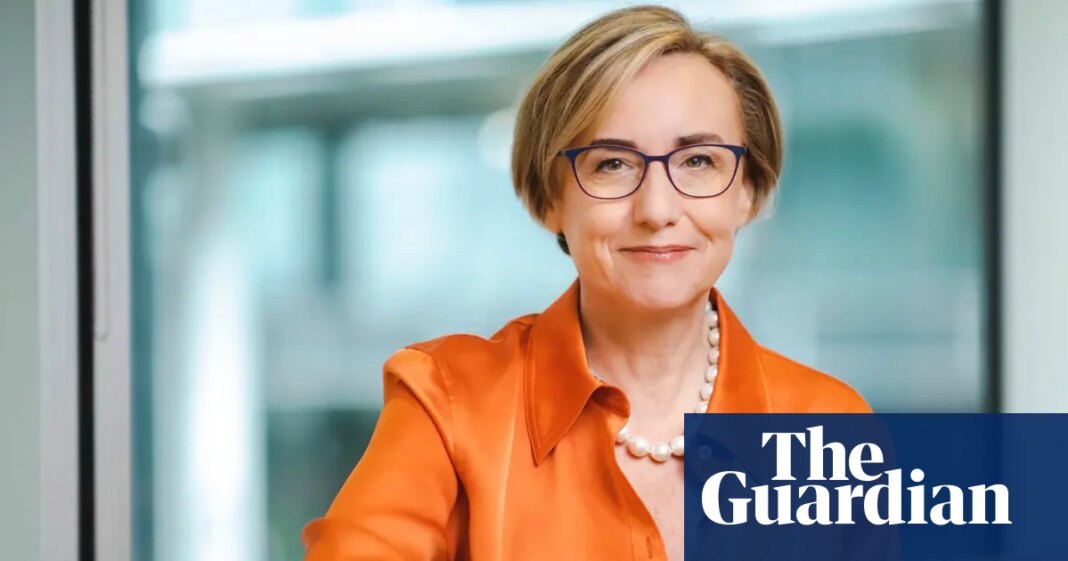
Campaigners have bemoaned the “achingly slow” progress made on gender equality at the top of Britain’s biggest businesses, as research showed blue-chip firms had missed key targets and there were only nine female bosses at FTSE 100 companies.
The average number of female FTSE 100 chief executives did not move last year, according to the government-backed FTSE Women Leaders Review.
They were Allison Kirkby at BT, Zoë Yujnovich at National Grid, Milena Mondini de Focatiis at Admiral, Stella David at Entain, Louise Beardmore at United Utilities, Margherita Della Valle at Vodafone, Amanda Blanc at Aviva and Cindy Rose at WPP.
The report also considered Emma Walmsley at GSK and Liv Garfield at Severn Trent, although both women left their roles in December, as well as Carol Howe, the interim chief executive of BP, who is due to be replaced by Meg O’Neill in April.
Debra Crew left the drinks group Diageo last summer after two years in which the company’s share price dropped more than 40%. The FTSE 100 also lost two female chief executives when the housebuilder Taylor Wimpey and the advertising firm WPP were relegated to the FTSE 250, although both companies are still run by women.
The number of female chief executives in the FTSE 100 peaked in 2023, when 10 out of the 100 bosses were women. It stood at only six in 2016.
The FTSE 350, which includes mid-sized businesses, missed a voluntary target set in 2021 of 40% of women in top executive roles by 2025. In this group, women made up 36% of senior leadership roles – defined as those on the executive committee and senior managers immediately below that level.
However, the group met its 40% target for boards, with 43% of seats now held by women.
Vivienne Artz, the chief executive of the FTSE Women Leaders Review, said progress had been “achingly slow”.
She said: “Roles like chief financial officer, chair and chief executive are the most difficult to fill. Progress has been very slow.
“It is about looking at the talent pipeline and female talent getting experience in revenue-generating and [profit and loss] roles.”
Burberry was the FTSE 100 company with the highest number of women on its leadership team, followed by the retailer Next.
Games Workshop, the company behind the fantasy game Warhammer, and the miner Fresnillo ranked as the businesses with the lowest proportion of women in senior leadership roles.
Female representation was notably stronger among non-executive directors (NEDs), who are part-time board members who provide guidance without being involved in daily business operations.
The report showed the proportion of female NEDs stood at 49% in the FTSE 350 and 50% in the FTSE 100, flat on the previous year.
The UK ranked second among G7 countries for women in the boardroom, behind France, the report found.
Women on the boards of FTSE 350 companies stood at 43%, and at 44% in the FTSE 100. In the French Cac 40 group, which covers its 40 biggest listed companies and where there is a mandatory quota for female representation, women held 45% of board seats.
The UK chancellor, Rachel Reeves, said that while the report showed “how far we’ve come”, there was “still a long way to go”.
She said: “As chancellor, I’m clear there should be no ceiling on a woman’s ambition. When they can participate fully at every level, organisations make better decisions, innovate more and perform more strongly, boosting our whole economy.”
Seema Malhotra, the minister for equalities, said: “In 15 years, women have moved from the periphery to the heart of the boardroom, showcasing the power of voluntary business-led efforts.
“Aligning with the review’s ambitions, this government is accelerating progress for women in leadership through the Employment Rights Act, a landmark shift providing stronger protections for mothers, tougher sexual harassment laws, and enhanced gender pay gap transparency. We’re also supporting women at work with expanded childcare hours and wraparound provision like free breakfast clubs.”
Games Workshop and Fresnillo were approached for comment.