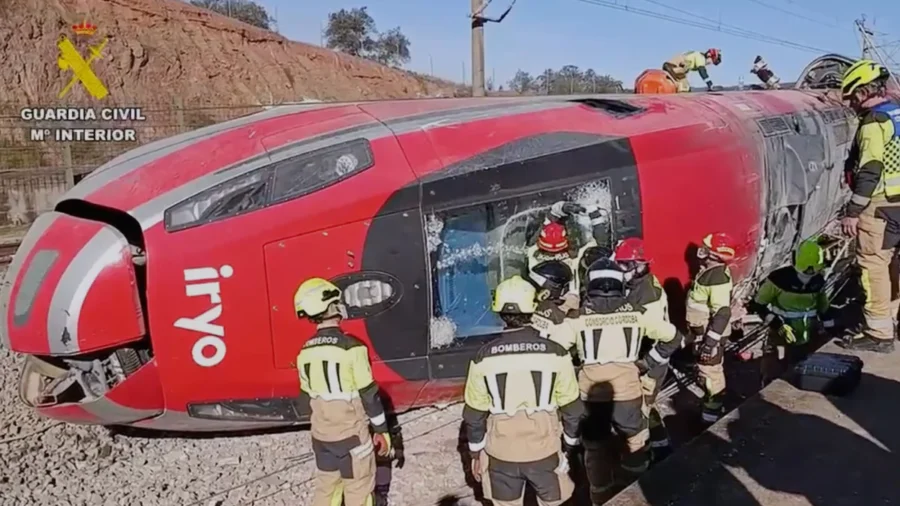
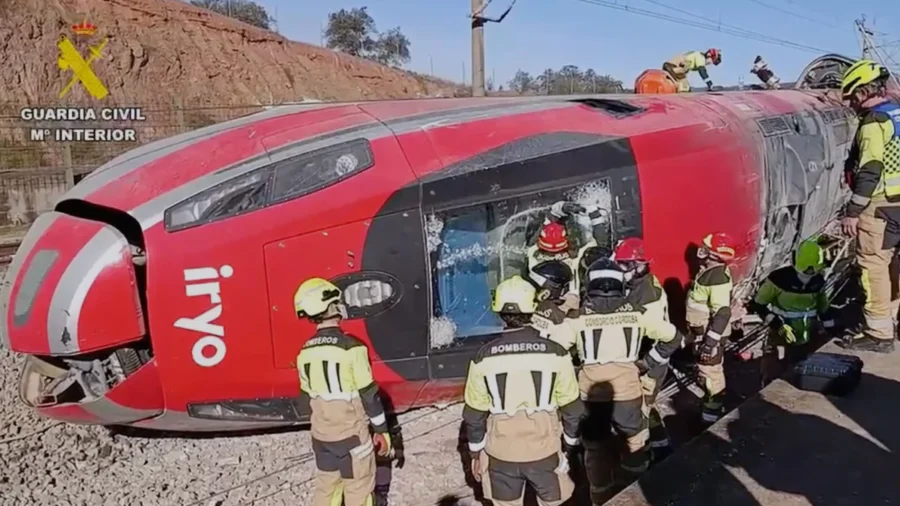
A rail fracture likely occurred before a high-speed train derailed and crashed into another high-speed train, resulting in dozens of fatalities, Spanish investigators said in a preliminary report published on Jan. 23.
The crash resulted in the deaths of 45 people, according to the latest figures from the Spanish Ministry of Transport and Sustainable Mobility. A further 29 were seriously injured, and another 129 sustained minor injuries.
Andalusia’s regional president, Juan Manuel Moreno, said, “The impact was so incredibly violent that we have found bodies hundreds of meters away.”
CIAF said this assessment should be considered provisional and subject to verification following further assessments. The rail accident investigation body said the next stage of the probe will involve sending rail samples to a specialist laboratory to determine possible causes of the damage.
“Regarding the causes of the rail break, no hypothesis is being ruled out,” the preliminary report said.
Other Rail Accidents
The collision in Córdoba was the deadliest in Spain since 2013, when a commuter train in the northern region of Galicia came off the rails while traveling too fast as it came around a bend, causing the deaths of 80 people.
This week, Spain has seen several other rail accidents.
The incident occurred near the port city of Cartagena in Murcia, southeastern Spain. Six people were injured, authorities said.
On Jan. 19, a commuter train derailed in Gelida, near Barcelona, after a containment wall fell on the track due to heavy rain. Four passengers were seriously injured, and the driver was killed.
That same day, another train derailment occurred on Barcelona’s regional network, caused by a rock that fell on the line during the same storm. There were no injuries resulting from that incident.
Following the incidents in Barcelona and Córdoba, on Jan. 21, Spain’s largest train drivers’ union (SEMAF) called for a nationwide strike to demand measures to guarantee railway safety.
“We are going to call a general strike across the entire sector to give legality and protection to the mobilizations of workers and users, in order to demand that the safety and reliability of the network be guaranteed.”
Puente told reporters that he would meet with unions, but that “we do not share [the view] that a general strike is the best approach.”
The Associated Press and Reuters contributed to this report.