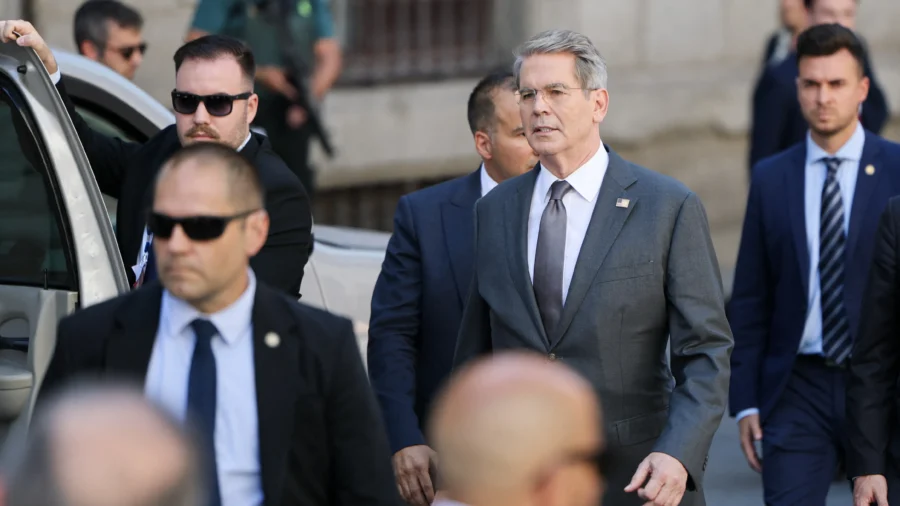
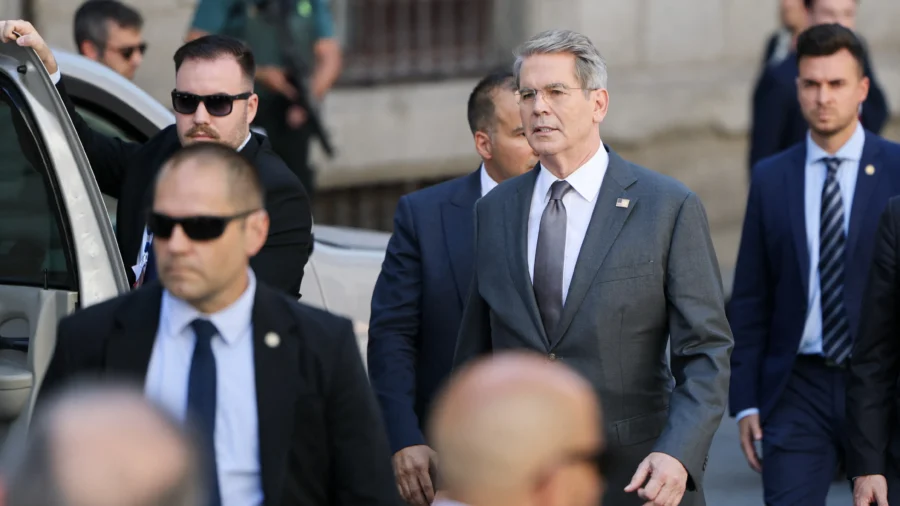
Top trade negotiators from the United States and China kicked off a new round of talks in Paris on March 15, less than two weeks ahead of an anticipated summit between their leaders in Beijing.
The U.S. delegation is led by Treasury Secretary Scott Bessent and Trade Representative Jamieson Greer, while the Chinese team is headed by Vice Premier He Lifeng, a member of the Chinese Communist Party’s powerful Politburo and the nation’s economic czar.
The trade talks started on the morning of March 15 at the headquarters of the Organisation for Economic Co-operation and Development in France, according to China’s state media Xinhua.
Neither Washington nor Beijing provided details about the meetings’ agenda. The Chinese regime’s commerce ministry said the latest consultations will cover “economic and trade issues of mutual concern,” according to a March 13 statement.
Bessent, in a March 12 statement announcing the trade talks, said that his team aims to “continue to deliver results that put America’s farmers, workers, and businesses first.”
The high-level meeting is expected to set the stage for U.S. President Donald Trump’s visit to China, which the White House has said will begin on March 31.
Over the past week, the Trump administration opened two investigations under Section 301 of the Trade Act of 1974, which allows the United States to impose penalties, such as tariffs, on countries that engage in unfair trade practices impacting American businesses.
A spokesperson for the Chinese commerce ministry has voiced the regime’s displeasure with Washington’s decisions, calling on the Trump administration to address the issues through dialogue, according to an online statement released on March 13. The spokesperson added that Beijing would closely monitor the development and that it “reserves the right to take all necessary measures to safeguard its rights and interests.”
The Coalition for a Prosperous America (CPA), a nonprofit business advocacy organization, welcomed the Trump administration’s Section 301 investigations. Jon Toomey, CPA’s president, said in a statement that many countries have used subsidies, suppressed wages, state-owned enterprises, and other policies to “directly undermine U.S. manufacturing and investment.”
In December, Rep. Raja Krishnamoorthi (D-Ill.), who was then-ranking member of the House Select Committee on China, said during a congressional hearing that China has relied on an “economic playbook” of intellectual property theft, massive subsidies, overproduction, export dumping, and forced labor to dominate the global auto and electric vehicle market.
Aside from committing to resuming purchases of U.S. agricultural products, Beijing has agreed to curb the flow of fentanyl precursors and roll back a stringent export control on rare earths that would impact all of Beijing’s trading partners.
Greer, speaking before heading to Paris, said the relationship between Washington and Beijing has been much “more balanced” than it was a year ago.
He described the trade talks as part of the Trump administration’s efforts to ensure the relationship with Beijing remains stable.
“We want to make sure that we continue to get the rare earths we need for our manufacturing base, that they keep buying the kinds of things they should be buying from us, and that the leaders have a chance to get together and make sure that the relationship’s going the way we want it to go.”
Frank Fang contributed to this report.