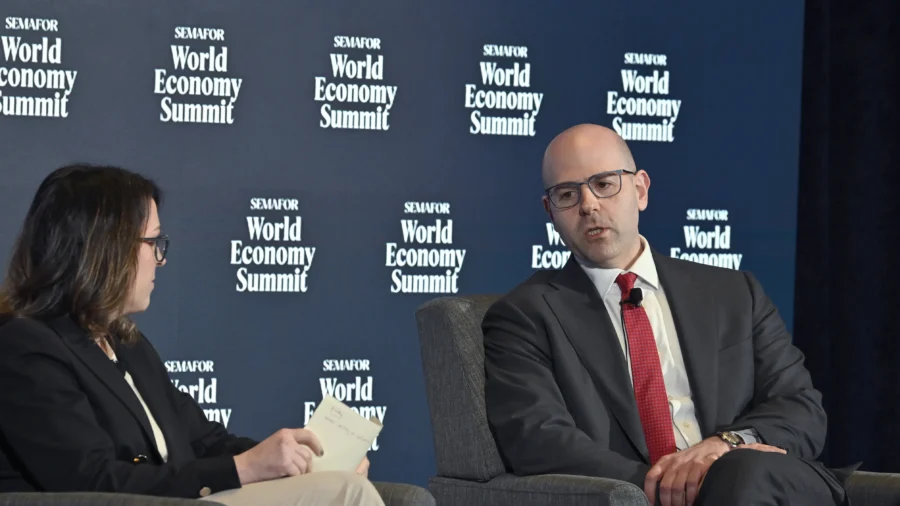
President Donald Trump has announced the appointment of Stephen Miran, chairman of the Council of Economic Advisors, to fill the recently vacated seat on the Federal Reserve Board of Governors.
Miran will serve in a temporary capacity until Jan. 31, 2026, as the administration searches for a permanent nominee.
“Stephen has a Ph.D. in Economics from Harvard University, and served with distinction in my First Administration,” Trump said in the announcement. “He has been with me from the beginning of my Second Term, and his expertise in the World of Economics is unparalleled—He will do an outstanding job. Congratulations Stephen!”
Miran, who served as a senior adviser at the Treasury Department during Trump’s first term, has emerged as a vocal critic of the Fed’s current leadership. Like Trump, he has said that the central bank has kept interest rates too high despite inflation falling near the Fed’s 2 percent target. In particular, he has questioned the timing and motives behind a major rate cut in September 2024, just weeks before the presidential election.
Trump has long accused Fed Chair Jerome Powell of “playing politics” and has repeatedly pushed for rate cuts to spur economic growth and reduce the government’s interest expenses. Powell, however, has insisted that the Fed must first assess the inflationary impact of Trump’s second-term tariffs before adjusting policy.
When asked whether he shared the view of other Trump advisers who have praised Waller’s stance, Miran responded positively, highlighting Waller’s inflation forecasting track record and resistance to what he called “tariff derangement syndrome.”
Earlier in the interview, Miran said that the inflation fears surrounding Trump’s tariff policy are overblown. He pointed to the 2018–2019 tariff rounds as well as recent data, claiming there was “zero macroeconomically significant evidence of inflation” in either case.
“The overall policy mix is extremely disinflationary,” he said in reference to Trump’s current economic policies, citing deregulation, incentives to increase capital stock, and labor supply expansion measures such as tax-free overtime. “People are underestimating the amount of service-driven disinflation that’s in the pipeline.”
While economists broadly agree that Trump’s tariffs are reshaping global trade flows and bringing in record revenue, debate persists over the long-term effects on consumer prices. Tariffs act as a tax on imports, but the cost is often absorbed partially by foreign producers and domestic firms seeking to remain competitive.
However, during Trump’s first term, 20 percent tariffs on Chinese goods raised consumer prices by less than 1 percent, Bessent noted.
Still, analysts caution that broader, reciprocal tariffs could have more widespread effects than the earlier, targeted measures. Early data show mixed outcomes—the June consumer price index showed declines in vehicle prices and flat readings for electronics, while prices rose for categories like apparel and appliances.
“It has been an honor of a lifetime to serve on the Board of Governors of the Federal Reserve System,” she wrote. “I am especially honored to have served during a critical time in achieving our dual mandate of bringing down prices and keeping a strong and resilient labor market.”
As a governor, Kugler was a permanent voting member of the Federal Open Market Committee (FOMC), which sets the benchmark U.S. interest rate. Miran will take her seat and join 11 others on the FOMC in September, when markets widely expect the Fed to cut rates by 25 basis points.