U.S.-Iran talks are expected to be held in Oman on Friday, sources told CBS News, after the U.S. military said it shot down an Iranian drone and Iranian forces threatened to seize a U.S.-flagged vessel.
Iran is seeking direct talks with the U.S. without the usual third party intermediary, according to two sources — an Arab diplomat and a source familiar with the matter. The direct format has long been sought by the Trump administration.
Iranian Foreign Minister Abbas Araghchi confirmed that talks are planned for Friday morning in the Omani capital of Muscat in a Wednesday afternoon X post.
The talks were in flux for part of the day Wednesday as the U.S. and Iran were at odds over the location and parameters, but two U.S. officials and a White House official confirmed to CBS News that the meeting is on as scheduled.
The leaders of at least nine Arab and Muslim countries in the region urged the Trump administration on Wednesday not to withdraw from diplomatic talks, the officials told CBS News, confirming an earlier report by Axios.
An Arab diplomat told CBS that the parameters of the negotiations still remain somewhat in question. The U.S. had sought direct talks that included items beyond Iran’s nuclear program, including ballistic missiles and its actions in the region. Araghchi’s social media post referred to the discussions as “nuclear talks.”
CBS News has confirmed that Saudi Arabia will not be participating in the talks. It is still unclear whether representatives from any other Arab or Muslim countries beyond Oman will be present in Muscat. The White House has not confirmed whether the Omanis or any other countries will be participating in the talks themselves as third-party intermediaries, or if they will be direct bilateral talks between the U.S. and Iran.
Iran had objected to holding the talks in Turkey, which was the initial proposed location.
The United States does not have formal diplomatic relations with Tehran and Iran is still designated as a state sponsor of terrorism by the U.S. government.
Ahead of the talks, Israeli Prime Minister Benjamin Netanyahu met with President Trump’s envoy Steve Witkoff on Tuesday in Israel. Netanyahu told Witkoff that Iran has proven its promises cannot be relied upon, according to a readout from the meeting.
Israel remains skeptical of the diplomacy that Arab and Turkish allies of the U.S. have scrambled to put together to avoid U.S. strikes against Iran.
Secretary of State Marco Rubio said in a press conference Wednesday that Witkoff is ready to meet with Iran on Friday.
“They’ve expressed an interest in meeting and talking. If they change their mind, we’re fine with that too. We prefer to meet and talk,” Rubio said. “I’m not sure you can reach a deal with these guys, but we’re going to try to find out.”
In an interview with NBC News on Wednesday, Mr. Trump said he had heard that Iran was looking to restart its nuclear program in a different location, and that he conveyed to the Iranians that if they do, “we’re going to do very bad things to you.”
Asked whether Iran’s Supreme Leader, Ayatollah Ali Khamenei, should be worried right now, Mr. Trump said, “I would say he should be very worried. Yeah, he should be. As you know, they’re negotiating with us.”
Drone and tanker incidents
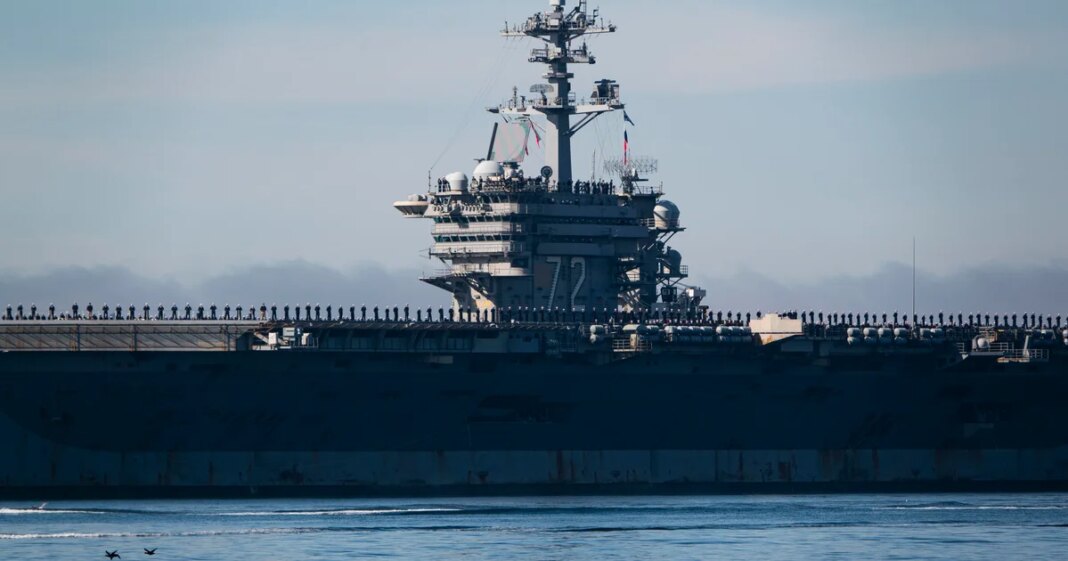
The U.S. military said a Shahed-139 drone “aggressively” approached the USS Abraham Lincoln aircraft carrier as it was moving through the Arabian Sea roughly 500 miles from the southern coast of Iran on Tuesday. The drone flew toward the carrier “despite de-escalatory measures taken by U.S. forces operating in international waters,” U.S. Central Command spokesman Capt. Tim Hawkins said in a statement.
“An F-35C fighter jet from Abraham Lincoln shot down the Iranian drone in self-defense and to protect the aircraft carrier and personnel on board,” Hawkins said. “No American service members were harmed during the incident, and no U.S. equipment was damaged.”
Hours later, in the Strait of Hormuz, an Iranian drone and two Islamic Revolutionary Guard Corps boats “threatened to board and seize” a U.S.-flagged tanker, Hawkins said.
The U.S.-crewed merchant vessel, the M/V Stena Imperative, was “lawfully transiting the international sea passage,” he said. The situation de-escalated after the USS McCaul responded to the scene and escorted the tanker with air support.
U.S. military buildup near Iran
The U.S. has built up military presence near Iran in recent days. The USS Abraham Lincoln aircraft carrier and three destroyers were in the Arabian Sea as of Tuesday, according to a Navy official. Other destroyers were positioned in the Red Sea and the Strait of Hormuz, while three littoral combat ships were in the Persian Gulf.
Mr. Trump told reporters last month that the military was sending ships to the Middle East “just in case,” as his administration watched Iran’s response to massive protests that broke out in December. Thousands of protesters are believed to have been killed in a crackdown on the demonstrations.
The president told reporters last week he has had conversations with Iranian officials and planned to hold more discussions.
“I told them two things: No. 1, no nuclear. And No. 2, stop killing protesters,” the president said. “They’re going to have to do something.”
Iran’s supreme leader has warned that any attack by the U.S. would spark a “regional war” in the Middle East.
The U.S. struck nuclear sites in Iran last summer.