Rarely has a film synthesized a director’s career inspirations and personal history in more aesthetically unique and drolly entertaining fashion as director Matthew Rankin’s Universal Language. The Canadian-born Rankin’s influences range from Iranian cinema to American comedian Groucho Marx, and both find their way into this bizarre little gem, as do a number of surreal ideas and visual references. Rankin’s second feature (after 2020’s sillier and doubly surreal re-telling of Canadian history, The Twentieth Century) is a gently unfolding oddity that mixes and matches time and place in ways that delight as much as they challenge.
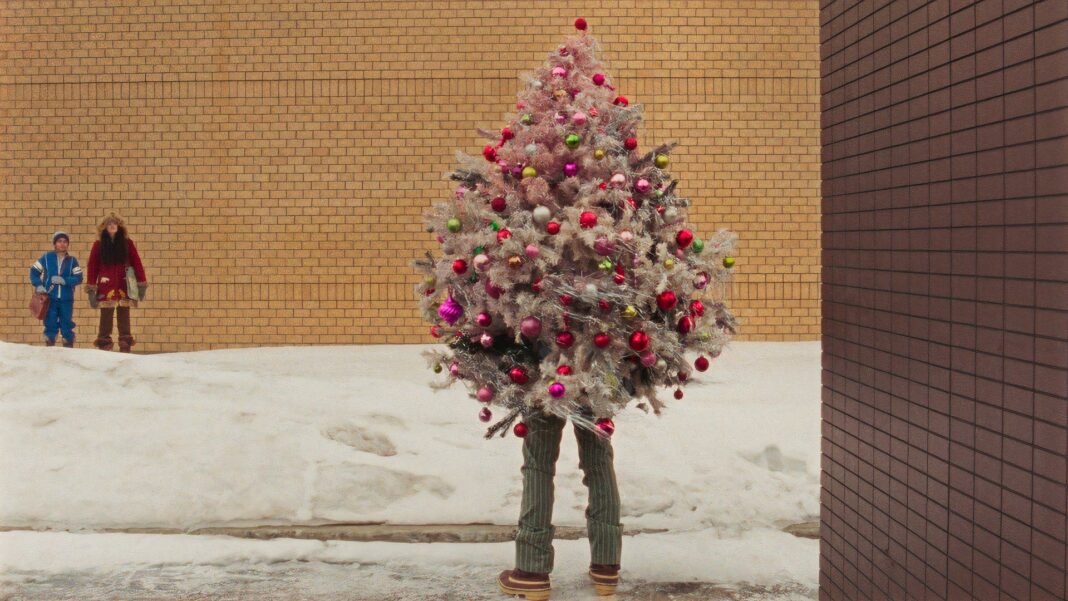
And that’s no easy accomplishment. Universal Language contains visual quotes from directors such as Wes Anderson, Jacques Tati, fellow Winnipeg native Guy Maddin, and Iranian master Abbas Kiarostami, whose 1987 drama Where Is the Friend’s House? is a touchstone here. But instead of being a prisoner to his cinematic role models, Rankin frees himself to put his own private-label stamp on a story that is partially based on an incident involving his grandmother. Of course, the question is whether this bone-dry experiment in wintry burlesque has any overarching point. And putting aside goofy references to the Winnipeg Earmuff Authority and the guy in the pink cowboy hat who sings to his turkey, the answer is definitely yes: Universal Language is a boldly imaged argument for the value of connection in a society constructed to limit it.
The City of Winnipeg Is an Unrecognizable Character in ‘Universal Language’

Universal Language

3.5
/5
- Release Date
-
January 23, 2025
- Runtime
-
89 minutes
- Director
-
Matthew Rankin
- Producers
-
Sylvain Corbeil
Cast

- The film is extremely droll with visual jokes and hilarious dialogue throughout.
- Director Matthew Rankin pays tribute to fellow auteurs like Wes Anderson and Jacques Tati.
- Underneath the eccentric comedy is a big-hearted story about connection.
- The film may be too “out there” for some audiences.
And that’s “constructed” in the literal sense; the film takes place among gargantuan, nondescript brick buildings and cement structures that Canadian DP Isabelle Stachtchenko frames in a way that limits and controls the movement of characters and, by extension, their ability to relate to each other. Not that Rankin’s alt-universe Winnipeg is worth exploring in anything other than a cinematic context.
At the beginning, he drops us into a Winnipeg middle school where the signage is in Farsi (in fact, all the film’s signage is in Farsi) and the disorderly students, including one dressed as Groucho Marx, speak a combination of Farsi and French. During class, their exasperated teacher (Mani Soleymanlou) tells the kids “I see little hope for human survival” and orders them to stand in the closet until the nearsighted Omid (Sobhan Javadi), who claims his eyeglasses were stolen by a turkey, is able to read the blackboard.

Related
21 Great Movies Shot in Canada
Whether for budgetary reasons or to take advantage of the versatile cityscapes and breathtaking landscapes, these films were shot in Canada.
If you’re already on guard for 89 minutes of self-congratulatory irony, the minor miracle of Universal Language is that Rankin’s cracked sense of humor is not an end to itself. There’s serious heart hiding beneath the snow or, in this case, the ice. To help bankroll Omid’s new pair of glasses, student siblings Negin (Rojina Esmaeili) and Nazgûl (Saba Vahedyousefi) have their eyes on a 500 rial bill frozen in a pond, a story thread based on a real-life incident involving Rankin’s grandmother. In what plays like a twisted fable, the kids go in search of an ax to extricate the cash, eventually finding a seller of “top quality turkey products” who can only offer to lend the children his circular saw.
In This Version of Canada, There are Lots of Turkeys and Lots of Laughs
Yes, there are plenty of turkeys in Universal Language, but that’s hardly the weirdest drop in the film’s comical ocean of bizarre asides and peculiar characters. Rankin and co-writers Pirouz Nemati and Ila Firouzabadi save some of their best barbs for Canada itself. Winnipeg is broken up into the equally drab Brown, Gray and Beige Districts while a tour guide (Pirouz Nemati) introduces tourists to a non-stop array of boring sights like the shrine to Manitoba founder Louis Riel that’s smack in the middle of a freeway (and where the guide insists on 30 minutes of silence in tribute). The tour also includes the location of The Great Parallel Parking Incident of 1958 and the sad and mostly empty Portage Place shopping center where the broken mall fountain means that “all wishes are canceled.”

Related
20 Wes Anderson Movie Quotes That Apply to Real Life
Ranging from profound topics of grief and family to love and kindness, these 20 quotes from Wes Anderson films apply to real life.
All this feeds into the film’s theme of connection, which is best conveyed in the story of Matthew (played by Rankin), who slowly emerges as the film’s lead character. In a hilarious early scene, Matthew meets with his corpulent Québécois boss (actress Danielle Fichaud dressed as a male executive) to quit his government job but spends most of the time unsuccessfully convincing his superior that Alberta is not the capital of Winnipeg.
Matthew is on his way to Winnipeg to be with his mother, but when he arrives he finds another family living in her home. The ensuing moments—a family enjoying a pleasant dinner together, a hug between friends that may bring a tear to your eye—are when Rankin drops the film’s established style of wry wit and lateral camera movements and attempts something deeper and even contemplative.
A Connected World is Worth Striving For
In Universal Language, which is Canada’s submission for Best International Feature Film at next year’s Academy Awards, a carefully constructed and offbeat world hides real emotions, frozen under the ice and waiting to be liberated. At one point, the tour guide shows visitors a briefcase that’s been sitting on a bus bench since 1978 and enshrined as a UNESCO World Heritage Site as a testament to “interhuman solidarity even at its most basic and banal.” And yet according to Rankin, even if one’s interaction with the world is basic and banal, it’s still an interaction worth striving for.
Universal Language, produced by Metafilms, will be released in theaters by Oscilloscope Laboratories on February 14.