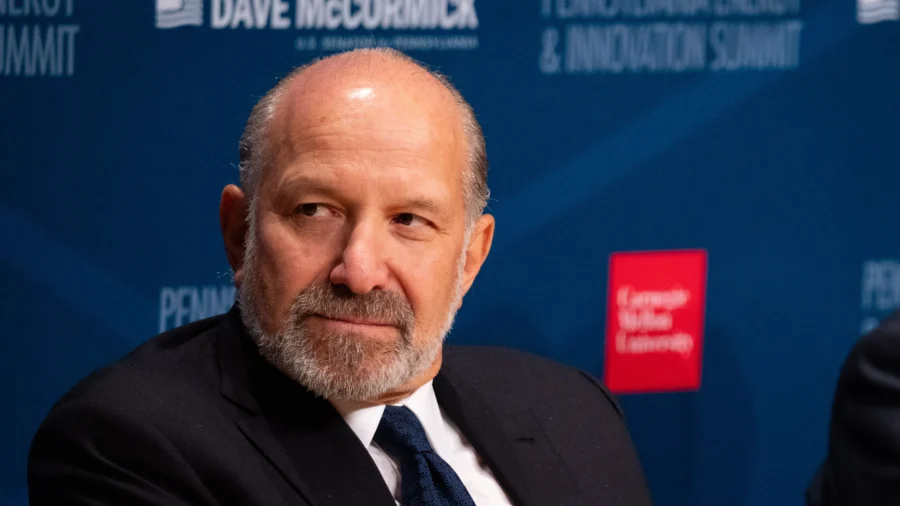
The United States is likely to extend the U.S. tariff deadline for China by another 90 days, says Commerce Secretary Howard Lutnick.
The current U.S.–China tariff pause, agreed to during talks in Geneva in May, is set to expire on Aug. 12.
Last week, senior U.S. administration officials met with their Chinese counterparts in Stockholm, and both sides proposed extending the deadline for 90 days to allow for further trade negotiations.
“I think we’re going to leave that to the trade team and to the president to make those decisions,” Lutnick said. “But it feels likely that they’re going to come to an agreement and extend that for another 90 days. But I’ll leave it to that team.”
All options are on the table for Trump, he noted.
“He’s going to use all the tools in his toolbox. … And he hasn’t ruled anything out,” Lutnick said. “So the president signaled progress on a China deal.”
The president, speaking to reporters at a press conference on Aug. 6, said he could announce additional tariffs on China.
“It may happen. I can’t tell you yet,” Trump said. “We did it with India. We’re doing it probably with a couple of others. One of them could be China.”
Trump imposed an extra 25 percent levy on Indian goods entering the United States, in addition to the 25 percent tariff announced last week. The initial 25 percent took effect on Aug. 7. The 50 percent levy will go into effect on Aug. 27.
He pointed to India’s purchases of Russian crude oil as justification for the decision, stating that New Delhi is “fueling the war machine” in Ukraine.
India purchased approximately $53 billion in Russian oil last year, up from almost $49 billion in 2023. Prior to the outbreak of the conflict in Ukraine, India bought only about $1 billion a year in Russian oil.
In a statement to The Epoch Times, a spokesperson for India’s Ministry of External Affairs said the South Asian country’s imports of Russian petroleum products “are based on market factors” and are intended to ensure the population has access to affordable energy.
“It is therefore extremely unfortunate that the US should choose to impose additional tariffs on India for actions that several other countries are also taking in their own national interest,” the statement reads.
Following a July 29 news conference, U.S. Treasury Secretary Scott Bessent told reporters that any country that purchases sanctioned Russian oil “should be ready” for higher tariffs.
China has been Russia’s top oil customer since 2022.
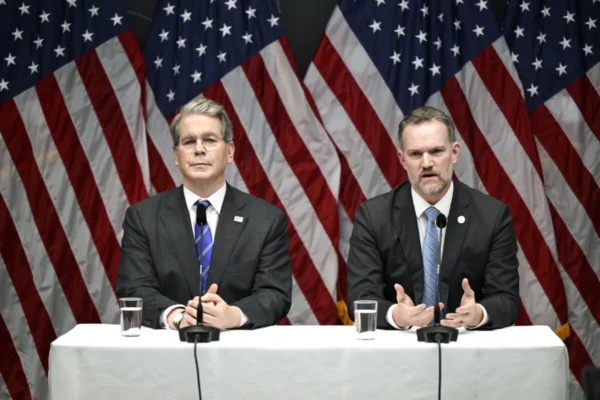
Treasury Secretary Scott Bessent (L) and Trade Representative Jamieson Greer address a press conference in Rosenbad after the trade talks between the United States and China concluded, in Stockholm, Sweden, on July 29, 2025. Magnus Lejhall/TT News Agency/AFP via Getty Images
Tariff Income Flowing
Since the implementation of the president’s global tariffs, the United States has collected a record amount of tariff income.
Lutnick told Fox Business on Aug. 7 that he expects the country will soon garner $50 billion per month in tariff revenues as higher import duties take effect.
“This could continue to head towards and ultimately reach $1 trillion,” he said.
At close to midnight on Aug. 6, the president’s reciprocal tariffs went into effect on nearly 70 U.S. trading partners.
Trump said at the Oval Office on Aug. 6 that he will introduce a 100 percent tariff on semiconductor and chip imports, but not for businesses that are “building in the United States.”
“But the good news for companies like Apple is, if you’re building in the United States, or have committed to build, without question, committed to build in the United States, there will be no charge,” he said.
“So in other words, we’ll be putting a tariff of approximately 100 percent on chips and semiconductors. But if you’re building in the United States of America, there’s no charge.”
Apple has pledged to invest an additional $100 billion in the United States over the next four years, bringing the total investment to $600 billion.