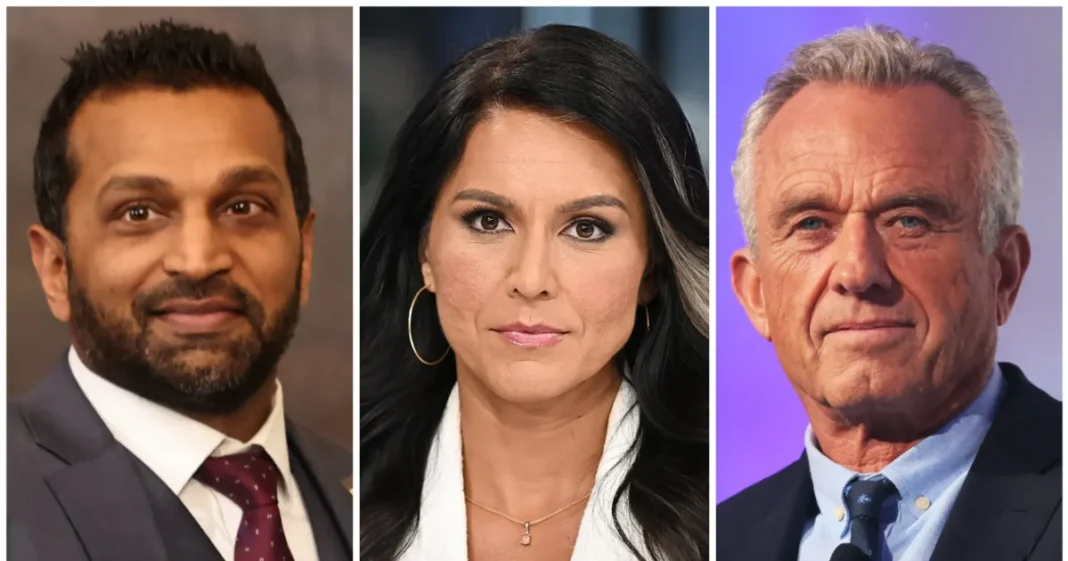
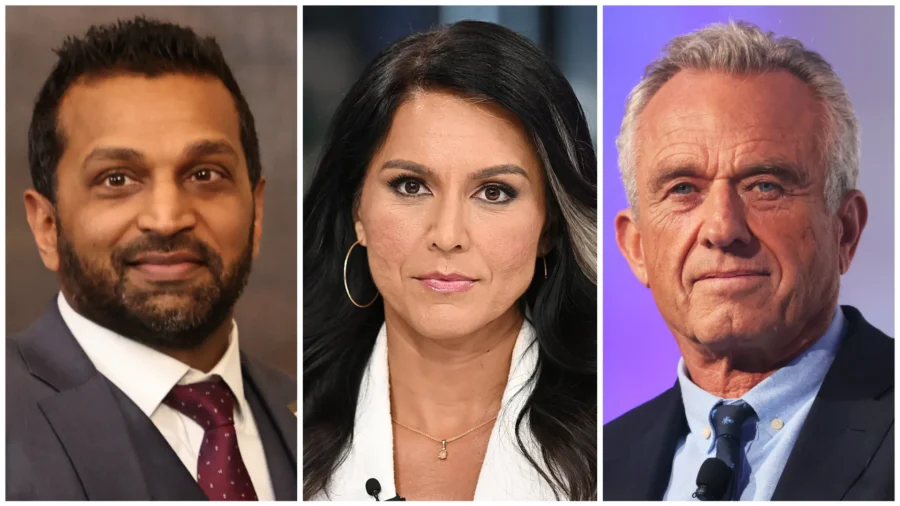
Three of President Donald Trump’s Cabinet nominees appear before Senate committees today. Tulsi Gabbard, nominated for Director of National Intelligence, and Kash Patel, Trump’s pick to lead the FBI, make their first appearances before the Senate.
Meanwhile, Robert F. Kennedy Jr., tapped to head the Department of Health and Human Services, testifies before the Health, Education, Labor, and Pensions (HELP) Committee, following his questioning by the Finance Committee yesterday.
Follow here for the latest updates:
Gabbard Recalls Meeting with Assad
Former congresswoman Tulsi Gabbard, President Donald Trump’s pick to be director of national intelligence, said that her 2017 meeting with former Syrian President Bashar al-Assad consisted of her asking “tough questions” such as using chemical weapons against his own people.
She said that she did not get any concessions from him.
Gabbard Proposes Reforms to Intelligence Gathering
Former congresswoman Tulsi Gabbard, President Donald Trump’s pick to be director of national intelligence, said there should be reforms in the intelligence community.
One of the reforms includes requiring warrants for surveillance, including for Americans. Section 702 of the Foreign Intelligence Surveillance Act allows for the intelligence community to collect information on non-American citizens abroad. Gabbard acknowledged that it is up to Congress to pass these reforms.
Gabbard said she would also seek reform for security clearances “to limit access to our nation’s secrets.”
Patel, Graham Condemn Crossfire Hurricane
Kash Patel denied having an enemies list after multiple senators have alluded—both in his confirmation hearing and in another—to a list of “deep state” actors in an appendix to his book “Government Gangsters: The Deep State, the Truth, and the Battle for Our Democracy.”
Sen. Amy Klobuchar (D-Minn.) asked Patel about the inclusion of former Attorney General William Barr on that list, noting that it has been referred to as an “enemies list.” Patel responded in part by calling that label a “total mischaracterization.”
Members of the committee similarly suggested Patel had an enemies list during a confirmation hearing for former Florida Attorney General Pam Bondi, who is Trump’s pick to lead the Department of Justice. Bondi told Sen. Sheldon Whitehouse (D-R.I.) earlier this month, “There will never be an enemies list within the Department of Justice.”
Republican Senators Spar Over CDC’s Vaccine Schedule at RFK Jr. Hearing
Sens. Rand Paul (R-Ky.) and Bill Cassidy (R-La.) engaged in a back-and-forth over the practicality of the Centers for Disease Control and Prevention’s (CDC) vaccine schedule for children.
Paul, coming to Robert F. Kennedy Jr.’s defense, said vaccinations should not be treated as “one size fits all.”
“The reason you have distrust from people at home, why they don’t believe anything you say, they don’t believe government at all, is you’re telling my kid to take a hepatitis B vaccine when he’s one day old,” Paul, an ophthalmologist, said in response to comments Cassidy had made.
Paul noted that hepatitis B is contracted through drug use and sexual activity, “but you’re telling me my kid has to take it at one day old. That’s not science.”
Cassidy, however, said that a mother’s hepatitis B status is not always known at the time of her child’s birth.
“A vaccine on day one of life prevents chronic hepatitis B 95 percent of the time,” he said. “So, it really depends upon … the knowledge of the mother’s hepatitis B status.”
Gabbard: Snowden ‘Broke the Law’
Former congresswoman Tulsi Gabbard said that former National Security Agency contractor Edward Snowden “broke the law” by leaking classified information.
Senate Intelligence Committee Vice Chair Sen. Mark Warner (D-Va.) noted Gabbard’s past comments in support of Snowden, in which she called him “brave” and said the charges against Snowden should be dropped.
“I cannot imagine a director of national intelligence that would say that kind of behavior is okay,” Warner said.
Sanders Calls Kennedy’s Vaccine Responses ‘Troubling’
Sen. Bernie Sanders (I-Vt.) asserted that “dozens of studies done all over the world” have confirmed that vaccines do not cause autism and asked Robert F. Kennedy Jr. if he agreed.
Kennedy, reiterating a response he gave to Sen. Bill Cassidy (R-La.), said he would accept that as true if shown those studies.
“That is a very troubling response because the studies are there,” Sanders replied. “Your job was to have looked at those studies as an applicant for this job.”
The senator then pressed Kennedy on why he filed a lawsuit seeking the revocation of the U.S. Food and Drug Administration’s emergency authorization for the COVID-19 vaccines.
“Senator, I filed that lawsuit after CDC recommended the vaccine for 6-year-old children, without any evidence that it would benefit them and without testing on 6-year-old children,” Kennedy said, referring to the Centers for Disease Control and Prevention.
“Was the vaccine—COVID vaccine—successful in saving millions of lives? I don’t know. We don’t have a good surveillance system,” Kennedy said.
Sanders said it was “really problematic” that Kennedy was casting doubt on whether the COVID-19 vaccines saved lives.
Patel Disagrees With Commutations for Violent Jan. 6 Defendants
Asked if he felt President Donald Trump was wrong to give blanket pardons for Jan. 6 defendants, including those convicted of violent offenses against law enforcement officers, Kash Patel said he has always rejected any violence against law enforcement.
“I do not agree with the commutation of any sentence of any individual who committed violence against law enforcement,” Patel said.
Patel, Trump’s nominee for FBI director, went on to condemn President Joe Biden’s decision to commute the sentence of Leonard Peltier, who was convicted of killing two FBI agents. Biden’s commutation will allow Peltier to serve out his life sentence in home confinement rather than prison without absolving him of the underlying conviction.
Gabbard Responds to Critics in Opening Statement
Former congresswoman Tulsi Gabbard made the case for why she should be the next director of national intelligence.
“I’ll begin by leading, by example, checking my own personal views at the door, and committing to delivering intelligence that is collected, analyzed, and reported without bias, prejudice, or political influence,” she said.
Gabbard called out to Sen. Susan Collins (R-Maine), who appeared to be on the fence over the nomination, noting that the senator voted in favor of creating the Office of the Director of National Intelligence.
Gabbard said that, if confirmed, she would “end the politicization of the intelligence community.” She cited examples such as the letter by former intelligence officials that the story about the laptop of Hunter Biden, former President Joe Biden’s son, was Russian disinformation.
Gabbard also addressed criticisms of her.
“You may hear lies and smears that challenge my loyalty to and love for our country,” she said.
“Those who oppose my nomination imply that I am loyal to something or someone other than God, my own conscience, and the Constitution of the United States, accusing me of being Trump’s puppet, Putin’s puppet, Assad’s puppet, a guru’s puppet, Modi’s puppet; not recognizing the absurdity of simultaneously being the puppet of five different puppet masters,” she continued, referring to the Russian President Vladimir Putin, former Syrian President Bashar al-Assad, and Indian Prime Minister Narendra Modi.
Sen. Ernst Defends Gabbard
Sen. Joni Ernst (R-Iowa) introduced former congresswoman Tulsi Gabbard, making the case for why she should be the next director of national intelligence.
Ernst described Gabbard’s life as “Duty, honor, service.”
The senator emphasized Gabbard’s military service as a reason for her to be confirmed as the head of the intelligence community.
“Tulsi exemplifies what it means to rise above partisanship, putting the needs of the American people over political divisions,” Ernst said.
“She put her own life on the line in combat operations, and now has set aside partisan differences as a former Democrat member of Congress to answer the call to serve in a Republican administration.”
Kennedy: ‘I’m Pro-Safety,’ Not Anti-Vaccine
Robert F. Kennedy Jr. responded to Sen. Bill Cassidy’s (R-La.) concerns about his vaccine stance by noting that he is not anti-vaccine but “pro-safety” and “pro-good science.”
“I worked for 40 years to raise awareness about mercury and other toxins in fish, and nobody called me anti-fish,” Kennedy noted.
“All my kids are vaccinated. I believe vaccines have saved millions of lives and play a critical role in health care.”
The nominee added that he is not against the food industry, either, but wants to work with food producers to remove some of the regulatory red tape that stifles “American ingenuity.”
“My advocacy has often disturbed the status quo by asking uncomfortable questions, and I’m not going to apologize for that,” Kennedy said.
“We have massive health problems in our country that we must face honestly, and the first thing I’ve done every morning for the past 20 years is to pray to God that he would put me in a position where I can end the chronic disease epidemic and protect our children,” he said.
“That’s why I’m so grateful to President Trump [for] the opportunity to sit here before you today and seek your support and your partnership in this endeavor.”
Cassidy Questions Kennedy’s Vaccine Views
Sen. Bill Cassidy (R-La.) started Robert F. Kennedy Jr.’s second confirmation hearing by challenging his previous comments about vaccines.
“Your past of undermining confidence in vaccines with unfounded or misleading arguments concerns me,” said Cassidy, chairman of the Senate Health, Education, Labor, and Pension Committee.
“Can I trust that that is now in the past? Can data and information change your opinion, or will you only look for data supporting a predetermined conclusion? This is imperative.”
Cassidy, a physician, said he has constituents who credit Kennedy’s statements questioning the safety of vaccines as the reason they decided not to vaccinate their children.
“I think you’ll tell us today, as you did in Finance Committee yesterday, that you’re pro-vaccine. So what will you tell the American mother? Will you tell her to vaccinate her child or to not?”
Cotton, Warner Give Opening Statements at Gabbard Hearing
Senate Intelligence Committee Chairman Sen. Tom Cotton (R-Ark.) expressed support for former congresswoman Tulsi Gabbard to be director of national intelligence.
Cotton said that Gabbard would be a fresh voice to go against “conventional” thinking that has included getting the United States involved in Egypt and Libya, overthrowing authoritarian leaders there.
Meanwhile, the committee’s vice chair, Sen. Mark Warner (D-Va.), told Gabbard that he has “significant concerns” about her judgment and qualifications “to meet the standard set by law.”
Kash Patel Offers Opening Remarks
Kash Patel, President Donald Trump’s nominee to lead the FBI, offered opening remarks at his confirmation hearing before the Senate Judiciary Committee after praise from Chairman Sen. Chuck Grassley (R-Iowa) and criticism from ranking member Sen. Dick Durbin (D-Ill.), who said Patel wasn’t qualified.
Sen. Thom Tillis (R-N.C.) introduced Patel, stating that he possessed significant expertise and was an “outstanding choice to lead the FBI.”
After Tillis’s statement, Patel was sworn in. He started by offering prayers for the victims of the plane crash at Reagan National Airport. Patel’s parents and sister were present behind him.
“Protecting the rights of the Constitution is of the utmost importance to me,” he said.
Patel pledged to remain focused on the FBI’s core mission and recounted his national security experience in both President Barack Obama’s administration and that of Trump during his first term.
Patel used his opening statement to call attention to low trust in the FBI. He proposed to focus on tackling violent crime as well as allowing congressional oversight as ways to restore trust.
RFK Jr. Faces Second Day of Questioning
Robert F. Kennedy Jr. returns to Capitol Hill on Thursday for a second day of questioning as he seeks confirmation to the role of Health and Human Services secretary.
Kennedy will testify before the Senate Health, Education, Labor, and Pension Committee starting at 10 a.m. ET.
The committee’s chairman, Sen. Bill Cassidy (R-La.), will be a key vote to securing Kennedy’s confirmation. Cassidy, a gastroenterologist, grilled the former presidential candidate at his hearing before the Senate Finance Committee on Wednesday about his proposals for reforming Medicare and Medicaid. Kennedy did not have any specifics to share.
Sens. Susan Collins (R-Maine) and Lisa Murkowski (R-Alaska) are two other Republicans who could swing either way.
Republicans currently hold a 53–47 vote majority in the Senate. Vice President JD Vance’s tie-breaking vote leaves room for just three GOP defections if Kennedy is to be confirmed without any Democrat support.
Kennedy fielded tough questions about his views on vaccines, abortion, and the food industry on Wednesday. He is likely to face similar questions during the second hearing.
Epoch Times reporters Sam Dorman, Jackson Richman, Sam Dorman, Samantha Flom contributed to this report.