BCC: Tariffs will sap business confidence and hurt UK manufacturers
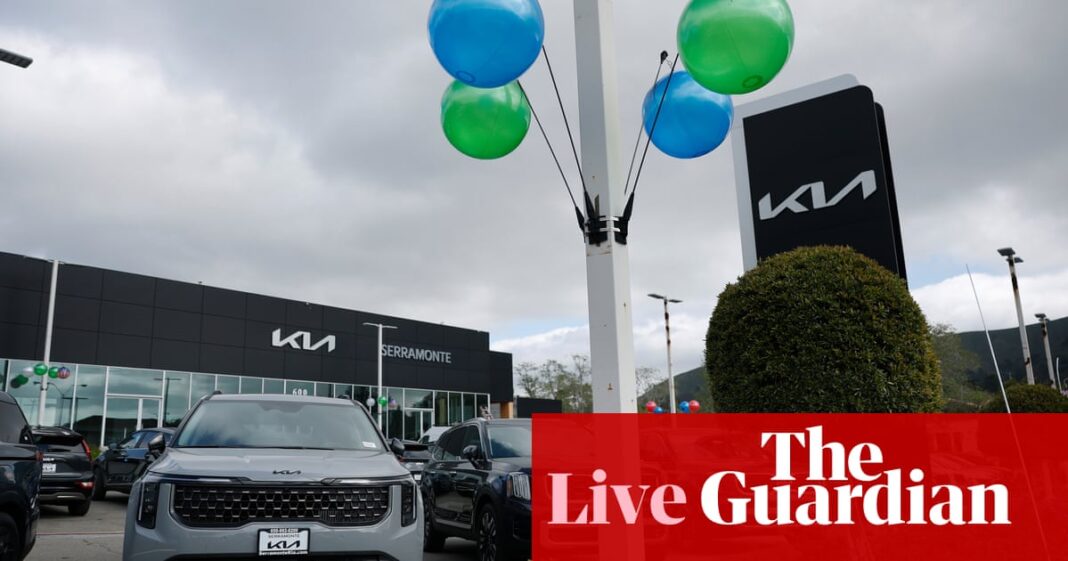
The British Chambers of Commerce has warned that the new 25% tariff on car imports to the US will hurt business confidence.
The BCC says the impact on the UK car sector “cannot be overstated”, given the importance of the US market for British manufacturers.
William Bain, BCC head of trade policy, explains:
“Businesses were already looking with trepidation towards next week’s planned reciprocal tariffs before this fresh upheaval was announced.
“Around half of the cars purchased in the US are imported so this will pass through into much higher costs for US consumers. If fully extended to all components it will affect supply chains too.
“The impact of this on the UK car industry cannot be overstated. Cars are the UK’s biggest goods export to the US, with £6.4bn in sales in 2023, led by iconic manufacturers such as Aston Martin, Jaguar, and Land Rover.
“Piling these tariffs on top of the others already expected on 2 April, will sap business confidence and add further uncertainty for both UK and US firms.
“We urge the UK Government and the US Administration to continue intensive dialogue over the coming days and weeks to reach a mutually beneficial agreement on technology and trade.
“This needs to provide certainty for business and consumers alike on the future tariff landscape and remove unnecessary levies already in place.”
Kathleen Brooks, research director at XTB, reports that tariffs are “dominating market sentiment”, as investors calculate the impact of the trade dispute:
European stocks have opened sharply lower after President Trump announced a 25% levy on imports of cars and car parts coming into the US. This news has had an immediate effect on share prices, the US imports 8 million cars a year and untold car parts, which equates to $240bn in trade.
Unsurprisingly, the biggest decliners on the Eurostoxx index include Ferrari, Volkswagen, BMW and Mercedez Benz Group.
Key events
The yield, or interest rate, on UK government bonds has risen today as investors digest yesterday’s Spring Statement.
10-year gilt yields are up 6 basis points, or 0.06%, to 4.784%, towards the 16-year high over 4.92% set in January. Long-dated 30-year gilt yields are up too, at 4.362%.
Yields rise when bond price fall, and measure the government’s cost of borrowing.
US government bond yields are also up today, but European borrowing costs are lower.
The fiscal plans outlined yesterday showed borrowing would be higher than previously forecast over the next five years:
Rising bond yields adds to the UK’s fiscal challenges, as it pushes up the cost of borrowing.
And if the UK’s economy performs worse than expected (perhaps due a trade war), tax receipts could be lower, meaning pressure to borrow more.
Yesterday, the UK’s Debt Management Office (DMO) outlined how it will issue £299bn of gilts this financial year, to cover maturing debt and new borrowing. That’s slightly lower than the £305bn forecast.
Evem so, analysts at Morgan Stanley have warned that “the path ahead looks fraught”, telling clients:
The headroom was restored, the gilt remit was kept just under £300 billion, and the share of longs [longer-dated gilts] was lower than even our below-consensus forecast.
And yet…the consolidation was back-loaded. Fiscal buffer is modest. Risks to growth are skewed to the downside. The path ahead looks fraught – although on current forecasts, it is a path of a meaningful fiscal consolidation.
Reynolds talk interrupted by pro-Palestinian protesters
Business and trade secretary Jonathan Reynolds has been interrupted by pro-Palestinian protesters calling for an end to the sale of F35 jet parts to Israel, PA Media report.
At the start of Mr Reynolds’ appearance at a conference on trade hosted by the think tank Chatham House, a demonstrated shouted:
“This man and his government are complicit in genocide.
“The F35s are massacring Palestinian children. They have not stopped the trade of F35s.”
After the protester was removed from the event, Mr Reynolds said:
“We have suspended arms exports to Israel.
“We have not suspended F35s because they are integral to our national security and the defence of Ukraine, and people will know the supply chain for the F35 means they cannot be isolated to one country.
“That decision was laid out very clearly in Parliament, so I’m quite happy if he wants to ask a question rather than jump on stage to have that engagement with him.”
He was then interrupted by another protester waving a Palestinian flag and calling for an end to F35 exports, who was subsequently removed.
The proposed closure of the Scunthorpe blast furnaces is another big issue in Jonathan Reynolds’s in-tray, as the business secretary also faces the threat of a US trade war.
Reynolds has insisted today that he will work with British Steel’s owners, Jingye, over the plant’s future, saying:
“I know this will be a deeply worrying time for staff and, while this is British Steel’s decision, we will continue working tirelessly to reach an agreement with the company’s owners to secure its future and protect taxpayers’ money.
“We’ve been clear there’s a bright future for steelmaking in the UK.
“We’ve committed up to £2.5 billion to rebuild the sector and will soon publish a plan for steel setting out how we can achieve a sustainable future for the workforce, industry and local communities.”
UK Steel: This is a gut punch to UK steelmaking
Trade body UK Steel has warned that Britain’s national security would be threatened if steelmaking ceased in Scunthorpe.
🚨
The Chinese owners of British Steel say they are now considering shutting their blast furnaces and end steelmaking at Scunthorpe in early June – only a few months away.
It would mean an end of virgin steelmaking in the country that invented it during the industrial revolution— Ed Conway (@EdConwaySky) March 27, 2025
UK Steel Director General, Gareth Stace, said:
“The proposal to close iron and steelmaking at Scunthorpe marks a heartbreaking and pivotal moment for our sector. It is a shocking blow to the 3,400 workers, our sector and to the whole community in Scunthorpe. This gut punch to UK steelmaking will have a profound impact, felt throughout the British economy.
“All options should be on the table, and we need a secure future for our steel industry. The end of steelmaking at British Steel would mean we have a major gap in capacity to meet the future demand of the nation and will be an irreparable break in the armour of national security.
“This devastating decision will cause untold disruption and damage to our supply chains, threatening jobs, businesses and the nation’s economic strengths. The steel industry is officially in a crisis. UK Steel has been sounding the alarm. Government must get back to the negotiating table to urgently stop the lifeblood draining from our sector and take action to rebuild the steel industry.”
Unite: his is a disgrace
The Unite union have condemned British Steel’s proposal to close its Scunthorpe blast furnaces, accusing the company of trying to blackmail the government into providing more financial support.
Unite general secretary Sharon Graham said:
“This announcement of job losses is quite simply a disgrace. British Steel is guilty of trying to hold the government to ransom, while using its dedicated workforce as pawns.
“In discussions with Unite, the government has clearly moved and has made an offer to invest heavily in British Steel (Jingye). This offer comes with long-term job guarantees, anything less would be a complete misuse of taxpayers’ money. British steel now needs to make the necessary commitments.
“British Steel must now withdraw its job threats and work with the government and Unite on a sustainable way forward which is in the best interests of the workers, their communities and the wider economy.
“The UK has the opportunity of becoming a leader in green steel and British Steel should be at the forefront of that transformation.”
British Steel proposes closure of Scunthope blast furnaces
Newsflash: British Steel is proposing to close its steelmaking operations in Scunthorpe, with the loss of up to 2,700 jobs.
It has just launched a consultation on the proposed closure of its Scunthorpe blast furnaces, rod mill and steelmaking operations in the Lincolnshire town.
British Steel says it has not been able to reach an agreement with the UK government for support to keep the plant running, and to allow future investment in Electric Arc Furnace (EAF) technology, which is more environmentally friendly than traditional furnaces.
Three options are under consideration:
-
Closure of the blast furnaces, steelmaking operations and Scunthorpe Rod Mill by early June 2025
-
Closure of the blast furnaces and steelmaking operations in September 2025
-
Closure of the blast furnaces and steelmaking operations at a future point beyond September 2025
The proposed closures will impact between 2,000 and 2,700 jobs, says British Steel, which is owned by Chinese industriall group Jingye.
British Steel CEO, Mr Zengwei An, says:
“We understand this is an extremely difficult day for our staff, their families, and everyone associated with British Steel.
“But we believe this is a necessary decision given the hugely challenging circumstances the business faces.
“We remain committed to engaging with our workforce and unions, as well as our suppliers and customers during this time.”
British Steel says it will continue to work with the UK Government to explore options for the future of the business.
Sky News reported earlier this week that Jingye had rejected a £500m offer from the government, to help British Steel’s transition to green steel production.
UK-based manufacturers might be able to pass on the impact of tariffs onto their wealthy customers, which would cushion the impact of the latest levies.
My colleague Jasper Jolly looked at this issue in January, and reported:
About 10% of UK car exports go to the US, although the majority go to the EU, according to the Society of Motor Manufacturers and Traders, a lobby group.
One small silver lining for the UK may be that a large number of those exports from companies such as the Jaguar and Land Rover owner JLR, the BMW-owned Rolls-Royce or the Volkswagen-owned Bentley, are classed as luxury vehicles, with prices that can start at £100,000 and rise to multiples of that. Those companies should be able to pass on the cost of tariffs to wealthier customers without denting sales.
BCC: Tariffs will sap business confidence and hurt UK manufacturers
The British Chambers of Commerce has warned that the new 25% tariff on car imports to the US will hurt business confidence.
The BCC says the impact on the UK car sector “cannot be overstated”, given the importance of the US market for British manufacturers.
William Bain, BCC head of trade policy, explains:
“Businesses were already looking with trepidation towards next week’s planned reciprocal tariffs before this fresh upheaval was announced.
“Around half of the cars purchased in the US are imported so this will pass through into much higher costs for US consumers. If fully extended to all components it will affect supply chains too.
“The impact of this on the UK car industry cannot be overstated. Cars are the UK’s biggest goods export to the US, with £6.4bn in sales in 2023, led by iconic manufacturers such as Aston Martin, Jaguar, and Land Rover.
“Piling these tariffs on top of the others already expected on 2 April, will sap business confidence and add further uncertainty for both UK and US firms.
“We urge the UK Government and the US Administration to continue intensive dialogue over the coming days and weeks to reach a mutually beneficial agreement on technology and trade.
“This needs to provide certainty for business and consumers alike on the future tariff landscape and remove unnecessary levies already in place.”
Kathleen Brooks, research director at XTB, reports that tariffs are “dominating market sentiment”, as investors calculate the impact of the trade dispute:
European stocks have opened sharply lower after President Trump announced a 25% levy on imports of cars and car parts coming into the US. This news has had an immediate effect on share prices, the US imports 8 million cars a year and untold car parts, which equates to $240bn in trade.
Unsurprisingly, the biggest decliners on the Eurostoxx index include Ferrari, Volkswagen, BMW and Mercedez Benz Group.
There’s also plenty of speculation today that Rachel Reeves may need to make tax rises in the autumn statement, if the UK’s fiscal position worsens.
Goldman Sachs has warned there are “further fiscal pressures ahead” that could squeeze the chancellor’s headroom against her fiscal targets.
Goldman analyst James Moberly told clients:
We think that the OBR will ultimately downgrade its trend growth forecast by around 0.2pp, possibly in the Autumn, which could reduce headroom by around £14bn, and we expect increasing pressure for the government to raise defence spending above 2.5% in the current Parliament.
If these pressures do materialise, we continue to think that tax changes are the most likely response. That said, we do think that lower interest rates could ease some of the pressure on the fiscal position as we expect the Bank of England to cut further than the market expects.
Richard Hughes, head of the independent Office for Budget Responsibility, has warned that the car tariffs announced by Donald Trump will eat into Rachel Reeves’s fiscal headroom.
Speaking to Radio 4’s Today programme, Hughes also flagged that a full-blown global trade war could eliminate that headroom altogether.
He explained:
“This represents the crystallisation of one of the risks that we highlighted around our central forecast, which was one of escalating global trade tensions.”
“The UK exports, in terms of goods to the US, around 2% of GDP. Car exports are about 10% of that.
“So that’s affecting directly UK goods exports of around 0.2% of GDP. So what Trump’s announced overnight is not the whole of that worst-case scenario, but it’s elements of it, and it’s the beginning of that risk side.”
The OBR presented three trade war scenarios yesterday – the worst, where the UK and US hit each other with reciprocal tariffs, showed 1% would be wiped off UK GDP.
We’re not there yet, though, with Reeves arguing against escalating the trade war this morning.

Sarah Butler
Next has rung up £1bn in annual profits for the first time but warned of growing risks to the UK economy, saying big business could not afford to finance “excessive regulation” and government debt.
The retailer said pre-tax profits rose 10% to just over £1bn, before one-off items including a £15m pension charge, in the year to January after sales rose 8.2% to £6.3bn, led by strong overseas growth and sales of other brands.
Simon Wolfson, the chief executive of Next, said he now expected to make £1.06bn next year, £20m more than previously expected, as he said the first eight weeks of the new financial year had been “ahead of our expectations”.
Wolfson, who is a Conservative peer, said: “We are as positive about the company today as we were [a year ago], albeit in an environment where the risks to the wider UK economy are growing.
Next’s shares have jumped over 5%, to the top of the FTSE 100 leaderboard.