When a 5.2-magnitude earthquake rattled the ground beneath the San Diego Zoo Safari Park Monday, a group of elephants quickly gathered around their young to keep them safe from harm.
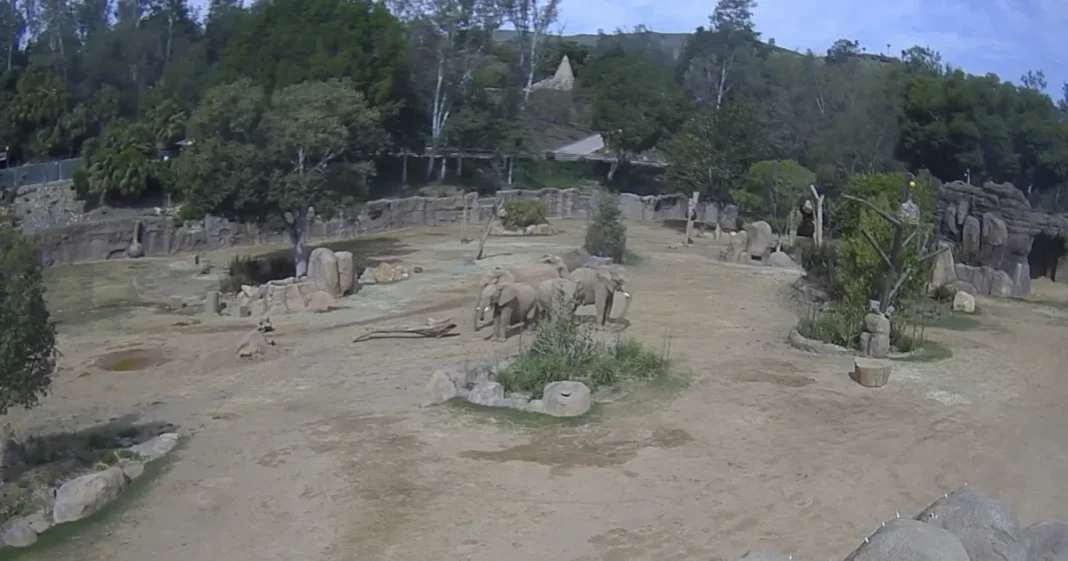
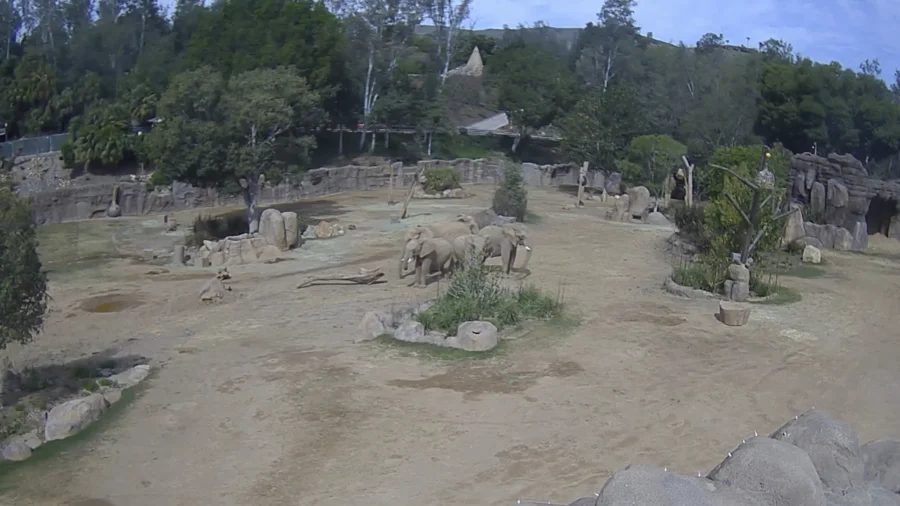
Footage taken from their enclosure shows five African elephants relaxing in the morning sun before the camera begins to tremble and the elephants scatter about.
An instant later, the older elephants—Ndlula, Umngani, and Khosi—gather in a circle, forming a protective barrier around the two 7-year-old calves, Zuli and Kaia, to shield them from any danger.
They remain huddled for several minutes as the older elephants look outward, their backs to the calves, ears spread and flapping, seemingly on alert even after the tremors had ended.
According to the Southern California Seismic Network (SCSN), the earthquake occurred at 10:08 a.m., with its epicenter a few miles south of the small mountain town of Julian.
The earthquake could be felt as far as 120 miles away in Los Angeles and caused boulders to tumble onto rural roads in San Diego County and knocked items off shelves in Julian.
There have been no reports of injuries or major structural damage.
But it spooked the elephants.
Once they had formed their protective circle, “they sort of freeze as they gather information about where the danger is,” said Mindy Albright, a curator of mammals at the San Diego Zoo Safari Park.
Elephants are highly intelligent and social animals. When they perceive a threat, they often bunch together in what is called an “alert circle,” typically with the young clustered in the center and the adults facing outward to defend the group.
In addition, the animals have fat pads in their feet that act like acoustic sensors, allowing them to detect infrasound—low-frequency sound waves below the range of human hearing.
In the video, one of the calves—Mkhaya—dashes into the safety of the circle, seeking comfort among the adults, a group of matriarchs which all helped raise her.
The other calf, Zuli—the group’s only male—lingers at the edge, displaying early courage and social responsibility, Albright said, even though he is still a baby.
Khosi—a teenage female who helped raise him along with his mother, Ndlula—repeatedly tapped him on the back with her trunk, even touching his face, as if to say, “Things are OK,” and “Stay back in the circle,” Albright said.
Zuli’s role will change once he becomes an adult and moves to join a bachelor group, while the female elephants stay with the family unit for their entire lives, Albright said.
“It’s so great to see them doing the thing we all should be doing—that any parent does, which is protect their children,” Albright said.
The elephants resumed their normal behavior after a few minutes once they had assessed the environment as safe. The scene repeated itself an hour later when an aftershock hit.
African elephants typically live to be 60 to 70 years old in the wild. According to the San Diego Zoo Safari Park, Ndlula and Umngani are 35 years old, and Khosi is 18. The park has a total of eight African elephants—all females and their offspring.
The Associated Press contributed to this article.