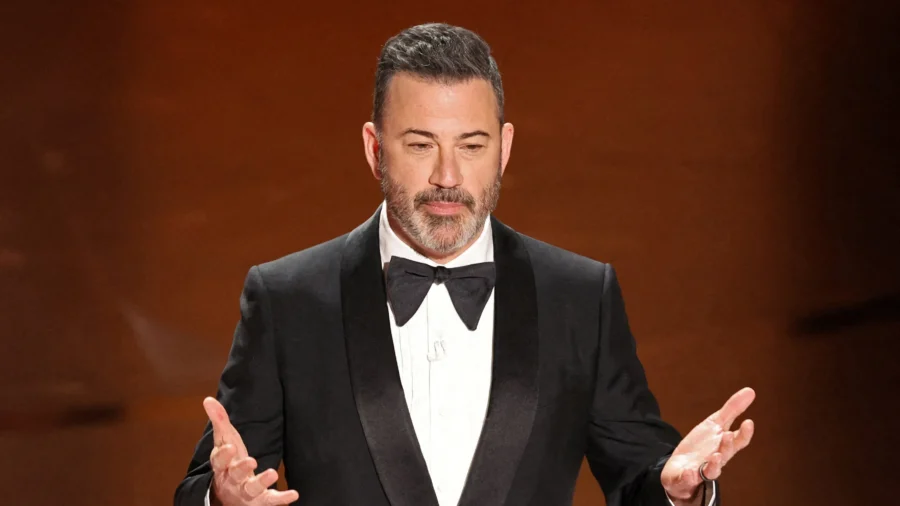
At the start of his late-night debut in 2003, Jimmy Kimmel fared well in ratings as an apolitical comedian who refrained from controversy, before making a major shift over the years and becoming someone recognized for his left-leaning commentary.
His recent suspension on Sept. 17 from ABC has spurred conversation about the political, cultural, and regulatory consequences of on-air commentary and the evolving entertainment industry.
Kimmel rose to fame in the early 2000s on Comedy Central’s “The Man Show” with comedian Adam Carolla, and together they embraced satirical and stereotypical male humor with little room for politics.
When “Jimmy Kimmel Live!” first hit the airwaves in 2003, its format leaned more towards pop culture, current events, and comedy, free from one-sided political campaigning or opinions.
Notably, President Donald Trump made an appearance on his show during the 2016 election cycle, where the two held open dialogue on hot-button issues and the race at the time.
A turning point came in 2017, when Kimmel revealed during an emotional monologue that his son, Billy, was diagnosed with a rare congenital heart defect, which led to three open-heart surgeries.
The personal experience fueled his political involvement, where he became a vocal proponent for affordable health care.
Kimmel would also discuss other topics dividing American voters, including Second Amendment rights, immigration, and others.
With an increase in his political monologues, occasional comedic jabs towards opposing viewpoints became more prevalent, as did pushback from viewers or conservative outlets.
Decades ago, late-night hosts like the late Johnny Carson or David Letterman steered clear of political comedy in an effort to remain non-offensive, and the major television networks agreed.
Prior to the current shift, filmmaker and former executive producer of Letterman’s “Late Show,” Rob Burnett, referred to that time period as the “golden age for late-night comedy.”
“As a person who wrote many thousands of jokes for late-night television, they’ve taken it to a whole other level,” he told The Associated Press in 2017.
However, when Kimmel made recent remarks about the assassination of conservative political commentator Charlie Kirk, the ripple effect spurred a new wave of discourse, not just politically but in the late-night world.
ABC network and its affiliated stations suspended future broadcast of “Jimmy Kimmel Live!” until further notice, after he delivered a monologue about Kirk’s suspected killer.
Now, the line between entertainment and activism is blurrier, and begs the question of how involved an audience or major network should be in content output.
Media conglomerate Sinclair Broadcast Group, which owns and operates television stations affiliated with ABC, said it does not intend to air the show until “appropriate steps” are taken to uphold national standards.
A security guard stands outside ahead of the taping of the late-night talk show ‘Jimmy Kimmel Live!’ at the Hollywood Masonic Temple in Los Angeles, Calif., on Oct. 2, 2023. (Mario Anzuoni/Reuters)
Meanwhile, the American Civil Liberties Union (ACLU) condemned the decision, with the director of its Democracy and Technology Division referring to it as a “grave threat to our First Amendment freedoms.”
Several other late-night TV hosts weighed in on Kimmel’s removal, standing in solidarity, while other public figures and industry insiders on the other side of the aisle applauded the move and pointed to his low ratings.
“Jimmy Kimmel was fired because he had bad ratings more than anything else,” Trump told reporters during his state visit to the UK on Sept. 18.
According to data from Nielsen, Kimmel’s ratings have dropped over the years, as he averaged 1.77 million total viewers during the second quarter compared to an average audience of 2.2 million in 2015.
Kimmel was made aware that his opinions were met with criticism. He said in 2022 that ABC expressed concern about his jokes about Trump, hoping he would tone them down.
“I have lost half of my fans—maybe more than that,” he said on the “Naked Lunch” podcast at the time.
“I just said, ‘Listen, if that’s what you want to do, I understand, and I don’t begrudge you for it, but I’m not going to do that,’” he continued.
“‘So, you know, if you want somebody else to host the show, then that’s fine. That’s OK with me. I’m just not going to do it like that.’”
Meanwhile, Kimmel, whose contract with ABC is up in May of next year, has yet to publicly comment on recent events.