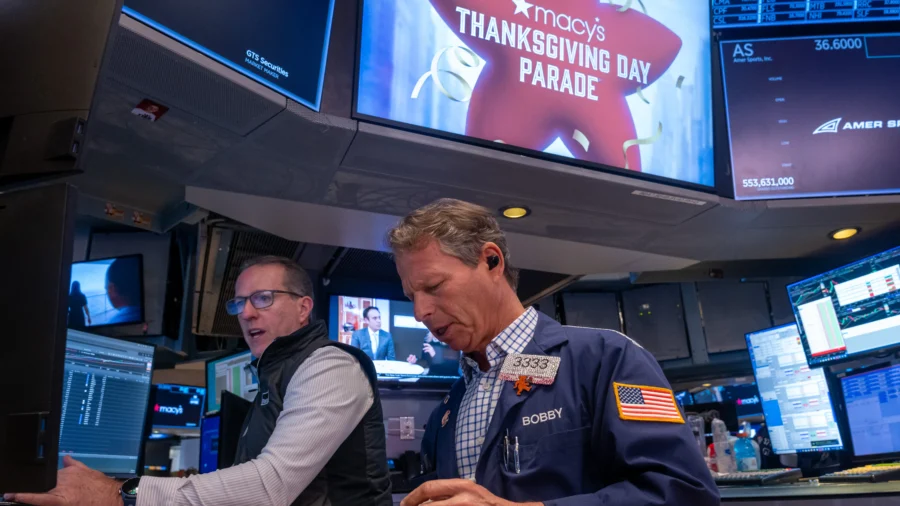
Equities posted a sharp rebound this week as investors shifted focus toward the prospect of lower interest rates and improving economic indicators.
The advance was strongest among small-cap shares, which are generally more sensitive to changes in borrowing costs and tend to benefit more directly from a falling rate environment.
Adding to the momentum were a series of upbeat earnings reports from major retailers nationwide. The results reinforced confidence that consumers remain engaged despite an economic backdrop defined by still-elevated inflation and signs of softening in the labor market.
Markets opened strongly on Nov. 24, led by large technology companies, as buyers returned following the midday recovery on Nov. 21, which appeared to mark a short-term floor to the previous week’s downturn.
The rally accelerated after midday news that President Donald Trump had accepted an invitation from Chinese leader Xi Jinping to visit China in April 2026 and later host Xi in the United States.
The prospect of renewed engagement between the world’s two largest economies raised hopes for easing trade tensions, lifting U.S. semiconductor firms on expectations of increased exports to China.
Bond markets reacted to dovish comments from Federal Reserve Governor Christopher Waller, who reiterated support for a December interest rate cut amid concerns about cooling conditions in the labor market.
By the close of trading, major indexes had staged a broad advance. The Nasdaq rose 2.67 percent, recovering nearly all losses from the previous week. The S&P 500 and Russell 2000 added 1.55 percent and 1.89 percent, respectively, while the Dow finished with a 0.44 percent gain.
Enthusiasm cooled in early trading on Nov. 25 following mixed economic headlines ahead of the opening bell, though sentiment improved as the session progressed.
Retail sales increased just 0.2 percent in September, down from a 0.6 percent rise the previous month, marking the slowest pace in four months and hinting at consumer caution entering the holiday season.
“As we head into the all-important holiday season, investors may be underwhelmed by the latest retail sales report,” Bret Kenwell, U.S. investment and options analyst at eToro, told The Epoch Times.
“Perhaps the biggest surprise was control group sales, which are used in the GDP calculation, and came in negative versus expectations for mild growth. Given that personal consumption accounts for roughly two-thirds of U.S. GDP, a weakening consumer would not read well for the overall economy,” he said.
The producer price index (PPI) rose at an annual rate of 2.7 percent in September, unchanged from August.
Markets initially focused on soft retail data and uncertainty at the open, but major indexes resumed gains later in the day as attention shifted back toward the growing likelihood of interest rate cuts.
“Tuesday’s PPI was in line with expectations and helps to justify the argument for another Federal Reserve rate cut in December, since it’s clear that inflation is under control, allowing the Fed to focus more on the labor market, which has been cooling in recent months,” Clark Bellin, president and chief investment officer at Nebraska-based Bellwether Wealth, told The Epoch Times.
Additional support for rate-cut expectations came from a weak consumer confidence reading.
“Consumer confidence came in well below expectations for November and hit its lowest level since April, when the report matched the lows previously seen during the height of the COVID-19 panic. November’s reading also marked the fourth straight decline in consumer confidence,” Kenwell said.
Despite the subdued signal for Main Street, Wall Street again responded positively, with the Russell 2000 and the Dow Jones Industrial Average leading the day’s gains.
Momentum continued on Nov. 26 for a fourth consecutive session as the narrative around forthcoming rate cuts strengthened, supported by the 10-year Treasury yield hovering near 4 percent, down from 4.15 percent a week earlier.
Sentiment was further lifted by stronger-than-expected earnings from Abercrombie & Fitch, Best Buy, Gap, and Kohl’s, easing concerns that retail spending was decelerating. Positive guidance from Dell helped maintain appetite for technology shares.
Although some investors took profits ahead of the Thanksgiving holiday, all major indexes ended the day higher on relatively light volume.
The shortened Nov. 28 session continued the week’s positive trend, led once again by small caps and the Dow, as markets closed out a strong week for equities.
“Stocks are celebrating the likelihood of a December rate cut, as it’s becoming clear that the labor market is the priority for the Federal Reserve, and another rate cut would help to protect against any further cooling of the job market,” Paul Stanley, chief investment officer at New Hampshire-based Granite Bay Wealth Management, told The Epoch Times.
Stanley said that equities appear to be regaining stability as new economic data gradually emerges, offering clearer insight into the direction of the economy.
“While the economic data is still sparse, the data published so far is showing that the inflation picture and the job market, while far from perfect, are not as troublesome as feared. This is helping stocks recover from the earlier November lows,” he said.
Even so, Stanley’s firm expects modest volatility through year-end as markets try to assess earnings trends and the broader 2026 outlook.
“The backdrop for stocks remains favorable heading into 2026, and we believe the buy-the-dip mentality is still in place,” Stanley said.