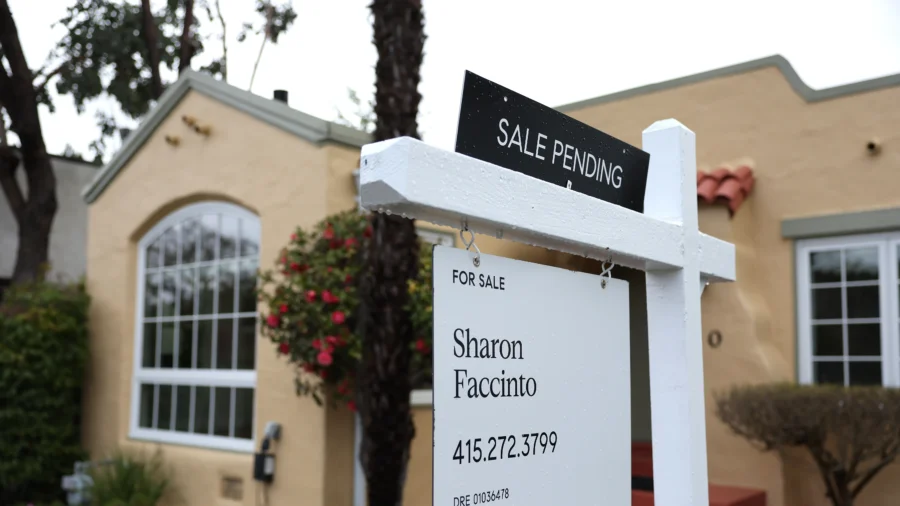
Pending home sales across America experienced a 9.3 percent decline from November to December 2025.
“The housing sector is not out of the woods yet,” NAR chief economist Lawrence Yun said in the report.
“After several months of encouraging signs in pending contracts and closed sales, the December new contract figures have dampened the short-term outlook.”
All four regions of the country saw month-over-month decreases in pending sales.
The Midwest reported the largest decrease in month-over-month pending sales at 14.9 percent, followed by the West at 13,3 percent, the Northeast at 11 percent, and the South at 4 percent.
Year over year, the South saw a 2 percent increase, while all other regions declined. At 9.8 percent, the Midwest showed the biggest drop, followed by the West at 5.1 percent, and the Northeast at 3.6 percent.
Yun said that December is typically a slower month due to holidays, vacations, and inclement weather.
“We’ll be watching the data in the coming months to determine whether the soft contract signings were a one-month aberration or the start of an underlying trend,” he said.
Inventory Falls to 2025 Low
While Yun noted that closing activity increased in December, he said new listings did not keep up the pace, resulting in a decline in inventory.
“Consumers prefer seeing abundant inventory before making the major decision of purchasing a home. So, the decline in pending home sales could be a result of dampened consumer enthusiasm about buying a home when there are so few options listed for sale,” Yun said.
In December, there were just 1.18 million homes on the market—the lowest inventory level of 2025.
While pending home sales were weak overall in December, NAR noted that several local markets experienced positive year-over-year gains.
An analysis of the country’s top 50 largest metropolitan markets showed the Louisville-Jefferson County, Kentucky-Indiana metro with a 23.8 percent year-over-year increase in pending home sales.
Wider Seller-to-Buyer Gap
Meanwhile, Redfin recently reported an estimated 47.1 percent more home sellers than buyers in December 2025, the largest gap since 2013.
According to Redfin, a market with over 10 percent more sellers than buyers is a buyer’s market.
“Of course, it’s only a buyer’s market for those who can afford to buy,” the report states. “High housing costs and economic uncertainty have caused many house hunters to retreat, creating an imbalance of buyers and sellers.”
Austin, Texas, had the largest imbalance among the nation’s top 50 metros in December, with an estimated 128 percent more home sellers than buyers. Other metros where sellers outnumber buyers included Fort Lauderdale and Miami, Florida, at 125 percent and 103 percent, respectively; Nashville, Tennessee, with 111 percent; and San Antonio, Texas, with 103 percent.
In Dallas, where there were nearly 87 percent more sellers than buyers last month, median home prices dropped 7.6 percent year over year, the largest decline among the top 50 metros.
“Homebuyers are backing off due to stubbornly high home prices and mortgage rates, layoffs, and mounting economic and political uncertainty,” the report noted.
“Sellers, many of whom are buyers themselves, are backing off in response to lackluster demand for their homes.”
The report also noted some sellers are delisting their properties after spending longer than usual times on the market.
Cash transactions comprised 28 percent of all sales, an uptick from 27 percent in November and unchanged from last year. Individual investors or second-home buyers represented 18 percent of all transactions in December—unchanged from November but up from 16 percent in December 2024.